Sharroco — Setúbal's Dialect
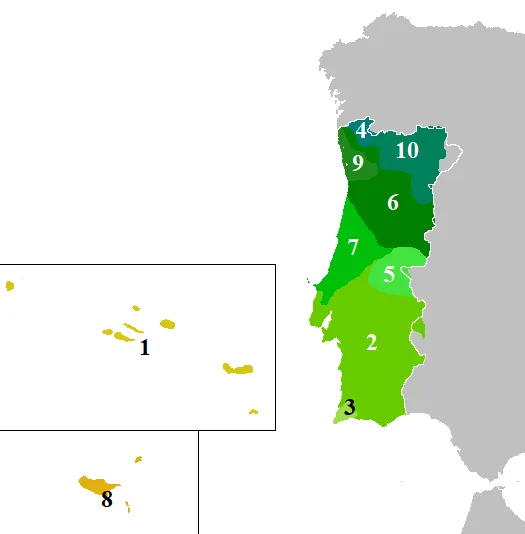 Photo: Semaforo GMS, CC BY-SA 4.0. Wikimedia Commons.
In the port taverns of the Troino quarter, amid the smell of sardines and salt, a language was born that you won’t find in any textbook. Sharroco is not just an accent, but an entire world of maritime metaphors, rolling “r"s, and fisherman’s philosophy that has absorbed centuries of life on the banks of the Sado estuary.
Origin of the Name
The word “sharroco” (charroco) comes from the name of a fish — the Lusitanian toadfish (Halobatrachus didactylus), which in Setúbal is called “charroco” or “peixe-sapo” (toad-fish). This fish is distinguished by its disproportionately large head and enormous mouth. According to folk etymology, the inhabitants of Setúbal who spoke this dialect “opened their mouths wide, like a sharroco” — hence the transfer of the fish’s name to the manner of speech.
There is also the form “charroque” — more commonly used in written tradition and academic works. Both forms are interchangeable: “charroco” is closer to popular usage, “charroque” to formal usage.
Theories of Dialect Origin
The Canning Theory
[DISPUTED] The most widespread version links the emergence of sharroco to the flourishing of the canning industry in Setúbal in the second half of the 19th century. According to this theory, the owners of many factories were French, and workers came from different regions of Portugal — from Algarve, Alentejo, Beira. The French accent of the owners with its characteristic uvular “r” was superimposed on the southern Portuguese dialects of the workers, and as a result of this mixing, the unique phonetic pattern of sharroco emerged.
The Algarve Fishermen Migration Theory
[DISPUTED] Another version emphasizes the role of migrant fishermen from Algarve, who in the 19th century massively relocated to Setúbal, following the sardine shoals. Algarvian fishermen brought their dialect, which, mixing with local pronunciation, formed the basis of sharroco. This theory explains why the dialect was initially localized in the fishing quarter of Troino and practically did not spread beyond its boundaries.
Comprehensive View
The academic study “A Semântica do Charroque nos Sítios da Internet” (University of Lisbon, 2012) indicates that the precise origin of the dialect remains a subject of discussion. Most likely, sharroco formed as a result of several simultaneous processes: migration of workers to canning factories, resettlement of Algarvian fishermen, presence of French entrepreneurs, and the traditional maritime culture of the Sado estuary.
Phonetic Features
The main distinguishing feature of sharroco is the intensified, rolled “r” (uvular vibrant [R]), which is pronounced instead of the standard alveolar [r]. In standard Portuguese, the distinction between “r” (single alveolar vibrant) and “rr” (uvular) is phonemic, but in sharroco the uvular “r” is used almost everywhere, even in positions where the standard norm requires alveolar.
Other phonetic features:
- Open vowels — tendency toward more open pronunciation of vowels, especially “a” and “o”
- Lengthening of stressed syllables — stressed vowels are pronounced longer than in standard Portuguese
- Intonational pattern — characteristic “sing-song” intonation, reminiscent of the rhythm of sea waves [FOLKLORE]
- Nasalization — more pronounced nasalization of some vowels
In practice, sharroco is immediately recognizable by ear: even the simple word “Setúbal” sounds like “Shetúbbal” with a characteristic rolling “rr” on all “r"s.
Sharroco Vocabulary
Besides phonetics, sharroco has its own lexical layer, largely related to the sea, fishing, and port life. Below are examples of characteristic words and expressions:
| Sharroco | Standard Portuguese | English Translation |
|---|---|---|
| bué | muito | very much, a lot |
| cardume | grupo de pessoas | crowd of people (lit. “school of fish”) |
| encalhar | ficar sem saber o que fazer | to be confused (lit. “to run aground”) |
| à bolina | andar sem destino | to wander aimlessly (lit. “to go windward”) |
| maré | sorte, momento | luck, moment (lit. “tide”) |
| dar à costa | aparecer inesperadamente | to appear unexpectedly (lit. “to be washed ashore”) |
| arriar | desistir | to give up, retreat (lit. “to lower sails”) |
| safra | período de trabalho intenso | period of intense work (lit. “fishing season”) |
| amarrar | comprometer-se | to commit oneself (lit. “to moor”) |
| à deriva | sem rumo na vida | without purpose in life (lit. “to drift”) |
Maritime Metaphors in Everyday Speech
One of the most striking features of sharroco is the systematic use of maritime metaphors to describe everyday situations. These are not random borrowings, but an entire metaphorical system in which a person’s life is understood through the prism of the sea element:
- About a difficult period in life they say “atravessar um temporal” (to weather a storm)
- About a lonely person — “está à deriva” (is adrift)
- About a reliable friend — “é uma boa âncora” (is a good anchor)
- About losing a job — “ficou em seco” (was left high and dry)
- About good luck — “apanhou boa maré” (caught a good tide)
- About death — “foi para o fundo” (went to the bottom) [FOLKLORE]
These metaphors reflect the deep connection of Setúbal speakers’ linguistic consciousness with the sea — a connection that has been forming for centuries in the environment of fishermen and salt workers.
Geographic and Social Localization
Troino Quarter
Historically, sharroco was localized in the Troino quarter — the old fishing district on the eastern side of Setúbal, facing the Sado estuary. Troino was the quarter of fishermen, salt workers, canning factory workers, and port stevedores. This is where the dialect reached its greatest intensity and was preserved the longest.
Social Stratification
Sharroco was never the language of the entire city. It was a working-class dialect, closely linked to specific professional groups:
- Fishermen (pescadores) — the main carriers of the dialect
- Canning factory workers (conserveiras) — women who made up the majority of the workforce at the factories
- Salt workers (salineiros) — workers at the salt production sites on the banks of the Sado
- Port workers — stevedores, ship carpenters, rope makers
The bourgeoisie, merchants, and members of the free professions of Setúbal spoke standard Portuguese. Sharroco, therefore, was simultaneously both a regional and a social marker — it indicated not just geographic but also class origin of the speaker.
Sociolinguistic Context
Canning Factories as Linguistic Environment
The canning factories, where during the boom period (late 19th — mid-20th century) thousands of people worked, were a powerful mechanism of linguistic standardization within the working class of Setúbal. Female workers (conserveiras) spent 12-14 hours at the factories, communicating exclusively in sharroco. The factory was not only a workplace but also a social space where the dialect was passed down from generation to generation.
Characteristically, descriptions of the specific “singing” style of communication of conserveiras have been preserved — work songs that women sang while processing sardines contained typical sharroco lexical and phonetic elements.
Stigmatization and Prestige
Throughout the 20th century, attitudes toward sharroco were ambivalent. On one hand, it was perceived by educated layers of society as “crude” and “uncultured” speech — a marker of low social origin. On the other hand, for the carriers of the dialect themselves, it was a source of pride — a sign of belonging to the genuine, “real” Setúbal.
This duality intensified during the period of Estado Novo (1933-1974), when the Salazar regime conducted a policy of linguistic unification and had a negative attitude toward regional dialects. [UNVERIFIED] There are testimonies that in Setúbal schools, teachers punished children for using sharroco.
Dialect Decline
The second half of the 20th century was a period of rapid decline of sharroco. Several factors came together:
- Closure of canning factories — from the 1960s, factories closed one after another, destroying the social environment in which the dialect was reproduced
- Urbanization — massive influx of population from other regions of Portugal diluted the linguistic homogeneity of working-class quarters
- Television and radio — standard Lisbon Portuguese displaced local dialects through mass media
- Aging of speakers — younger generations used the dialect less and less, associating it with “backwardness”
- Social mobility — as children of fishermen and workers received education and moved beyond the working class, they lost the necessity and motivation to maintain the dialect
By the beginning of the 21st century, sharroco in its full form was preserved only among elderly residents of the Troino quarter — people born before the 1950s who had worked all their lives in fishing or at factories.
Contemporary Revival
Internet and Social Media
Paradoxically, it was the digital age that gave sharroco new life. An academic study by the University of Lisbon (2012) documented the process of “metaphorical revitalization” of the dialect on Internet sites and social media. Young Setúbal residents, who no longer use sharroco in everyday speech, began using its elements in online communication — as a marker of regional identity and humor.
Pages and groups dedicated to the dialect appeared on Facebook and Instagram, where jokes, memes, and stories using sharroco are published. The dialect transformed from an everyday language of communication into a cultural symbol — a sign of belonging to the “real” Setúbal.
“Charroque da Prrofundurra”
The most vivid manifestation of this revival was the trademark and shop “Charroque da Prrofundurra,” located on Rua António Maria Eusébio street in the Troino quarter. The founder — Rui Garcia, a forestry engineer by training, who started with a humorous blog and then turned the project into a full-fledged brand.
“Charroque da Prrofundurra” sells children’s clothing, T-shirts, hoodies, jackets, aprons, pins, keychains, magnets, car stickers, and books with characteristic phrases in sharroco. The main character of the brand is the fictional fisherman Sharroque, who owns a fishing vessel and experiences endless adventures.
The shop receives orders from tourists from all over the world — from Europe, Brazil, Canada, and the USA. Thus, sharroco, once a stigmatized dialect of the poorest quarters, has turned into a commercially successful cultural brand.
Comparison with Minderico
Sharroco is often compared with minderico — another unique linguistic phenomenon of Portugal. However, there is a fundamental difference between them.
Minderico is a full-fledged creole language (or, according to other classifications, argot), that arose in the 16th century in the village of Minde, in central Portugal. It was created by weavers and traders of woolen blankets as a secret language (língua secreta) to protect commercial interests from competitors. Minderico is incomprehensible to Portuguese speakers and is recognized by UNESCO as an endangered language. Today no more than 150 people speak it, of which only 23 are fluent.
Sharroco is a dialect (variante dialectal), not a secret language. It is fully understandable to Portuguese speakers, although it may cause difficulties due to specific phonetics and vocabulary. Sharroco was never intentionally created to conceal information — it arose naturally as a result of linguistic mixing and social isolation of fishing quarters.
| Characteristic | Sharroco | Minderico |
|---|---|---|
| Type | Dialect | Creole language / argot |
| Origin | Natural mixing | Intentional creation |
| Purpose | No special purpose | Secret communication |
| Comprehensibility | Understandable to Portuguese speakers | Incomprehensible |
| Speakers | Hundreds (passive — thousands) | ~150 (23 fluent) |
| UNESCO Status | Not registered | Endangered language |
Sharroco in the Museum of Labor
The Michel Giacometti Museum of Labor in Setúbal preserves audio recordings of stories by elderly fishermen and canning factory workers, made in the 1980s-1990s. These recordings are invaluable linguistic material, capturing living sharroco in its most complete form. The museum’s exposition includes materials about the linguistic culture of fishing quarters and the role of the dialect in the everyday life of the working class of Setúbal.
The Future of Sharroco
The fate of sharroco remains uncertain. On one hand, as a full-fledged dialect it is probably doomed: the last speakers who are fluent in all the richness of its vocabulary and phonetics are passing away. On the other hand, as a cultural symbol and marker of identity, sharroco is experiencing a renaissance — albeit in a simplified, “meme-ified” form.
The key question is whether this cultural renaissance can lead to real linguistic revival, or whether sharroco will remain only a nostalgic element of city branding. For now, academic studies note that young Setúbal residents use elements of sharroco “performatively” — to create a humorous or nostalgic effect — but not as an everyday language of communication.
See Also
- Canning Industry — the economic foundation on which the dialect was formed
- Fishing Culture — the environment where sharroco existed
- Toponymy of Setúbal — reflection of the city’s linguistic history in street names
- Michel Giacometti Museum of Labor — repository of dialect audio recordings
All our knowledge is free. Creating it is not.
☕ Support on Ko-fi