Fórum Luísa Todi
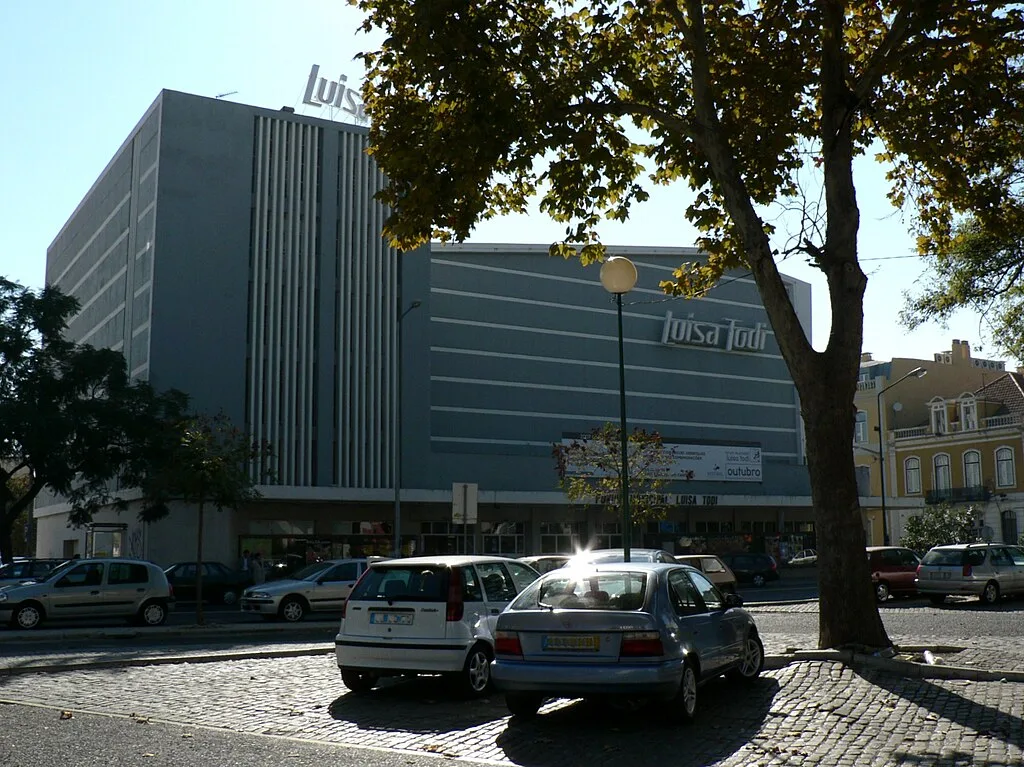 Photo: Paulo Juntas, CC BY-SA 3.0. Wikimedia Commons.
In the heart of Setúbal, on Avenida Luísa Todi, stands a building that for over sixty years has set the cultural pulse of the city. Fórum Luísa Todi is not just a concert hall: it is a place where Setúbal meets its past and future, where fado neighbors hip-hop, and international stars — local young artists.
Prehistory: Teatro Rainha D. Amélia
On the site of the current Fórum Luísa Todi, there previously existed Teatro Rainha D. Amélia (Queen D. Amélia Theater) — a theatrical building that was the starting point for Setúbal’s cultural life in the late 19th — first half of the 20th century. The theater was distinguished by its exquisite interior and was considered one of the best in the region . However, by the mid-20th century the building had deteriorated and needed replacement.
Construction (1958-1960)
The decision to build a new cultural center was made in the late 1950s. The project was executed by architect Fernando Silva in the style of modernism — an architectural direction that in Portugal during the Estado Novo period combined functionality with monumentality.
Construction took place in 1958-1960, and the building was solemnly opened July 24, 1960. Notably, the opening date coincided with the period when Setúbal already had city status (since 1860), and the centennial anniversary of this event gave the opening additional symbolism.
The building was named after Luísa Todi — the great opera singer of the 18th century, native of Setúbal, who gained fame on the largest stages of Europe and remains one of the most significant figures in the musical history of the city and country.
Architecture
Modernist Appearance
The Forum building is an example of Portuguese modernism of the second half of the 20th century. Architect Fernando Silva created a strict, functional volume characteristic of the era: clean lines, rational organization of space, moderate decorativeness. The building’s facade faces Avenida Luísa Todi — one of the city’s main thoroughfares, named after the same singer.
Main Hall
The main auditorium is the core of the building. In the original configuration it accommodated several hundred spectators; after the 2009-2012 reconstruction, capacity is 634 seats (according to some sources — 640). The hall’s acoustics are evaluated by specialists as excellent and suitable for a wide range of performances — from chamber music to rock concerts.
Municipal Property
In 1990, the building passed into the ownership of Câmara Municipal de Setúbal (Setúbal City Hall). This transition was of fundamental importance: from a private or semi-state institution, the Forum became fully municipal, which ensured stable funding and integration into the city’s cultural policy.
From this moment, the Forum officially bears the name Fórum Municipal Luísa Todi (Luísa Todi Municipal Forum) and is managed by a municipal structure responsible for the city’s cultural program.
Major Reconstruction (2009-2012)
Reasons for Reconstruction
By the beginning of the 21st century, the building built half a century ago needed serious updating. The technical equipment of the stage and hall was outdated, acoustic characteristics required refinement, and the infrastructure did not meet modern standards of accessibility and safety.
Course of Works
Complete reconstruction of the building was carried out in 2009-2012. The works affected all major systems: stage equipment, lighting, sound, air conditioning, safety systems. The auditorium was completely modernized, while the overall planning structure of the building was preserved.
Result
Fórum Luísa Todi reopened to the public September 15, 2012 — fully modernized and equipped with everything necessary for conducting events of various formats and scales. The reconstruction transformed the 1960s building into a modern, technically equipped venue meeting European standards.
According to The Arts Desk, the renovated Fórum Luísa Todi is an “ultra-modern and beautifully restored” concert hall.
Cultural Program
Range of Events
Fórum Luísa Todi is the main cultural venue of Setúbal and hosts events of the widest spectrum:
- Concerts — from classical music and fado to hip-hop and rock. Both international and Portuguese stars, as well as young local artists, have performed on the Forum’s stage
- Theater productions — drama, comedy, experimental theater
- Dance performances — classical and contemporary dance
- Official ceremonies — city celebrations, awards, memorial events
- Congresses and seminars — scientific and business events
- Film screenings — special screenings and film festivals
- Children’s programs — performances and concerts for young audiences
Youth and Music
The British publication The Arts Desk, describing a visit to Setúbal, noted the city’s unique atmosphere: “Youth and music under the jacarandas.” Fórum Luísa Todi plays a key role in this atmosphere, providing a venue for young musicians and cultural initiatives.
The Name: Luísa Todi
The Forum bears the name of Luísa Agueda Rosa de Aguiar (1753-1833), better known as Luísa Todi — the greatest opera singer in Portuguese history. Born in Setúbal, Luísa Todi reached the heights of the European opera stage, performing at the courts of Lisbon, Madrid, Paris, London, Berlin, and St. Petersburg. She was considered one of the best mezzo-sopranos of her time and rivaled the German Elisabeth Mara for the title of Europe’s first singer.
The name Luísa Todi is everywhere in Setúbal: an avenue, a forum, a monument on Bocage Square are named after her. She is a symbol of the city’s cultural greatness, proof that a small port city on the banks of the Sado is capable of producing talents of world scale.
Forum in the Urban Context
Fórum Luísa Todi is not the only, but the central venue in the network of cultural spaces of Setúbal. The city also has:
- Auditório José Afonso — chamber hall named after José Afonso, bard of the Carnation Revolution
- A Gráfica — Center of Artistic Creativity — space for contemporary art
- Casa da Cultura — house of culture with diverse program
- Museu do Trabalho Michel Giacometti — museum combining exhibition and cultural functions
Together these venues create a dense cultural infrastructure, unusual for a city of this size and providing residents access to European-level events.
Practical Information
- Address: Avenida Luísa Todi, Setúbal
- Capacity: 634 seats (main hall)
- Management: Câmara Municipal de Setúbal
- Program and tickets: information on the official website forumluisatodi.pt
The Forum is located in the city center, within walking distance of Bocage Square and Livramento Market, making it a convenient starting or ending point for a cultural route through Setúbal.
See Also
- Luísa Todi — singer after whom the Forum is named
- A Gráfica — Center of Artistic Creativity — another key cultural space of the city
- Slow J and the Hip-Hop Scene — contemporary musical culture using the Forum’s stage
- Fado in Setúbal — musical tradition regularly sounding on the Forum’s stage
- Bocage Square — nearest historic square
All our knowledge is free. Creating it is not.
☕ Support on Ko-fi