Fun Facts & Curiosities of Setúbal
Setúbal is a city full of surprises. Here, a king personally stabbed a conspirator, dolphins are rescued by military helicopters, and the city’s most famous dish isn’t even made from local ingredients. A collection of the most unbelievable, amusing, and astonishing facts about the city on the River Sado.
Historical Curiosities
A City Founded by Noah’s Grandson [FOLKLORE]
According to medieval legend, Setúbal was founded by Tubal — son of Japheth and grandson of the biblical Noah. The name supposedly derives from “Sede de Tubal” — “Seat of Tubal.” A more prosaic etymology: “Ceto” (fishing) + “Uba” (port). The Tubal legend was popular in 16th–17th century Portugal and was used to assert the city’s ancient origins.
The King Who Personally Stabbed a Conspirator
In 1484, King João II’s cousin, the Duke of Viseu Diogo, plotted to murder the monarch on a Setúbal beach. One conspirator revealed the plan. João II summoned the duke to the palace and personally stabbed him with a dagger. A decade later, in 1494, the Treaty of Tordesillas — dividing the world between Spain and Portugal — was ratified in Setúbal.
A Fortress Against Its Own Citizens
Fort São Filipe (1582) was built by Philip II of Spain not to defend against foreign enemies, but to control Setúbal’s rebellious population, which had supported the rival claimant Dom António. The fortress cannons were aimed not at the sea, but at the city.
An Earthquake on the Doorstep of City Status
In 1858, just as Setúbal authorities submitted a petition for city status, a devastating earthquake struck — 90 houses reduced to rubble. Despite the catastrophe, on April 19, 1860, Setúbal became a city — then the fourth largest in Portugal (~30,000 inhabitants). More: The 1858 Earthquake.
The 1941 Cyclone: The Sea Invades the City
On February 15, 1941, a ferocious cyclone struck the Atlantic coast. The waters of the Sado flooded Setúbal’s city centre — seaweed and marine creatures were found in the streets. Fifteen fishermen perished, four vessels sank. On the Tróia Peninsula, thousands of trees were uprooted.
Records & Statistics
Guinness World Record: Largest Sardine Barbecue
On May 29, 2010, Setúbal entered the Guinness Book of Records: 6,340 kg of sardines were grilled on a 100-metre barbecue by 40 grillers using 3+ tonnes of charcoal. Some 25,000 people attended. The previous record belonged to Los Angeles (5,871 kg, 2008).
420 Fish Canning Factories
From 1854 to 1995, Setúbal hosted 420 canning factories producing goods under 613 brand names from 97 manufacturers. The peak came in 1919: 132 factories operating simultaneously. More: Canning Industry.
Political Street Name Capital
Setúbal is Portugal’s leader in politically-named streets: Rua 1.º de Maio, Avenida dos Capitães de Abril, Rua 25 de Abril, and dozens more. A legacy of its status as a “red city” — a bastion of left-wing movements after the 1974 Carnation Revolution.
Temperature Record [DISPUTED]
On August 4, 2018, according to some sources, Setúbal recorded a temperature of 45.5°C — a record for the Iberian Peninsula’s coast. Official IPMA data, however, indicates 42.6°C. The debate over the exact figure continues.
Urban Legends
The Arrábida–Sintra Tunnel [FOLKLORE]
One of the most enduring urban legends claims there is an underground tunnel between Serra da Arrábida and Serra de Sintra — running beneath the River Tagus. Both mountain ranges are supposedly “hollow inside.” No geological evidence has been found.
UFOs Over Arrábida [UNVERIFIED]
Residents near Arrábida periodically report sightings of UFOs and USOs (unidentified submerged objects): glowing objects among the mountain’s vegetation, flashes from the riverbed of the Sado. The topic inspired a documentary film.
Our Lady Who Chose Her Own Place [FOLKLORE]
Around 1215, English merchant Hildebrant made a vow to the Virgin Mary during a storm. Once saved, he brought an icon to Setúbal, but the image vanished from the church three times and was found in a cave on Mount Arrábida. The merchant understood — Our Lady had chosen her own place. Thus was born the Convento da Arrábida.
Gastronomic Curiosities
Did Dolphins Teach People to Make Choco Frito? [FOLKLORE]
Legend has it that Sado dolphins ate only the head of cuttlefish, discarding the body. Fishermen collected the remains — and thus choco frito was born. The first version was created by fisherman Manuel Coutinho in the 1950s. The breaded version was invented by Virgílio Santiago in the 1990s — inspired by Spanish calamari.
The Great Irony: Choco Frito Isn’t Made from Local Cuttlefish
The famous choco frito is not made from local cuttlefish! Local cuttlefish goes on the grill, while the fried version uses imports from the North Sea and Indian Ocean. The newspaper Público headlined: “Se é frito não é de Setúbal” — “If it’s fried, it’s not from Setúbal.”
A Slogan on a Takeaway Bag
The phrase “Setúbal, capital do choco frito” was coined by Júlio Santiago in the early 1990s — he simply printed it on his restaurant’s takeaway bags. The phrase became the city’s unofficial motto.
Moscatel: “Sunshine in a Bottle”
Moscatel de Setúbal is one of Europe’s oldest wines. Richard II of England was the first importer (14th century). Louis XIV was a passionate devotee. French critic Léon Douarche called it “C’est le soleil en bouteille” — “It’s sunshine in a bottle.” There existed “vinhos de roda” — barrels of Moscatel shipped to the colonies and back, as the rocking motion improved the flavour. An opened bottle can be enjoyed for up to 4 weeks.
Torta de Azeitão — Invented by a Blind Baker
The recipe for the famous pastry was brought from Fronteira (Alentejo). The bakery’s founder, Manuel Rodrigues, went blind in his youth, earning the nickname “O Cego” (“The Blind One”). This didn’t stop him from creating one of Portugal’s most recognizable sweets.
Azeitão Cheese — A Migrant’s Invention
The famous Azeitão cheese was created in the 19th century by Gaspar Henriques de Paiva from Beira Baixa — he brought the cheese-making technique south.
Celebrity Fun Facts
Bocage: Arrested by the Inquisition for Poetry
Bocage — Setúbal’s greatest poet — was arrested by the Inquisition in 1797 for “heresy and licentiousness.” His satirical and erotic verse was banned well into the Salazar era. Most “Bocage jokes” are actually folk humour attributed to the poet posthumously. His statue in the main square stands 12 metres tall.
Luísa Todi: Fan Wars in Paris
In Paris, Luísa Todi’s impresario orchestrated a PR war against singer Mara — the public split into “Todistas” and “Maristas”. Their rivalry was so fierce it made the newspapers. At a concert in Bonn, a young Beethoven played in the orchestra.
José Mourinho — Just “Zé Mário” at Home
The famous football manager was born in Setúbal in 1963. His father played for Vitória FC. In his hometown, he’s simply known as “Zé Mário”. A street has been named in Mourinho’s honour.
Animal Stories
Portugal’s Only Resident Dolphin Population
The Sado dolphins (~30 individuals) are Portugal’s only resident population of bottlenose dolphins. The Portuguese name “roaz” comes from their habit of “gnawing” fishing nets. Each dolphin is identified by its fin shape. They appear on 98% of boat excursions.
A Dolphin Rescue by Helicopter
A dolphin nicknamed Aza became trapped in an irrigation ditch. A Portuguese Air Force helicopter was called in for the rescue operation, which was successful.
Architectural Surprises
An Elephant in a Church
Among the azulejo tiles of the Church of the Monastery of Jesus hides an image of an aggressive elephant — an unexpected subject for a 15th-century religious temple.
The Dolphin Parade
Since 2011, Setúbal’s waterfront features 19 life-size dolphin sculptures — the “Golfinho Parade” project. One sculpture is decorated in the style of traditional azulejos.
Monastic Cells Carved in Rock
At the Convento da Arrábida, monks’ cells are carved into the rock — impossible to stand upright in. The mountain contains over 100 caves. The elevation drop: 501 metres to the sea — only 1 km horizontally.
See Also
Image sources
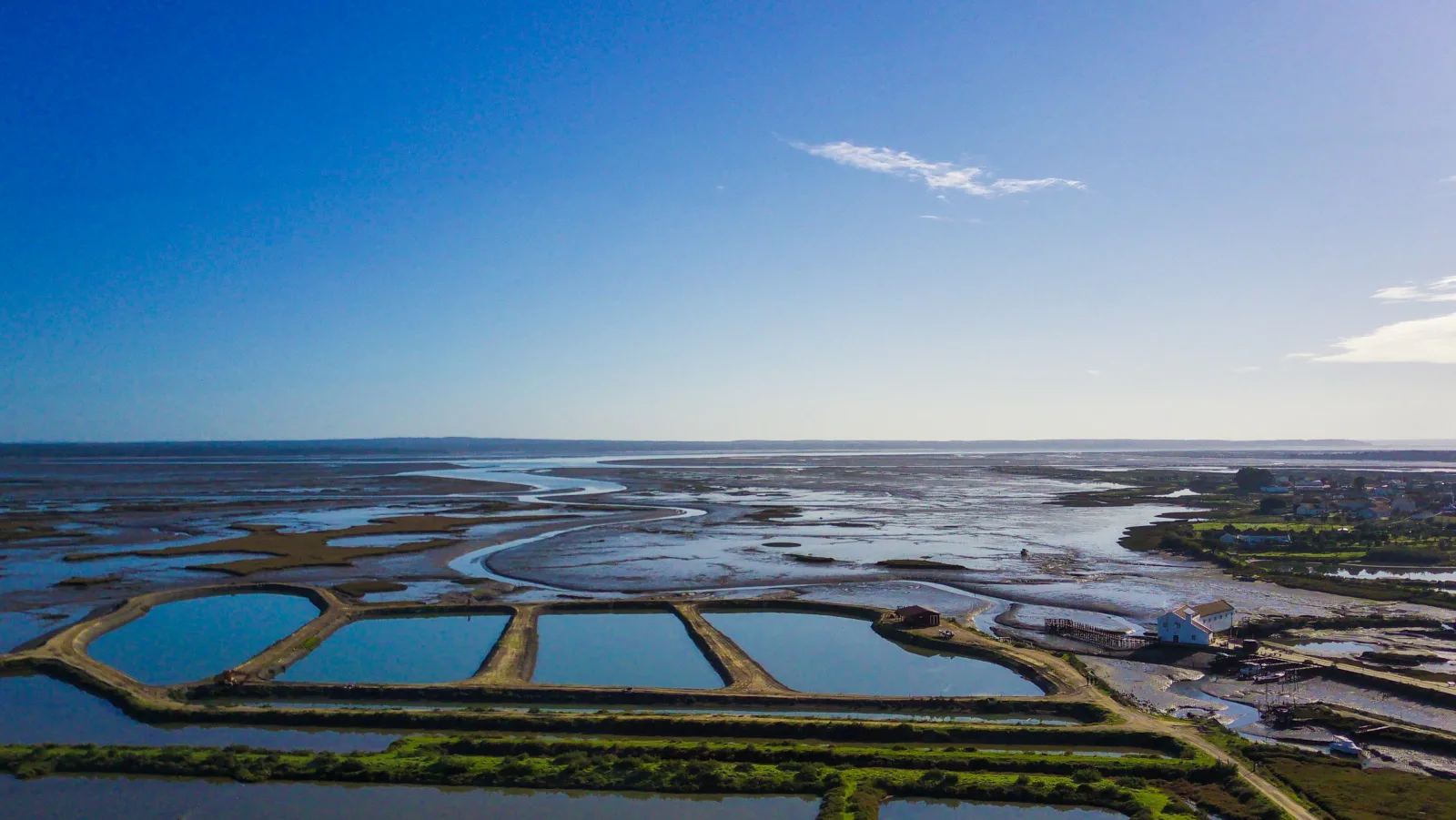
- setubal-panorama-fun-facts.webp — Sado River panorama, Setúbal. License: CC BY-SA. Source
The light is on for free. But someone has to clean the lantern.
☕ Support on Ko-fi