Street Art and the TAUS Program
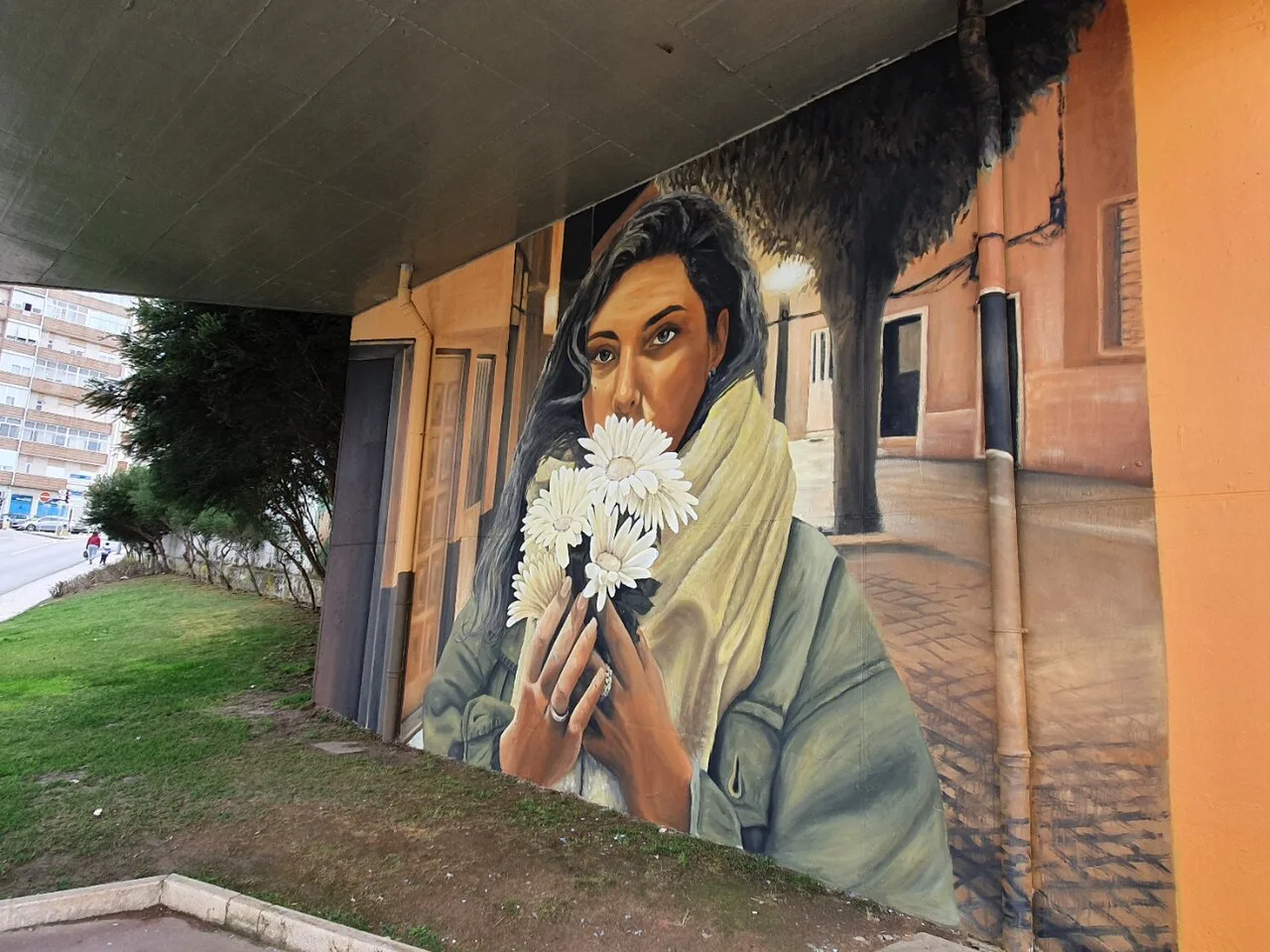 Photo: GualdimG, CC BY-SA 4.0. Wikimedia Commons.
The walls of Setúbal speak. Giant murals grow on the facades of multi-story buildings, foxes from Arrábida watch from the ends of houses, and three-dimensional graffiti turn gray concrete surfaces into optical illusions. The TAUS program has made the entire city an open-air museum — free, accessible, and alive.
TAUS — Tour de Arte Urbana de Setúbal
What is TAUS
TAUS (Tour de Arte Urbana de Setúbal — Setúbal Urban Art Tour) is a municipal program for promoting and popularizing street art, operating in Setúbal. The program was created on the initiative of the city hall (Câmara Municipal de Setúbal) in partnership with the association Faísca Voadora — an organization specializing in promoting street art in Portugal.
TAUS encompasses dozens of murals placed in public spaces of the city: on building facades, walls, squares, stairs, electrical distribution boxes, and tunnels. Each mural is not just decoration, but an artistic statement connected with the history, culture, and identity of Setúbal.
TAUS a Céu Aberto
The development of the basic program was the project “TAUS a Céu Aberto” (TAUS in the Open Air), aimed at creating new murals in residential quarters with active involvement of the local community. The project is implemented under the coordination of the Faísca Voadora association and assumes that each mural is created after dialogue with neighborhood residents — the subjects reflect their memories, traditions, and values.
The first anniversary of the TAUS program was celebrated on March 26, when an anniversary mural was created, and free tours of already existing works were conducted throughout the city.
Free Tours
One of the key features of TAUS is regular free walking tours along street art routes. Guides tell about the authors of the works, their conception, and connection with the city’s history. The routes pass through the Pescadores (Bairro dos Pescadores) and Grito do Povo (Bairro do Grito do Povo) quarters, where a significant part of the murals is concentrated.
Key Murals of Setúbal
“O Caminho dos Pescadores” — Explicit Citizens collective
As part of the TAUS a Céu Aberto project, works reflecting the life and memory of fishing quarters were created in the “Fishermen’s Path” (Caminho dos Pescadores) district. The Explicit Citizens collective — a group of three independent artists: David Martins, Filipe Serralheiro, and João Murta — actively participated in decorating these quarters.
Explicit Citizens began their activity in 2017 during the municipal campaign “Setúbal Mais Bonita” (More Beautiful Setúbal) and since then have created dozens of works throughout the city. The collective specializes in portrait murals of historical personalities — among their works in the Camarinha district are portraits of General Humberto Delgado (green-brown palette, reference to military life), writer Ramalho Ortigão (beige and sepia tones), and Fialho de Almeida (gray-black-white palette).
“Jardins Efémeros” — Gonçalo Mar (120 m)
The mural “Jardins Efémeros” (“Ephemeral Gardens”) by artist Gonçalo Mar (Gonçalo Ribeiro, artistic pseudonym MAR) is one of the largest works in the city. The mural’s length is 120 meters with a height of six meters. The work is executed in various shades of green with surrealistic contrasts emphasizing plant motifs.
The mural is located on the facade of a building with workshops, along the new extension of the approach to Avenida de Moçambique, at the northern entrance of Avenida dos Ciprestes, next to the future Várzea Urban Park (Parque Urbano da Várzea). According to the artist’s concept, the mural creates a visual connection between the urban environment and the future park, conveying a sense of peace and tranquility that a person finds only in nature.
The project was implemented on the initiative of the municipality of Setúbal with the support of Lidl company and complemented the landscaping program of the Várzea district.
“Vulpes Vulpes” — Gonçalo Mar (210 m²)
Another major work by Gonçalo Mar is the mural “Vulpes Vulpes,” named after the Latin name of the common fox inhabiting the Serra da Arrábida mountain range. The mural’s area is 210 square meters. The work is located on Avenida Jaime Rebelo and was created in 2021 as part of the Mural18 project with the support of the municipality.
The mural depicts a fox — symbol of Arrábida’s wildlife — in the realistic style characteristic of Gonçalo Mar. The work has become one of the most recognizable images of Setúbal’s street art and has been included in the TAUS route.
“O Rapaz dos Pássaros” — Odeith (Auditório José Afonso)
Perhaps Setúbal’s most famous mural is “O Rapaz dos Pássaros” (“The Boy with the Birds”), created in March 2014 by the legendary Portuguese street artist Sérgio Odeith on the southern end of the José Afonso Auditorium building.
The mural reproduces a photograph from the archive of Setúbal photographer Americo Ribeiro, taken in the 1930s. The photograph shows a barefoot boy selling birds on the streets of Setúbal. This boy was Vicente Inácio Martins, who at the time of the mural’s creation was already over 90 years old.
The work was created as part of the “Arte em Toda a Parte” (“Art Everywhere”) project, promoted by Immochan company with the support of the municipality, during the construction of the Alegro Setúbal shopping center. In 2014, the I Support Street Art movement included “O Rapaz dos Pássaros” in the list of 24 best murals in the world.
Odeith’s Style: Three-Dimensional Illusions
Sérgio Odeith (Sérgio Odeith, born 1976, Damaia) is one of the most famous street artists in Portugal and the world. His calling card is anamorphic compositions, painted on 90-degree corners, on “floor-wall” transitions, or on several planes simultaneously. These works create an optical illusion of three-dimensionality: figures seem to burst out of the wall, hang in the air, or crawl across the surface.
Odeith began drawing graffiti in the mid-1980s, and in 2005 developed his signature anamorphic style, which brought him international fame. His works have been presented at the Museum of Public Art (Louisiana, USA), the Brazilian Sculpture Museum (São Paulo), and at the Meeting of Styles festival (Germany). Among Odeith’s commercial clients are Coca-Cola, Samsung, London Shell, and Kingsmill.
In Setúbal, besides “The Boy with the Birds,” Odeith has created a number of other works using his signature three-dimensional illusion technique. The artist’s connection with the city makes Setúbal one of the key points on the world street art map.
Quarters as Galleries
Bairro dos Pescadores (Fishermen’s Quarter)
The Fishermen’s Quarter is one of the oldest districts of Setúbal, historically linked with fishing culture and the canning industry. As part of the TAUS a Céu Aberto program, murals reflecting the life and memory of the fishing community were created here. The works were carried out with the participation of quarter residents, who shared memories and stories that became the basis for the subjects.
Among recent works is the mural “Luz” by artist Ângela Miranda Penedo, which includes an intervention on the wall and staircase, executed in simple colors. The work symbolizes unity and tranquility in a space of meeting, hope, and memory, connecting the Pescadores and Grito do Povo quarters.
Bairro do Grito do Povo (Grito do Povo Quarter)
The “People’s Cry” quarter (Grito do Povo) is another district with active street art. The quarter’s name reflects its connection with the workers’ movement and social struggle, which occupy an important place in the political history of Setúbal. Murals here often touch on social themes — labor, solidarity, collective memory.
Other Significant Works
Centennial and Anniversary Murals
Setúbal regularly uses street art to mark significant city events. Murals are created for anniversaries, festivals, and as part of neighborhood improvement programs. The “Prá Rua” (“To the Street”) project combines street art with playful activities for residents of various districts.
Sado Fish
Among thematic murals, a series dedicated to fish of the Sado estuary stands out — an ecosystem that determined the economic and cultural history of the city. A mural depicting river fish was created with the participation of biologists and ecologists, which ensured scientific accuracy of the images.
Portraits of Historical Personalities
A separate direction of Setúbal street art is portraits of outstanding city residents. Among the mural characters are poet Bocage, singer Luísa Todi, revolutionary bard José Afonso, and other figures connected with the city.
Organizational Model
Municipal Support
Unlike many cities where street art develops spontaneously or semi-legally, in Setúbal it has received official municipal support. The city hall finances the creation of murals, provides walls for works, and coordinates projects through the Faísca Voadora association. This ensures legal protection of works and their preservation.
Partnership with Faísca Voadora
The Faísca Voadora association acts as a professional intermediary between the municipality and artists. It is responsible for selecting authors, curating projects, organizing residencies, and coordinating with local communities. This model allows combining professional quality of works with their social significance.
Community Involvement
A key principle of TAUS is participation of the local population. Before creating a mural in a residential quarter, meetings with residents are held where the themes and subjects of future works are discussed. This approach ensures that murals are perceived not as decoration imposed from outside, but as an expression of the community’s own identity.
Setúbal in the Context of Portuguese Street Art
Portugal is one of the European capitals of street art. Lisbon, Porto, Coimbra, Cascais have long been part of world street art tourism routes. Setúbal, despite the modesty of its scale compared to the capital, has developed its own model, distinguished by two features:
- Thematic coherence — Setúbal’s murals systematically refer to the city’s history and culture, rather than being disparate artistic statements
- Social integration — active involvement of quarter residents in the process of creating works transforms street art from a purely aesthetic phenomenon into a tool of social cohesion
This model attracts the attention of urban planning and cultural policy specialists as an example of how street art can serve as a tool for urban development.
Practical Information
Free tours along TAUS routes are conducted regularly. The current schedule is published on the website of the municipality of Setúbal and on the program’s social networks. A complete map of murals is available in the document “T.A.U.S. — Tour de Arte Urbana de Setúbal,” posted on the Câmara Municipal de Setúbal website.
Most murals are located within walking distance of the city center and can be viewed independently. The greatest concentration of works is in the Troino, Pescadores, Grito do Povo districts, and along Avenida Luísa Todi.
See Also
- Fishing Culture — theme inspiring many murals
- José Afonso — revolutionary bard after whom the auditorium with Odeith’s mural is named
- Michel Giacometti Museum of Labor — another space where art meets working-class history
- Canning Industry — historical context of working-class quarters that became galleries
The light is on for free. But someone has to clean the lantern.
☕ Support on Ko-fi