Maritime Trade Routes of Moscatel
The export history of the Setúbal Peninsula’s wines spans seven centuries of maritime trade, diplomatic treaties and commercial ambition. Muscat from the Sado basin was drunk by English kings in the 14th century, crossed the Indian Ocean in caravel holds, graced Louis XIV’s table at Versailles and won gold medals at the 1855 Paris World Exhibition. Yet, unlike Port wine, Moscatel de Setúbal never acquired a powerful international trading infrastructure – and this paradox holds the key to understanding its fate.
The Middle Ages: English kings and wine from Azoia
Viticulture on the Setúbal Peninsula has ancient roots. Muscat grape varieties have been cultivated in this region for an estimated three thousand years, thanks to the limestone-clay soils of the Serra da Arrábida slopes and a Mediterranean microclimate tempered by the Atlantic.
The earliest documented evidence of wine exports from the Setúbal region to England dates from the second half of the 14th century. King Richard II of England (reigned 1377–1399) was among the first known importers – wine from Azoia (modern Azeitão) was sold in England under the phonetically adapted name “Osoye”. This is one of the oldest documented references to Portuguese wine exports to the British Isles.
By the 15th century, Setúbal wine had become a regular commodity in the ports of the English Channel and the North Sea. Trading vessels that came for salt from the Sado estuary often loaded barrels of local wine as well – thus the salt trade and wine exports reinforced each other, forming the economic foundation of the port of Setúbal.
The Age of Discoveries: Moscatel aboard caravels
In the 15th–16th centuries, during the Age of Discoveries, Setúbal Peninsula wines reached beyond Europe. Moscatel was carried on caravels and galleons to India, Brazil, Angola and other colonies of the Portuguese Empire. The wine served not only as a commodity for colonial trade but also as part of ship crews’ provisions.
The “Torna Viagem” phenomenon
Long sea voyages had an unexpected effect on the wine. The heat of tropical latitudes, constant rocking in the holds, temperature swings when crossing the equator – all of this accelerated the ageing process. According to legend, nine months in a ship’s hold was equivalent to fifteen years of cellar ageing. [FOLKLORE] The exact equivalence has not been confirmed by scientific research, but the accelerated ageing of fortified wines during maritime transport is a widely recognised phenomenon, underpinning the Madeira “Torna Viagem” (“return voyage”) tradition.
Barrels of wine that had completed a sea voyage and returned to Portugal were labelled “Torna Viagem” and commanded significantly higher prices. In 2000, the company José Maria da Fonseca revived this practice by sending Moscatel barrels aboard a sailing ship across the Atlantic – recreating the historical route. The result was released under the Moscatel Torna Viagem label and confirmed that the sea voyage does indeed impart exceptional complexity and depth to the wine.
The Methuen Treaty and competition with Port
On 27 December 1703, England and Portugal signed the Methuen Treaty (Tratado de Methuen) – a trade agreement that shaped the fate of Portuguese winemaking for centuries. Under the treaty, England lowered duties on Portuguese wines (at least one-third less than on French wines), while Portugal opened its market to English textiles.
The treaty created a powerful incentive for Portuguese wine exports to England – but the main beneficiary was Port wine. The reason was simple: by that time, the Douro Valley already had an extensive network of British trading houses – the so-called factory houses (Croft, Taylor’s, Sandeman and others). These firms controlled the entire chain from vineyard to London shop counter.
In Setúbal, there were no British trading houses. Moscatel de Setúbal never developed a comparable commercial infrastructure. The wine continued to be exported, but without major international distributors, its presence on the British market remained modest compared to Port. This structural asymmetry – Port with its British trading network versus Moscatel without one – largely explains the difference in international fame between Portugal’s two great fortified wines.
The trading houses of Setúbal
Despite the absence of British factory houses, the Setúbal Peninsula developed its own system of wine estates – predominantly Portuguese family-owned enterprises.
| Company | Founded | Notes |
|---|---|---|
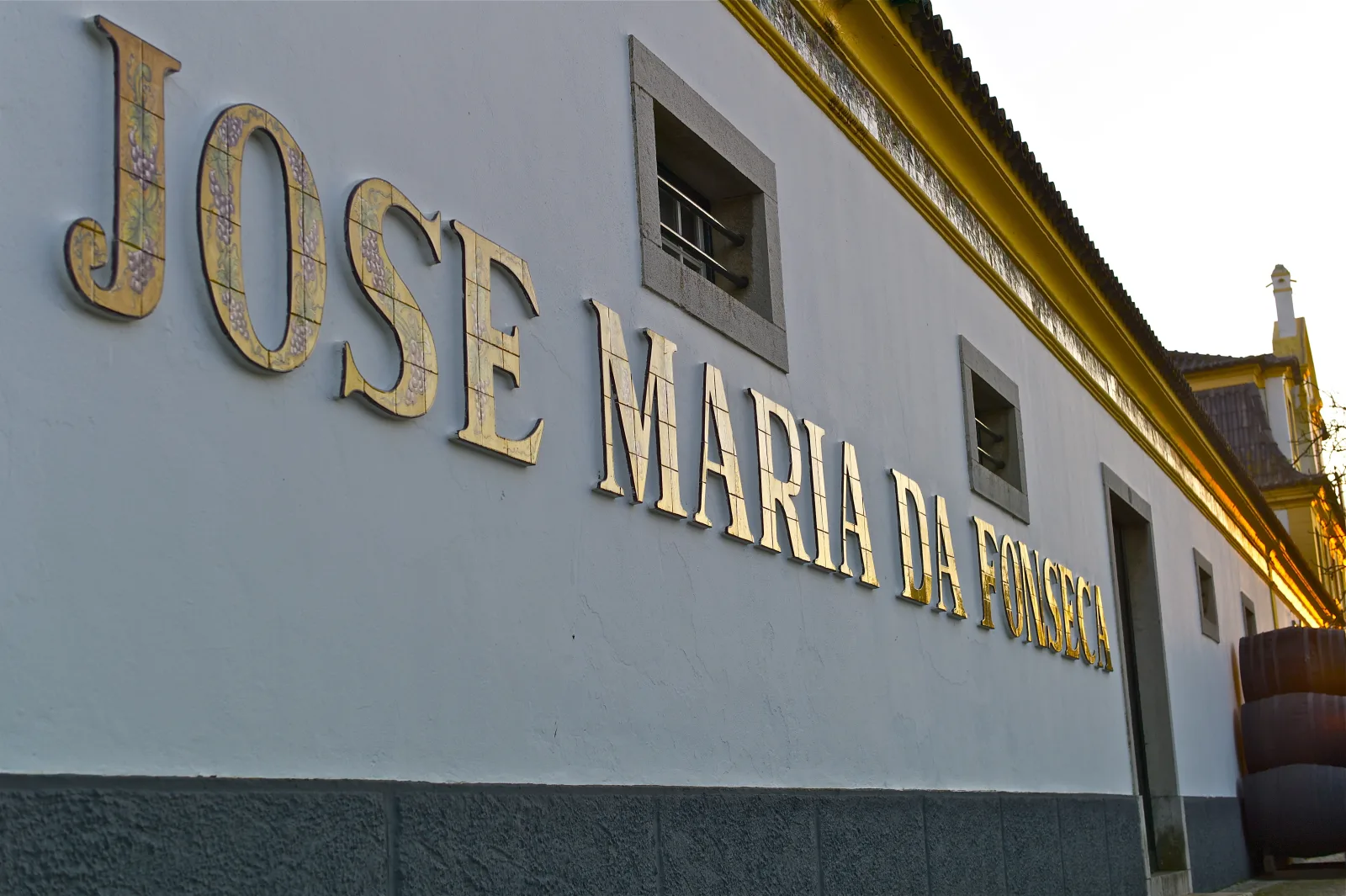
| José Maria da Fonseca | 1834 | Portugal’s oldest industrial producer of table wines. The Soares Franco family, seven generations. |
| Horácio Simões | 1910 | Family winery in Quinta do Anjo, Palmela. |
| Venâncio da Costa Lima | 1914 | Vineyards in Palmela and Azeitão. |
| Bacalhôa (Bacalhôa Vinhos de Portugal) | 1922 | Founded as João Pires & Filhos; since 1998 under the control of Comendador José Berardo. |
| SIVIPA | 1964 | Cooperative association of peninsula winegrowers. |
A key role in building the international reputation of Moscatel de Setúbal was played by José Maria da Fonseca. In 1855, the company’s wine was awarded a gold medal at the Paris World Exhibition – an event that cemented Moscatel’s status as a world-class wine. [UNVERIFIED] Some sources indicate that the award went specifically to Moscatel Roxo (red Muscat), but this has not been confirmed from the exhibition’s primary records.
It was also on the Setúbal Peninsula that the Lancers brand was created – a rosé semi-sparkling wine in a ceramic bottle that became one of Portugal’s most widely exported wines of the 20th century. By the early 21st century, José Maria da Fonseca exports reached more than 70 countries.
Golden age and decline
Demarcation and recognition
In 1907 – just two years after the creation of the Regional Viticulture Commission (1905) – Moscatel de Setúbal was granted D.O.C. (Denominação de Origem Controlada) status. It is Portugal’s second oldest appellation, surpassed in age only by the Douro region (1756). Vinhos Verdes and Dão were demarcated one year later, in 1908.
Phylloxera
In the second half of the 19th century, the peninsula’s vineyards, like those across Europe, were devastated by phylloxera – an American vine louse that destroys root systems. A significant portion of the vineyards was lost. Recovery took decades and required grafting onto resistant American rootstock.
The Salazar era
During the Estado Novo period (1933–1974), Salazar’s economic policies dealt another blow to the peninsula’s viticulture. The drive for food self-sufficiency – the “Wheat Campaign” (Campanha do Trigo) – led to the mass uprooting of vineyards in favour of grain crops. [UNVERIFIED] The exact scale of vineyard reduction on the Setúbal Peninsula during this period requires further research.
21st-century revival
Regulatory overhaul
In 1997–1999, DOC Setúbal regulations were revised: Muscat was established as the mandatory primary grape variety (minimum 85%), and previously permitted other varieties were excluded. This raised both quality and appellation identity.
Sales growth and the price paradox
In recent decades, Moscatel de Setúbal sales have doubled, and the region is attracting growing attention from international wine critics. However, its affordable price – in the $15–20 per bottle range even for aged categories – creates a paradox: on one hand, it attracts consumers; on the other, it hinders the perception of Moscatel de Setúbal as a truly premium product. As VinePair notes, “affordability may be this wine’s biggest problem” – on a shelf where Port costs $40–80, a $15 bottle is perceived more as a souvenir than a collector’s item.
Nevertheless, many experts see strategic advantage in this very affordability: Moscatel de Setúbal is one of the world’s most underrated fortified wines, and its moment may yet be ahead.
Timeline
| Year | Event |
|---|---|
| 14th c. | Richard II imports “Osoye” wine from Azoia |
| 15th–16th c. | Moscatel on caravels – exports to India, Brazil, Angola |
| 17th c. | Louis XIV serves Moscatel at Versailles |
| 1703 | Methuen Treaty – preferential tariffs for Portuguese wines |
| 1834 | José Maria da Fonseca founded |
| 1855 | Gold medal at the Paris World Exhibition |
| 1905–1907 | DOC Setúbal demarcation |
| 2nd half 19th c. | Phylloxera devastates vineyards |
| 1933–1974 | Salazar era: vineyards give way to wheat |
| 1997–1999 | DOC rules revised: Muscat made mandatory primary variety |
| 2000 | JMF revives the Torna Viagem practice |
| 21st c. | Sales double, international recognition grows |
See also
- Moscatel de Setúbal – Fortified Wine – full description of the wine, varieties and production
- Wines of the Setúbal Region – overview of all peninsula appellations
- The Salt Trade of Setúbal – the port’s parallel trade history
- Setúbal and the Age of Discoveries – maritime expansion and the port’s role
- The Modern Port of Setúbal – contemporary port infrastructure
Image sources
- jose-maria-fonseca-winery.webp — José Maria da Fonseca winery, Azeitão. License: CC BY 2.0. Source
If this article was useful — help us write the next one.
☕ Support on Ko-fi