Popular Saints in Setúbal (Santos Populares)
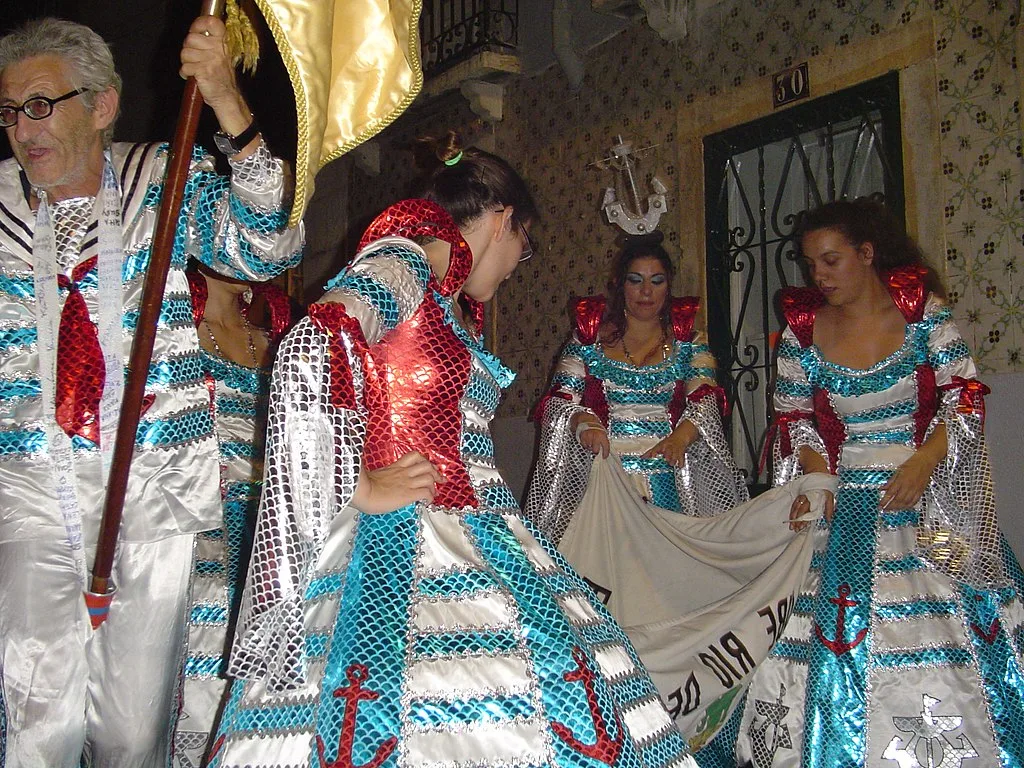 Photo: Beria Lima de Rodriguez, CC BY-SA 3.0. Wikimedia Commons.
In June, Setúbal smells of charcoal and sardines, rings with accordions and the roar of thousands of voices merged in the unified rhythm of marches – the Popular Saints festival transforms the city into a vast open-air stage where the history of the fishing port comes alive in dances, processions, and night-long celebrations until dawn.
The Three Saints of June
The Popular Saints festival (Santos Populares) is one of the most important folk traditions in Portugal, spanning the entire month of June with three key dates:
- Santo António – June 13, patron saint of Lisbon and one of the most venerated saints in the country
- São João – June 24, especially celebrated in Porto and northern Portugal
- São Pedro – June 29, patron saint of fishermen, holding special significance for Setúbal
While Lisbon is traditionally associated with Santo António and Porto with São João, Setúbal – a city whose identity is inseparably linked to the sea and fishing – gives pride of place to Saint Peter, patron of fishermen. This is no coincidence but a reflection of the city’s deep connection with the Sado River and the Atlantic Ocean, which for centuries defined the way of life for the local population.
Nevertheless, all three saints are celebrated in Setúbal with great pomp: the June festivities stretch over several weeks, turning the city into a continuous carnival of folk culture.
Marches on Avenida Luísa Todi
The Main Parade
The central event of the Santos Populares celebration in Setúbal is the Popular Marches (Marchas Populares) – a ceremonial parade along Avenida Luísa Todi, the city’s main waterfront boulevard. Traditionally, the first march outing falls on June 14, on a Saturday evening, when the column of participants parades along the avenue in a presentation format.
In 2025, 14 collectives participated in the marches – nine competitive and five non-competitive. Participants included sports and cultural societies from various neighbourhoods: Grupo Desportivo Setubalense “Os 13”, Associação ACTS – Companhia de Teatro de Setúbal, Grupo Desportivo Independente, União Desportiva e Recreativa das Pontes, Núcleo de Bicross de Setúbal, and others. Each collective represents its neighbourhood and prepares unique choreography, costumes, and musical accompaniment.
Competitive Programme
After the presentation parade on the avenue, the marches perform in a competitive format at the Pavilhão das Manteigadas – usually on Friday and Saturday of the following week, starting at 9:00 PM. A jury evaluates choreography, costumes, music, and overall impression. In 2025, the winner was the march “Setúbal das Salinas”, dedicated to the city’s salt works – an important but often forgotten page of local history.
Children’s and Inclusive Marches
In addition to adult collectives, the parade includes children’s marches (marchas infantis), as well as the APPACDM Honour March – an association supporting people with disabilities. This gives the festival an inclusive character: Santos Populares is a celebration for all city residents, regardless of age or physical ability.
The Night of Santo António
Arraiais and Popular Festivities
On the night of June 13, Setúbal, like all of Portugal, celebrates Santo António’s day. At Largo de Santo António and surrounding streets, arraiais are held – folk festivities with music, dancing, street food, and decorations. The squares and alleyways of the old town are decorated with garlands, coloured lanterns, and paper flags.
Traditional elements of the arraiais include:
- Charcoal-grilled sardines – the smell of sardines grilled over coals becomes the defining aroma of June
- Bifanas – hot pork sandwiches with mustard, an ever-present companion of folk festivals
- Caldo verde – traditional kale soup
- Folk music and dancing – live bands play fado, march tunes, and contemporary pop music
- Basil pots (manjericos) – the symbol of Santos Populares, small pots of basil decorated with paper flowers and poems
The celebrations continue until dawn. For many Setúbal residents, this is one of the most anticipated nights of the year – a time when the entire city takes to the streets.
Religious Processions
Besides secular festivities, religious processions are held in honour of Santo António. A procession with the saint’s image passes through parish streets, accompanied by prayers and singing. In some years, the procession begins at the Church of Santo António and passes through the central neighbourhoods, though the exact route may vary.
São Pedro – Patron of Fishermen
Special Significance for Setúbal
The feast of Saint Peter (June 29) holds special significance for Setúbal, going beyond an ordinary religious holiday. São Pedro is the patron saint of fishermen, and Setúbal remained one of Portugal’s most important fishing ports for centuries. The fishing industry – from sardine catching to canning factories – defined the city’s economy and culture from the late 19th century onward.
The veneration of Saint Peter in Setúbal is not an abstract religious tradition but a living connection with the sea. Fishing families, many generations of whom sailed into the Sado estuary and the open ocean, turned to the saint for protection from storms and for a bountiful catch.
Festive Traditions
São Pedro celebrations include:
- A Mass for fishermen in churches of coastal parishes
- A maritime procession – some sources mention a tradition of a river procession in honour of São Pedro, though in recent years Setúbal’s main water procession has been associated with Our Lady of the Rosary of Tróia in August
- Folk festivities in squares and along the waterfront
- Gastronomic events with an emphasis on fish dishes
Thus, if Santo António opens the June festivities, São Pedro crowns them – and for Setúbal, this crowning carries special symbolic weight.
Santos Populares Gastronomy
The Sardine – Queen of the Festival
It is impossible to imagine Santos Populares without charcoal-grilled sardines (sardinhas assadas). June is the peak season for Atlantic sardines, and this is precisely when the fish reaches its maximum fat content and flavour. In Setúbal, a city with centuries of fishing tradition, the sardine holds a place of honour on the festive table.
The traditional preparation method is simple and has remained unchanged for centuries: fresh sardines are sprinkled with coarse salt and grilled over hot coals, turned on a double grill rack. They are served on a slice of bread (pão de broa), which absorbs the aromatic juices. This very recipe – Sardinha Assada – was recognised as one of the “7 Wonders of Portuguese Gastronomy” in 2011, with Lisbon and Setúbal featured as regions particularly associated with the dish.
Other Festive Dishes
Besides sardines, the arraiais offer:
- Bifanas – pork marinated in garlic and white wine, served in a crispy roll
- Farturas – long spiral doughnuts dusted with sugar and cinnamon
- Febras – grilled pork steaks
- Tripas – thin crepes with filling (not to be confused with the offal dish)
- Ginjinha – sour cherry liqueur, served in chocolate cups
- Folk wine (vinho) – red and white table wine, often from the Palmela region
Cultural Significance
Identity Through Celebration
Santos Populares in Setúbal is more than just an entertainment event. The popular marches embody the spirit of neighbourhood community: each quarter prepares for months, rehearsing choreography and sewing costumes. The themes of the marches often draw on local history – fishing, salt works, canning factories, maritime trade. Thus the festival becomes a form of collective memory, passing from generation to generation the knowledge of what the city lived by and continues to live for.
Social Function
For many Setúbal residents, preparing for the marches is an opportunity for socialisation: coming together with neighbours, collective creativity, and strengthening bonds within the neighbourhood. In an era when traditional forms of neighbourhood interaction are eroding, Santos Populares preserves and cultivates these connections.
[FOLKLORE] There is a belief that unmarried girls who leave a pot of basil on the windowsill on the night of Santo António and make a wish will find a husband before the end of the year. This tradition, though not specific to Setúbal, is actively upheld in the city.
Practical Information
- Dates: All of June; key dates – June 13, 24, and 29; march parade usually June 14
- Main venues: Avenida Luísa Todi (parade), Pavilhão das Manteigadas (competition), Largo de Santo António (arraiais), waterfront and squares of the historic centre
- Admission: Free for all street events
- Recommendations: Arrive in the evening; carry cash for street food; dress lightly – June nights in Setúbal are warm
- Transport: The city centre is compact; most events are within walking distance of the central squares
Notes
[UNVERIFIED] The exact date when the tradition of popular marches began in Setúbal requires clarification. Some sources link it to Estado Novo (New State) initiatives to institutionalise folk festivals in the 1930s–1940s, though spontaneous street processions in honour of Santos Populares likely existed earlier.
[DISPUTED] Some authors note that the modern format of Santos Populares – with centralised organisation, a competitive programme, and municipal support – differs significantly from the original spontaneous folk celebrations, and that institutionalisation led to a certain standardisation affecting the spontaneity of the tradition. Other researchers, on the contrary, believe that municipal support ensured the survival and development of the tradition in modern conditions.
See Also
- Fishing Culture of Setúbal
- Religious Festivals of Setúbal
- Fado in Setúbal
- Sardine: Queen of the Setúbal Table
- Sardine Gastronomic Week
- Luísa Todi – The Great Singer
The light is on for free. But someone has to clean the lantern.
☕ Support on Ko-fi