Grape Harvest Festival in Palmela (Festa das Vindimas)
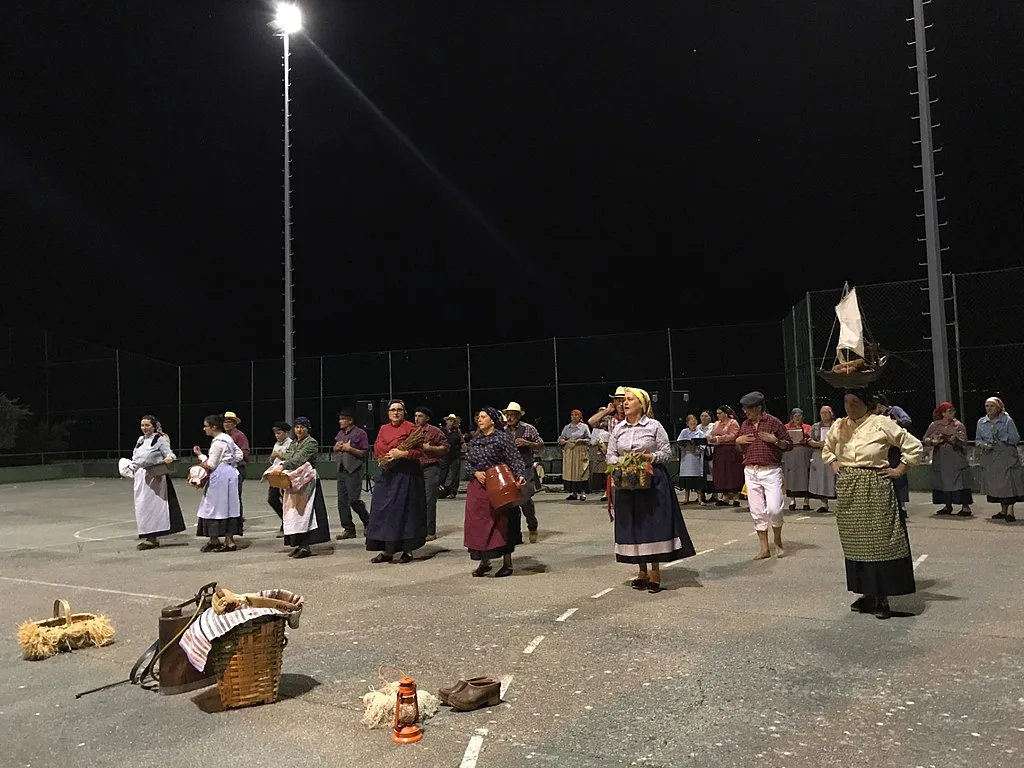 Photo: Huang Jing-yuan, CC BY-SA 4.0. Wikimedia Commons.
When the grapevines on the slopes of Palmela bend under the weight of ripe clusters and the air fills with the sweet scent of mature berries, the time comes for one of the oldest festivals on the Setúbal Peninsula – the Grape Harvest Festival, where centuries-old rituals of blessing and barefoot grape treading come alive to the rhythm of music and popular merriment.
Festival History
Foundation
The Grape Harvest Festival (Festa das Vindimas) in Palmela traces its history back to 1963, when the local community decided to organise a celebration dedicated to the region’s primary wealth – vineyards and wine. The idea was born in the late 1950s, when a group of local enthusiasts recognised the need for a festival that would not only mark the end of the harvest but also draw attention to Palmela’s winemaking at the national level.
In 2025, the festival’s 62nd edition was held under the motto “O Renascer da Tradição” (“The Rebirth of Tradition”), underscoring the organisers’ desire to preserve the festival’s historic core while updating its format for a modern audience.
Inspiration
According to some sources, the festival’s creators were inspired by the wine festivals of Jerez de la Frontera (Spain), though they adapted the concept to the Portuguese context. In particular, the ritual of treading grapes by foot (Pisa da Uva) symbolises gratitude for the harvest and the connection between people and the land – a motif that acquired its own resonance in Palmela thanks to the region’s unique history.
Three Pillars of Tradition
From the very first edition, the festival has been defined by three key rituals that have become its hallmark:
- Pisa da Uva – treading grapes with bare feet
- Blessing of the First Must (Bênção do 1.º Mosto) – a religious ceremony consecrating the new harvest
- Election of the Harvest Queen (Eleição da Rainha das Vindimas) – a contest crowning the festival
These elements have remained unchanged for six decades, forming an unbroken link between past and present.
Festival Programme
Dates and Format
In 2025, the festival ran from September 4 to 9 in the centre of Palmela, though the ceremonial opening took place the day before – September 3 – with the Harvest Queen Election show at the Cine-Teatro S. João at 9:00 PM.
Pisa da Uva: Treading Grapes by Foot
The Pisa da Uva ceremony is the festival’s most photogenic and emotional moment. Participants (both locals and visitors) remove their shoes and step into large treading vats filled with ripe grapes. To the accompaniment of folk music and cheers from the crowd, they crush the berries with their bare feet – just as their ancestors did for centuries, before the advent of mechanical presses.
This ritual is not merely a show for tourists. It is a symbolic act that reproduces the most ancient stage of winemaking and reminds us that wine is a product not only of technology but also of human labour, patience, and love for the land.
Blessing of the First Must
Bênção do 1.º Mosto is a religious ceremony during which a priest blesses the first must of the new harvest. This ritual unites Christian tradition with the agricultural cycle and symbolises hope for a good year for winemakers. The blessing takes place in a solemn setting, often against the backdrop of Palmela Castle – the city’s architectural landmark.
Wine Market (Mercado do Vinho)
Throughout the festival, a Wine Market operates where regional winemakers present their products: Moscatel, red and white wines DOC Palmela and DO Península de Setúbal. Besides wine tasting and sales, the market offers regional products – Queijo de Azeitão (Azeitão cheese), olive oil, honey, and traditional sweets.
Culinary Masterclasses
Culinary masterclasses allow participants to learn traditional and modern recipes for dishes that pair perfectly with local wines. Chefs demonstrate the preparation of regional dishes, explaining the principles of harmony between food and wine.
Harvest Parade and Rural Parade
The Harvest Parade (Cortejo Vindimeiro) and Rural Parade (Cortejo Campestre) are ceremonial processions through the streets of Palmela featuring local collectives representing traditional agricultural practices. Participants wear grape grower and farmer costumes, carrying baskets of grapes, winemaking tools, fruits, and flowers.
Election of the Harvest Queen
The Election of the Harvest Queen (Eleição da Rainha das Vindimas) is one of the festival’s most spectacular moments. Young women from Palmela compete for the title, representing various parishes and communities of the municipality. The ceremony takes place at the Cine-Teatro S. João and includes a traditional costume fashion show, performances, and interviews.
Musical Programme
Music is an integral part of the festival. In 2025, the main stage featured:
- Luís Represas – one of Portugal’s most famous singers and guitarists, former member of the band GNR, performing together with the Palmela Philharmonic Society “Loureiros” Band (Banda da Sociedade Filarmónica Palmelense “Loureiros”)
- Áurea – a popular soul and pop performer, appearing with the “Humanitária” Philharmonic Society Band (Banda da Sociedade Filarmónica Humanitária)
- Virgul – rapper and MC
- David Antunes & Emanuel Moura – duo
- Marco Rodrigues – fado performer
- Sons do Minho – folk ensemble
The combination of national stars with local musical collectives ensures a diverse programme for all tastes.
Sports Events and Wine Tourism
The programme is complemented by sporting events and enoturismo (wine tourism) offerings – organised visits to regional wineries where guests can witness the winemaking process and taste wines directly in the cellars.
Palmela – Heart of Winemaking
Geographic Position
Palmela occupies a strategic position on the Setúbal Peninsula: between the Arrábida mountain range to the south, the Tagus estuary to the north, and the Sado estuary to the east. This geographic context creates a unique microclimate – mild winters, hot dry summers, sea breezes – ideal for growing grapes.
Winemaking Traditions
Viticulture on the Setúbal Peninsula has been documented since Roman times. However, winemaking flourished after the Reconquista, when the Order of Santiago, based at Palmela Castle, actively developed agriculture in its territories. The order’s monk-knights not only fought but also practised viticulture, laying the foundations for the tradition that lives on today.
Today, winemaking remains one of the municipality’s main economic sectors, and Palmela is rightfully considered the wine capital of the Setúbal Peninsula.
Main Varieties
The region specialises in several key grape varieties:
- Moscatel de Setúbal (Muscat of Alexandria) – for producing fortified Moscatel
- Castelão (formerly known as Periquita) – a red variety dominating the DOC Palmela region
- Fernão Pires – a white variety widely used for dry white wines
- Trincadeira, Aragonez and others – for blends
Economic and Cultural Significance
For the Local Economy
The Grape Harvest Festival attracts thousands of visitors annually, stimulating local tourism, the restaurant business, and direct wine sales. For many wineries, the festival is an important platform for promoting their products and building relationships with consumers.
For Regional Identity
Festa das Vindimas is not just an event but an element of identity for Palmela and the entire Setúbal Peninsula. The festival reminds us that winemaking is not merely an economic sector but a way of life that defines the landscape, architecture, cuisine, and rhythm of the year. Sixty-two years of continuous celebration testify to the resilience of this tradition, which has survived a regime change, economic crises, and a pandemic.
Evolution of the Festival Through the Decades
From Estado Novo to the Carnation Revolution
The festival was founded during the Estado Novo – Salazar’s authoritarian regime, which actively used folk festivals as instruments of ideological legitimation. In this context, Festa das Vindimas reflected the state rhetoric about the “folk roots” of the Portuguese nation, the agrarian ideal, and traditional values.
After the Carnation Revolution of 1974, the festival underwent a transformation: its ideological subtext disappeared, and it became more an expression of genuine local identity. The social composition of participants also changed: if under Estado Novo the festival was organised “from above,” in the democratic era, initiative passed to local communities and winemakers.
Modern Format
Today’s format of Festa das Vindimas is the result of decades of evolution. The festival combines three dimensions:
- Ritual-symbolic – Pisa da Uva, blessing of the must, election of the Queen maintain the connection with origins
- Gastronomic – wine market, tastings, masterclasses position Palmela as a wine capital
- Entertainment – concerts, parades, sporting events attract a broad audience
The 62nd edition’s motto – “O Renascer da Tradição” – reflects the organisers’ desire to find a balance between modernisation and preserving authenticity. In recent years, increased attention has been given to wine tourism and educational programmes, attracting a new audience – young urban professionals interested in gastronomy and winemaking.
Queijo de Azeitão – Festival Companion
The Cheese Pairing
No visit to Festa das Vindimas would be complete without tasting Queijo de Azeitão DOP – a soft sheep’s cheese with a creamy texture and intense flavour, produced in the neighbouring town of Azeitão. The cheese is made from raw sheep’s milk using a vegetable coagulant – cardoon thistle (cardo), which gives it a characteristic slight bitterness.
The classic combination – a slice of fresh bread, a piece of Queijo de Azeitão, and a glass of red Castelão wine from Palmela – represents the quintessence of the Setúbal Peninsula’s gastronomic identity. At the festival’s Wine Market, this combination can be enjoyed in its ideal form.
Practical Information
- Dates: Early September (in 2025 – September 4–9, opening September 3)
- Location: Centre of Palmela (Vila de Palmela)
- Admission: Free for most street events; tickets may be required for some concerts
- Getting there: Palmela is 12 km from Setúbal; TST bus or car
- Recommendations: Be sure to try Queijo de Azeitão with local red wine; participate in the Pisa da Uva (bring a change of clothes); visit wineries as part of the wine tourism programme
Notes
[DISPUTED] The question of how much the Pisa da Uva ritual is an authentic local tradition versus a borrowing from Spanish wine festivals of the 1960s remains a matter of debate. There is no doubt that treading grapes by foot was a real practice in the region before the mechanisation of winemaking; however, its ritual framing within the festival may have been inspired by foreign analogues.
See Also
- Wines of the Palmela and Setúbal Region
- Moscatel de Setúbal
- Azeitão Cheese
- Moscatel Festival
- Castle of Palmela
The light is on for free. But someone has to clean the lantern.
☕ Support on Ko-fi