Sardines: Cult and Cuisine
The sardine (Sardina pilchardus) is the fish that shaped the economic history of Setubal and became one of the symbols of Portugal as a whole. Setubal was the country’s largest centre of sardine fishing and canning, and charcoal-grilled sardines remain a ritual dish without which no Portuguese summer festival is conceivable.
History
Ancient Roots
The harvesting and processing of sardines in the Setubal area has ancient origins. On the opposite bank of the Sado estuary, at Cetobriga, archaeologists have uncovered the remains of Roman factories that produced garum – a fermented fish sauce exported throughout the Roman Empire. The sardine was one of the principal ingredients of garum, placing the sardine fishery of the Sado estuary in a history spanning two millennia.
The Medieval Period
During the Middle Ages, sardines were salted and sold as an important source of protein for the Portuguese population. Fish salting remained a key sector of Setubal’s economy, closely tied to the salt trade – another pillar of the city’s wealth.
The Canning Revolution
The true turning point came in the nineteenth century with the development of canning technology. In 1853, the firm Ramirez – the oldest active canning company in the world – began producing tinned sardines. Founded by Sebastian Ramirez in Vila Real de Santo Antonio, the company subsequently expanded, opening factories in Setubal, the Algarve, and other cities.
Key dates in the history of Setubal’s canning industry:
- 1854 – first canning factory in Setubal (Manuel Jose Neto and Feliciano Antonio da Rocha)
- 1862 – adoption of pasteurisation, opening the way to mass production
- After 1880 – arrival of French industrialists with steam-powered technology; rapid growth in the number of factories
- 1897 – 26 factories in the city
- 1910s – 85 factories; Setubal becomes the largest canning centre in Portugal
The Golden Age of Canned Fish
In the first half of the twentieth century, Portuguese canned sardines became a major export commodity. The First World War boosted demand: armies needed long-lasting provisions, and sardines in olive oil were ideally suited to the ration of the trenches. By this time, roughly 10% of Setubal’s population was employed in the canning industry.
The tins of that era have become collectors’ items: manufacturers commissioned artistically designed labels, with each factory striving to distinguish itself through its packaging. Today, vintage sardine tins are sought-after objects on the antiques market.
Decline and Crisis
From the mid-twentieth century onward, Setubal’s sardine fishery and canning industry entered a phase of decline:
- Stock depletion – in 1984, the biomass of the Iberian sardine was estimated at roughly 1.3 million tonnes, but by 2015 it had fallen to one-tenth of that figure
- Relocation of production northward, to the Matosinhos area near Porto
- Social instability following the Carnation Revolution of 1974
- Factories closed one after another; today, only the brick chimneys of former plants serve as reminders of the industrial past
Present-Day Restrictions
The European Union has imposed strict sardine catch quotas under the Common Fisheries Policy. In 2019, the Portuguese government capped the annual catch at approximately 10,000 tonnes (down from 14,600 tonnes in 2018), triggering protests from fishing communities. Sandra Lazaro, a fisherwoman from Setubal, told the press that “making a living from fishing is no longer possible.”
By the end of 2019, the first signs of stock recovery had appeared, but the situation remains fragile.
Description
Species and Characteristics
The European sardine (Sardina pilchardus) is a small pelagic fish of the herring family. Key characteristics:
- Length: 15–25 cm
- Season: at its fattest and most flavourful from June to October (the summer months)
- Habitat: migrates along the Atlantic coast of the Iberian Peninsula
- Nutrition: rich in omega-3 fatty acids, calcium, and vitamin D
Preparation Methods
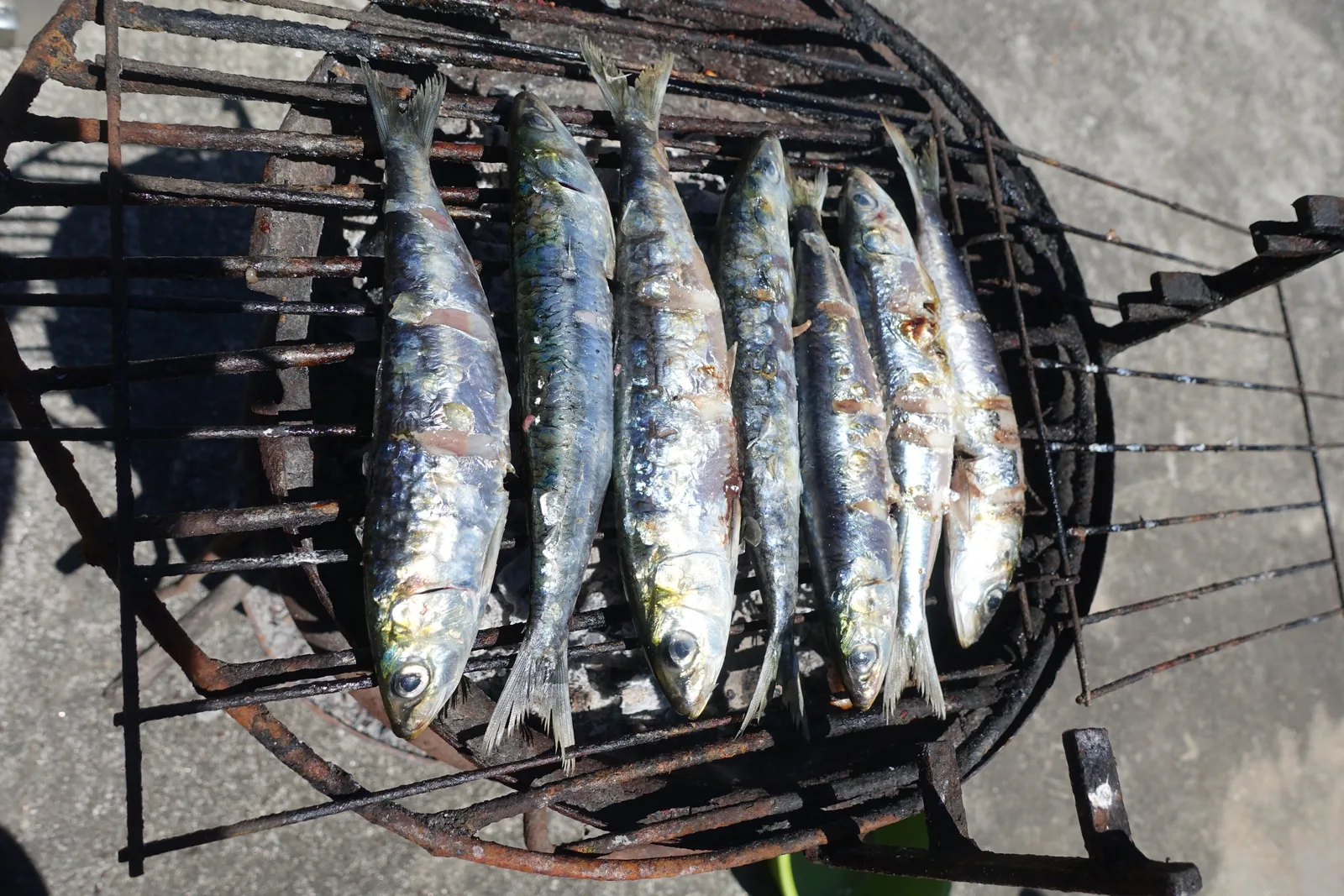
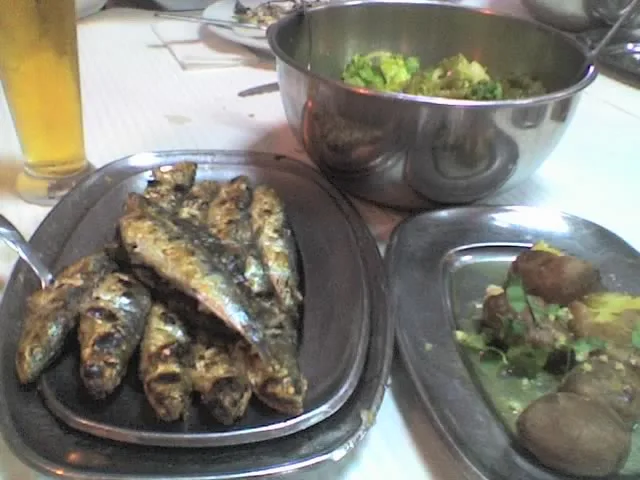
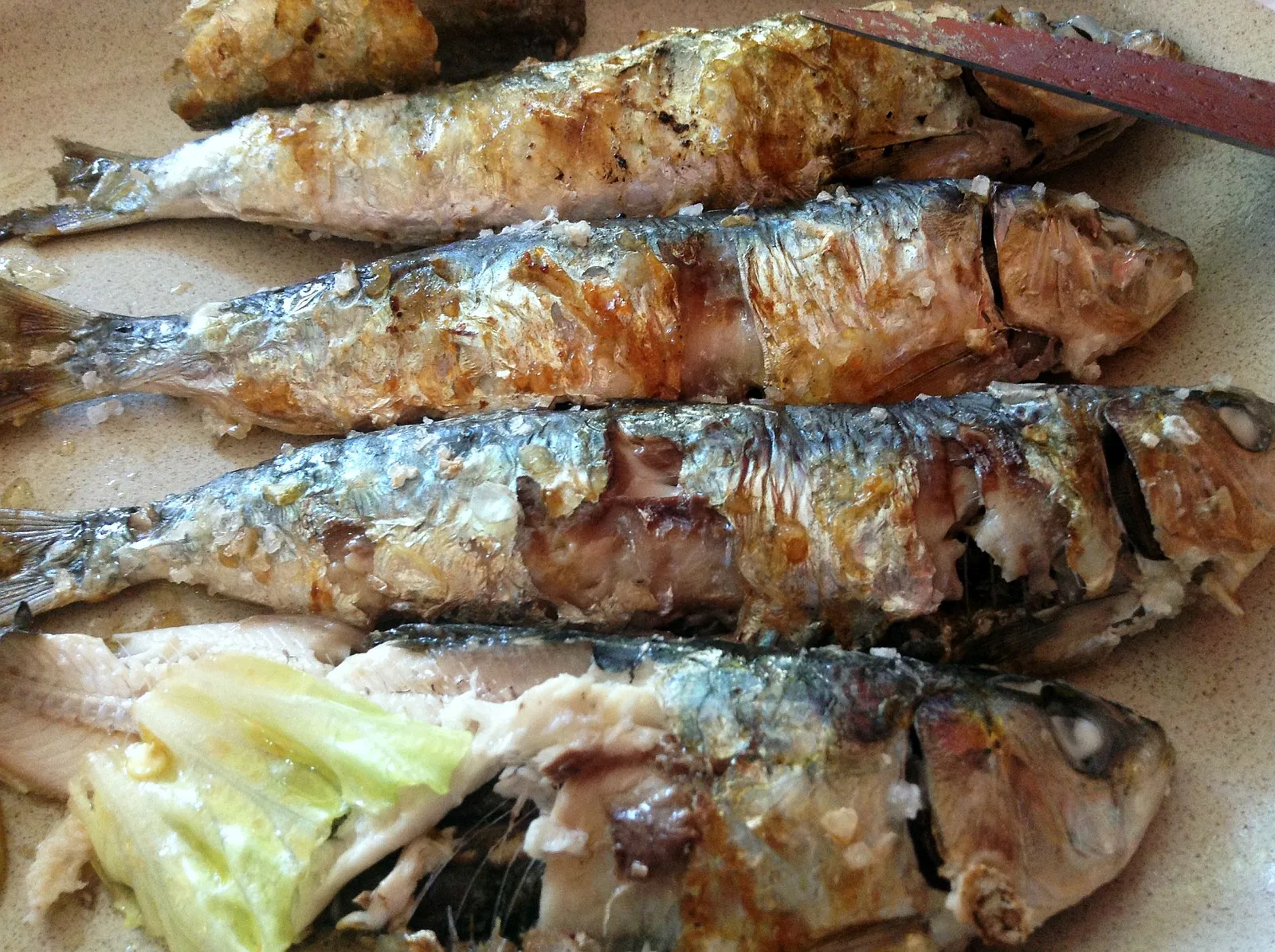
Sardinhas Assadas – charcoal-grilled sardines: The foremost and most revered method of preparation. Fresh sardines are sprinkled with coarse sea salt and grilled over charcoal until the skin is crisp. They are served on a slice of bread that soaks up the fat and juices, accompanied by roasted peppers and olive oil. A properly grilled sardine should be plump and oily, with a crackling skin and tender, melt-in-the-mouth flesh.
Canned sardines:
- In olive oil – the classic variety
- In tomato sauce
- In a tangy marinade (escabeche)
- Smoked
Other methods:
- Sardinhas de Escabeche – marinated in vinegar with onion, garlic, and bay leaf
- Pate de Sardinha – sardine pate
- Oven-baked sardines – with potatoes and vegetables
The Ritual of “Sardinha Assada”
Grilling sardines over charcoal is not merely a culinary process but a social ritual. It is always a collective affair: the grill is set up outdoors, smoke fills the neighbourhood, neighbours gather round, and wine flows freely. Sardines are eaten with the fingers, the flesh pulled from the bones while the fish is held by the tail over a slice of bread.
Cultural Significance
Sardines and Santos Populares
The culmination of the sardine cult is Santos Populares (“Popular Saints”), the festive cycle in June:
- Santo Antonio – 13 June, the principal feast day of Lisbon
- Sao Joao – 24 June, the principal feast day of Porto
- Sao Pedro – 29 June
On these days, streets across Portugal – and the Setubal district is no exception – are transformed into open-air grilling grounds: barbecues are set up on the pavements and the aroma of grilled sardines fills entire neighbourhoods. The sardine is the obligatory dish of the feast of Santo Antonio, without which the celebration would be unthinkable.
A Symbol of National Identity
For Portugal, the sardine is far more than just a fish. It is a symbol of the humility and resourcefulness of a people who knew how to turn the simplest of products into the foundation of an economy and a culture. In Setubal, this symbolism is especially potent: a city that grew on the sardine fishery and the canning industry remains associated with this fish to this day.
The Canned Fish Renaissance
In recent years, Portuguese canned goods have been experiencing a renaissance. Canned-fish shops (conserveiras) have become fashionable retail destinations in Lisbon and Porto. Designer sardine tins are a popular souvenir. Heritage brands are being revived and new producers are betting on quality and design. This trend has touched Setubal as well, serving as a reminder of its canning heritage.
Where to Try Them
In Setubal
- Mercado do Livramento – fresh sardines straight from the boats every morning; here you can choose your fish and ask to have it prepared at a nearby restaurant
- Waterfront restaurants (Avenida Luisa Todi) – virtually all offer grilled sardines in season
- Fishermen’s restaurants in the port area
- Feast of Santo Antonio (12–13 June) – street barbecues throughout the city
Seasonality
The best time for fresh grilled sardines is June to September, when the fish is at its fattest. A Portuguese proverb has it: “The sardine is good when the cherry is ripe” (A sardinha e boa quando a cereja esta madura). Canned sardines are available year-round.
Interesting Facts
-
In the 1980s, Portugal and Spain together caught approximately 200,000 tonnes of sardines each year. Today, quotas are limited to a few thousand tonnes – a stark illustration of the scale of overfishing.
-
The firm Ramirez, founded in 1853 by Sebastian Ramirez in Vila Real de Santo Antonio, is considered the oldest active canning company in the world. It is still in operation, although its main production facilities have long since moved away from Setubal.
-
Historically, some 20,000 people in Setubal were involved in sardine fishing or the canning industry – a significant proportion of the city’s population.
-
The word “sardine” is thought to derive from the island of Sardinia, off whose shores the fish was found in enormous quantities in antiquity.
-
[FOLKLORE] According to one account, the tradition of grilling sardines on the feast of Santo Antonio is linked to the legend of the saint’s sermon to the fishes at Rimini – when heretics refused to listen to him, Anthony addressed the fish instead, and they, according to his hagiography, rose from the water and listened attentively. This episode was later reinterpreted by the Portuguese preacher Antonio Vieira in his celebrated sermon of 1654.
-
The fat content of the sardine is the key indicator of quality: at the peak of the season (July–August), fat content can reach 20%, which is precisely what gives charcoal-grilled sardines their distinctive flavour.
Image sources
- sardinhas-grelhadas.webp — Grilled sardines. Author: Wikimedia Commons. License: CC BY-SA 4.0. Source
- sardinhas-assadas.webp — Roasted sardines. Author: Wikimedia Commons. License: CC BY-SA 4.0. Source
- sardines-on-plate.webp — Sardines on a plate. Author: Wikimedia Commons. License: CC BY-SA 4.0. Source
See also
- Fishing Culture of Setubal
- The Canning Industry
- Choco Frito
- Seafood Cuisine of Setubal
- Religious Festivals of Setubal
- Mercado do Livramento
If this article was useful — help us write the next one.
☕ Support on Ko-fi