Setubal and the Age of Discoveries
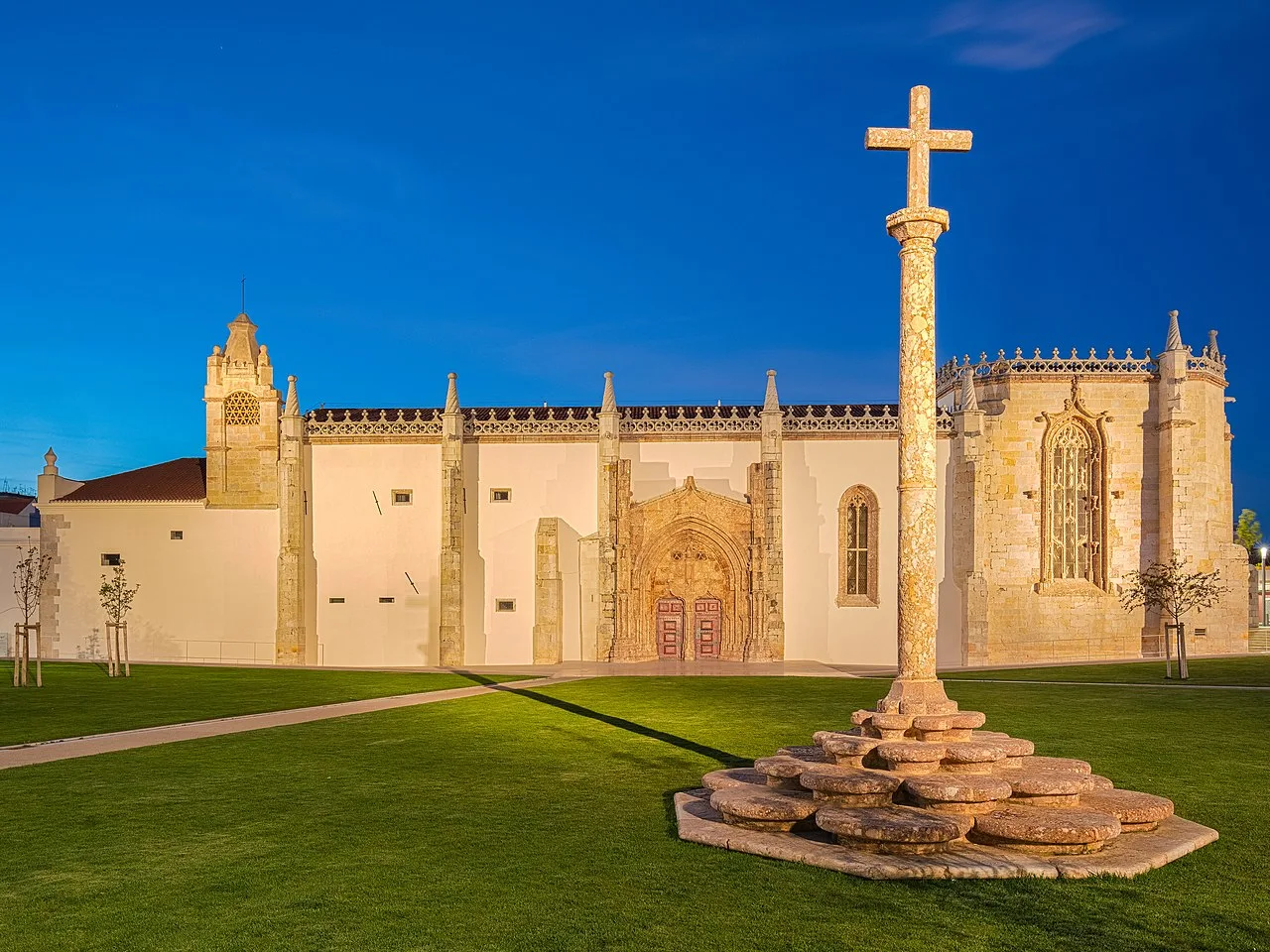
In the 15th and 16th centuries, Setubal transformed from a medieval fishing town into a strategic port of the Portuguese Empire. Expeditions to Africa set sail from its harbour, the city served as a royal residence, and its salt supplied the fishing fleets of all Europe. The Monastery of Jesus (Mosteiro de Jesus) — the first building in the Manueline style — became the architectural symbol of the era.
Port and Naval Role
A Royal Residence
During the reign of King Joao II (1481–1495), Setubal served as a royal residence. This speaks to the city’s considerable status at the end of the 15th century: it was not merely a fishing port but one of the political centres of the kingdom.
It was at the court in Setubal that decisions were made which shaped the course of Portuguese overseas expeditions. The city occupied a convenient position — close enough to Lisbon to maintain contact with the capital, yet possessing its own port and a sheltered bay at the mouth of the Sado River.
The Expedition of Afonso V to Morocco (1458)
One of the most notable episodes in Setubal’s naval history was the expedition of King Afonso V to conquer Alcacer Ceguer in Morocco.
Date of departure: 1458, from the port of Setubal.
Scale of the expedition:
- 25,000–26,000 soldiers (not counting sailors and support personnel)
- A fleet of 200–220 ships
Participants:
- The Duke of Viseu, Fernando
- Henry the Navigator (Infante Henrique) — the legendary organiser of Portuguese maritime expeditions, commanding the Algarve armada
Following the expedition’s success, Afonso V adopted the expanded title of “King of Portugal and the Algarves” (in the plural, to include the new African territories).
The fact that a fleet of more than two hundred ships could be assembled and dispatched from the port of Setubal testifies to the city’s well-developed harbour infrastructure.
The Mission of Vasco da Gama (1492)
In 1492, King Joao II dispatched Vasco da Gama — the future discoverer of the sea route to India — to the port of Setubal and the Algarve with orders to seize French ships. This was a retaliatory measure against French pirates and privateers who had been attacking Portuguese vessels in peacetime.
The episode confirms the strategic naval importance of the port of Setubal and indirectly attests to its integration into the defensive system of the Portuguese coast.
The Salt Trade
The White Gold of Setubal
Salt from Setubal was one of Portugal’s most important export commodities in the 15th and 16th centuries. Salt pans (salinas) on the banks of the Sado estuary were operated by artisanal methods, but merchants controlled transport and distribution, turning salt into a highly profitable enterprise.
Export Destinations
The principal buyers of Setubal salt were:
- Flanders and the Netherlands — their rapidly expanding fishing fleets needed more salt for curing their catch than their own salt works could produce
- England — English salt production had declined in the 15th century due to competition, increasing demand for imports
- Northern Europe at large — salt was re-exported alongside wine, olive oil, and fruit
Salt and Fish — An Eternal Partnership
The salt trade of Setubal was inextricably linked to fishing. The city occupied a unique position: it simultaneously produced salt and caught fish, meaning it could both cure and export finished products. This dual specialisation — a continuation of a tradition dating back to Roman Cetobriga — defined Setubal’s economic identity well into the 20th century.
The Monastery of Jesus — The First Manueline Building
Foundation
The Monastery of Jesus (Convento de Jesus) is the foremost architectural monument of the Age of Discoveries in Setubal and one of the seminal landmarks of Portuguese architecture.
- Founded: around 1490
- Founder: the noblewoman Justa Rodrigues Pereira, a lady-in-waiting at court
- Patron: from 1491, King Joao II, who took the construction under his personal patronage
- Architect: Diogo de Boitaca, a master builder of presumably French origin
- Construction period: 1490–1510
Architectural Significance
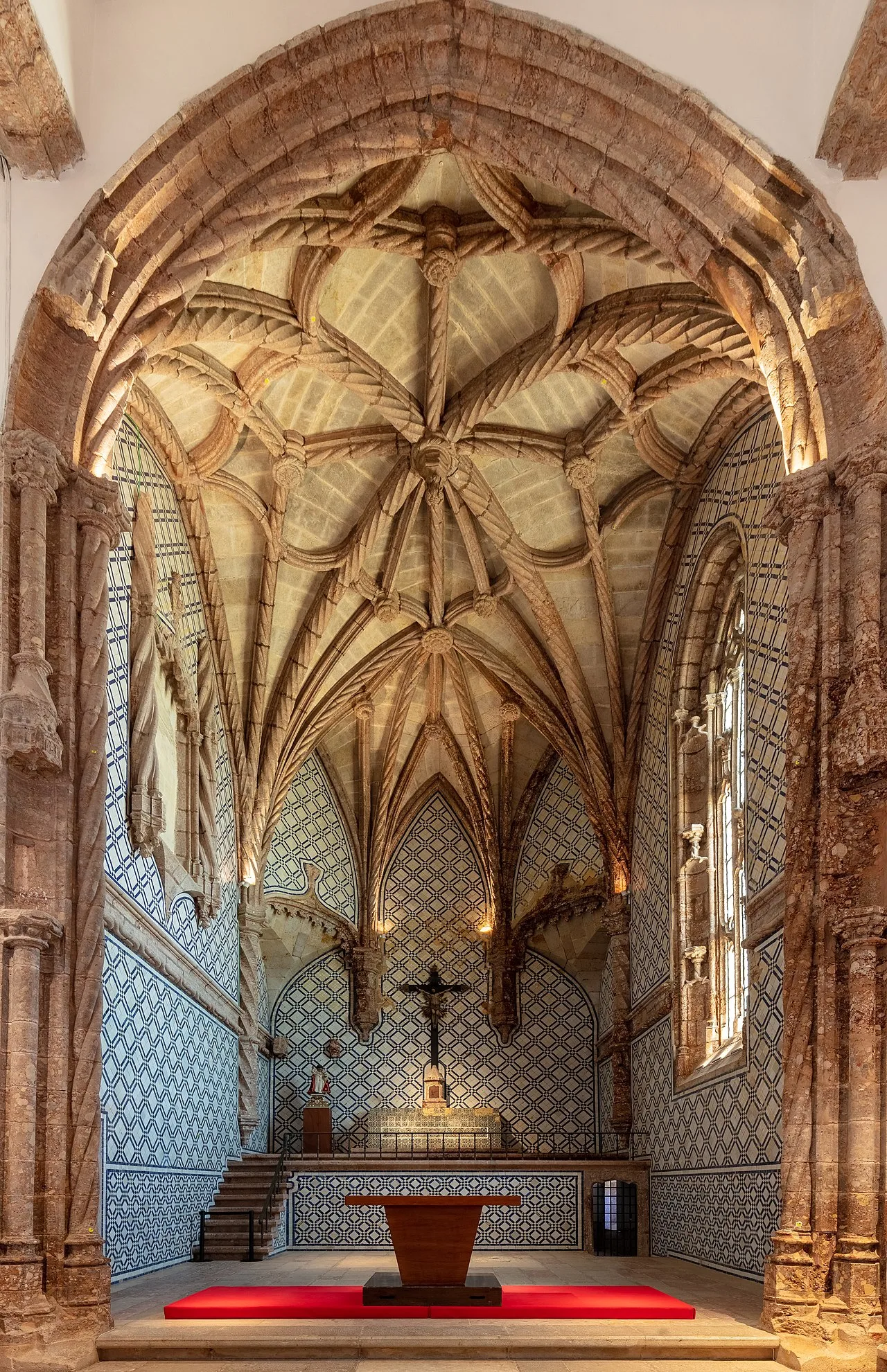
The church of the Monastery of Jesus is the first known building to employ elements of the Manueline style (Manuelino) — a distinctly Portuguese variant of the late Gothic, named after King Manuel I (1495–1521).
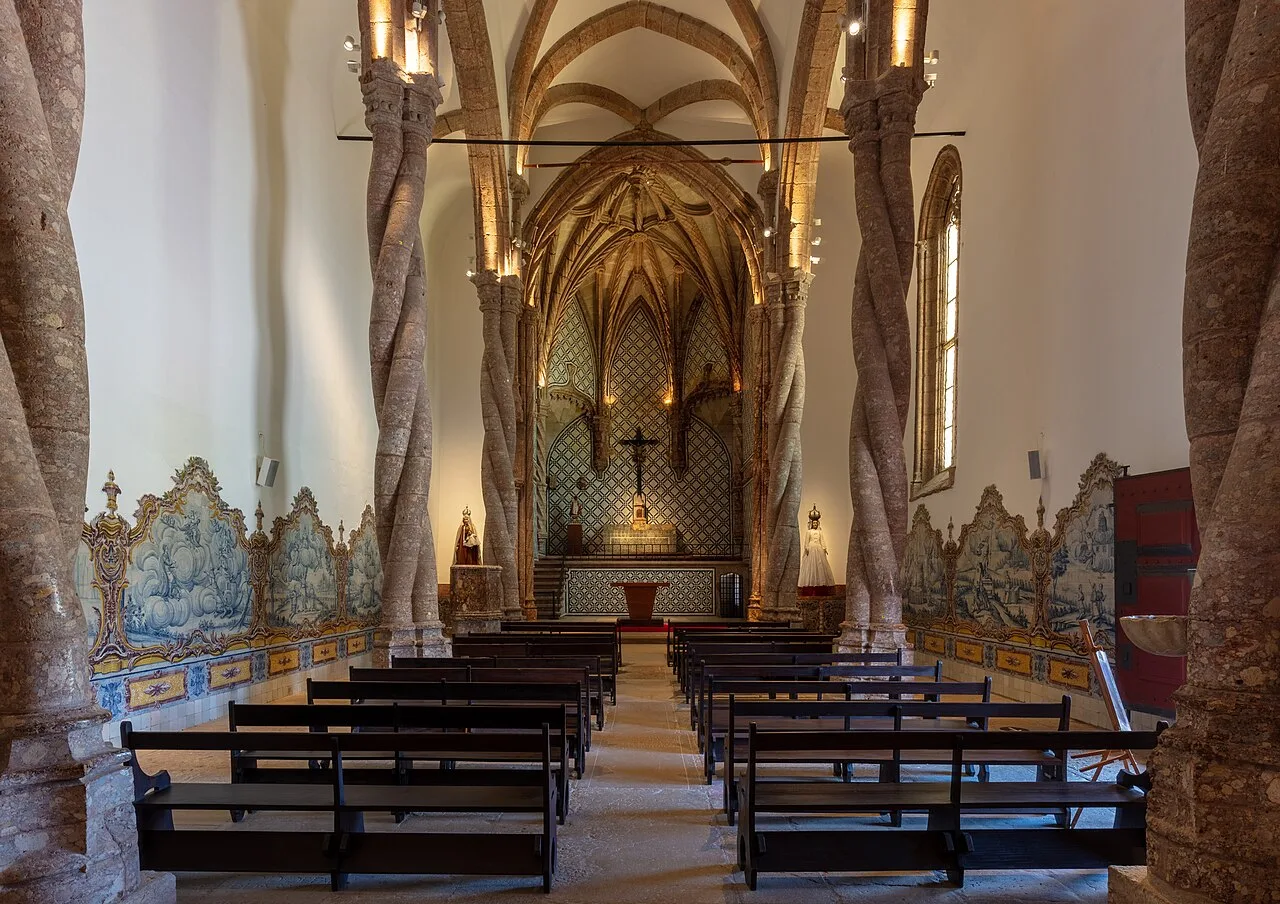
The church’s signature feature is its spiralling columns made of breccia quarried from the Serra da Arrabida mountains. This motif would later become a hallmark of Manueline architecture, appearing in buildings such as the Cathedral of Guarda.
The Manueline style as a whole captured the spirit of the Age of Discoveries: its decorative vocabulary is saturated with maritime symbolism — ropes, anchors, nautical knots, waves, exotic plants. The Monastery of Jesus in Setubal was the starting point of this uniquely Portuguese style.
Subsequent History
The monastery sustained significant damage in the earthquake of 1755, but was carefully restored with maximum preservation of its original Manueline details. Today the building houses the Setubal Museum (Museu de Setubal).
Growth and Prosperity
The 16th-Century Flourishing
In the 16th century, Setubal experienced a period of vigorous growth:
- The population increased as merchants and craftsmen flocked to the city
- Port infrastructure expanded
- The city became a major centre of trade between Portugal and Northern Europe
- Fishing and salt production provided a stable economic base
Precise figures for Setubal’s population in the 16th century have not been found in available sources.
Winemaking
During this period, winemaking began to develop in the Setubal region, particularly in the Azeitao district on the slopes of the Serra da Arrabida. The tradition of producing Moscatel wine from the Muscat grape likely dates to the 16th century, although vineyards existed in the area even earlier.
Fort of Sao Filipe
Construction
In the late 16th century, Setubal acquired a formidable fortification that would define its military significance for centuries to come:
- 1582 — laying of the cornerstone on the orders of Philip II of Spain (Philip I of Portugal), who personally attended the ceremony
- Design: Italian military engineer Giovan Giacomo Paleari Fratino (1583)
- Chief engineer: the Italian Filipe Terzi
- Construction: 1590–1600 (completed by Leonardo Torreano after Terzi’s death)
Architecture and Purpose
The Fort of Sao Filipe is a star-shaped fortress with six bastions, built according to the latest principles of 16th-century fortification design. It controlled the mouth of the Sado River and the approaches to the port.
Its construction served a dual purpose:
- Defensive — protecting a strategic port from external enemies
- Political — demonstrating Spanish authority and controlling a city whose inhabitants put up considerable resistance to Spanish rule (during the Iberian Union, 1580–1640)
Inside the fort stands a small Baroque chapel adorned with azulejo (tile) panels depicting scenes from the life of Saint Philip.
Bocage — The Poet of Setubal
Life and Legacy
Although Manuel Maria Barbosa du Bocage (1765–1805) lived after the Age of Discoveries, his biography is inseparable from the maritime heritage of Setubal and deserves mention in the context of the city as a seafaring port.
- Born in Setubal on 15 September 1765
- At 14, joined the 7th Infantry Regiment, later transferring to the navy
- Voyaged to Brazil and India (Goa), and visited Macau
- Wrote satirical sonnets about the “Decline of the Portuguese Empire in Asia”
- Regarded as the greatest Neoclassical poet of Portugal
Bocage’s memory lives on in Setubal: his statue stands in the city’s main square (erected in 1871), and every 15 September the Festas do Bocage — a festival honouring the poet — is held in his name.
The Age’s Significance for Setubal
The Age of Discoveries transformed Setubal from a local fishing port into a city of imperial importance. Three pillars defined its role:
- The port — a launching point for expeditions, a naval base, a trading hub
- Salt — the export commodity that fuelled the city’s economy and linked it to Northern Europe
- Culture — the Monastery of Jesus as an architectural manifesto of the era, the poet Bocage as the voice of a seafaring nation
The prosperity would not last forever: the earthquake of 1755 dealt the city a devastating blow from which it took decades to recover. Yet the economic model built on fish and salt proved remarkably resilient, re-emerging in the 19th century in the form of the canning industry.
Key Dates
| Date | Event |
|---|---|
| 1458 | Departure of Afonso V from Setubal for the conquest of Morocco |
| 1481–1495 | Setubal serves as the royal residence of Joao II |
| ~1490 | Foundation of the Monastery of Jesus |
| 1490–1510 | Construction of the monastery church (first Manueline building) |
| 1492 | Vasco da Gama’s mission to Setubal |
| 1514 | Second foral of Setubal |
| 1582 | Laying of the cornerstone for the Fort of Sao Filipe |
| 1590–1600 | Construction of the Fort of Sao Filipe |
| 1765 | Birth of the poet Bocage in Setubal |
Image sources
- discoveries-convento-jesus-exterior.webp — Monastery of Jesus — an architectural symbol of the Age of Discoveries. Author: Diego Delso. License: CC BY-SA 4.0. Source
- discoveries-igreja-jesus-interior.webp — Interior of the Monastery of Jesus with Manueline twisted columns. Author: Diego Delso. License: CC BY-SA 4.0. Source
- discoveries-igreja-jesus-altar.webp — Altar of the Monastery of Jesus in Manueline style. Author: Diego Delso. License: CC BY-SA 4.0. Source
See also
- The Reconquista and the Medieval Period
- The Earthquake of 1755
- The Canning Industry
- Monastery of Jesus
- Fort of Sao Filipe
- Arrabida Natural Park
- Moscatel de Setubal
- Bocage — Poet of Setubal
- Festas do Bocage
- Fishing Culture
The light is on for free. But someone has to clean the lantern.
☕ Support on Ko-fi