The Freguesias of Setúbal
📷 Image credit
Photo: Gazilion / Wikimedia Commons / CC0
Five freguesias—five worlds. From the narrow streets of the historic center, which remember the knights of the Order of Santiago, to the endless salt flats of the Sado; from the vineyards of Azeitão to the apartment blocks of São Sebastião with its 52,000 residents—the administrative division of Setúbal reflects not only bureaucratic logic but also the deep geographical, cultural, and social diversity of the municipality.
What Is a Freguesia
Portugal’s Smallest Administrative Unit
A freguesia (parish) is the smallest administrative-territorial unit in Portugal, the level below the municipality (concelho). The word derives from the Latin “frequentia” (assembly) and is historically linked to the church parish (paróquia)—the parish was the primary form of territorial organization.
Each freguesia has:
- Junta de Freguesia—an executive body (parish council) headed by a president
- Assembleia de Freguesia—a representative body (parish assembly)
- Its own budget—limited but sufficient to address local improvement matters
- Powers—civil registration, minor infrastructure works, social assistance
In the Portuguese system of governance, the freguesia is the level closest to the citizen—the place where one registers a child’s birth, obtains a certificate, or raises a problem about a leaking roof or a broken street lamp.
The 2013 Reform
Context: Crisis and the Troika
The 2013 parish reform was part of a large-scale program of fiscal austerity carried out by Portugal under pressure from the “troika” (European Commission, European Central Bank, IMF) during the 2011–2014 financial crisis.
The legislative basis of the reform:
- Law No. 22/2012 (May 30)—established criteria for merging freguesias (known as the “Lei Relvas,” after Minister Miguel Relvas)
- Law No. 11-A/2013 (January 28)—determined specific mergers across the country
At the national level, the reform reduced the number of freguesias from 4,259 to 3,091—more than a thousand administrative units disappeared, many of which had existed for centuries.
Before the Reform: 8 Freguesias
Before 2013, the municipality of Setúbal comprised 8 freguesias:
- São Julião—central, including the Troino district and port
- Nossa Senhora da Anunciada—the market and trade zone
- Santa Maria da Graça—the upper city
- São Lourenço (Azeitão)—vineyards and palaces
- São Simão (Azeitão)—rural zone
- São Sebastião—largest by population
- Sado—estuary area, salt flats, Mitrena
- Gâmbia-Pontes-Alto da Guerra—northeastern rural zone
After the Reform: 5 Freguesias
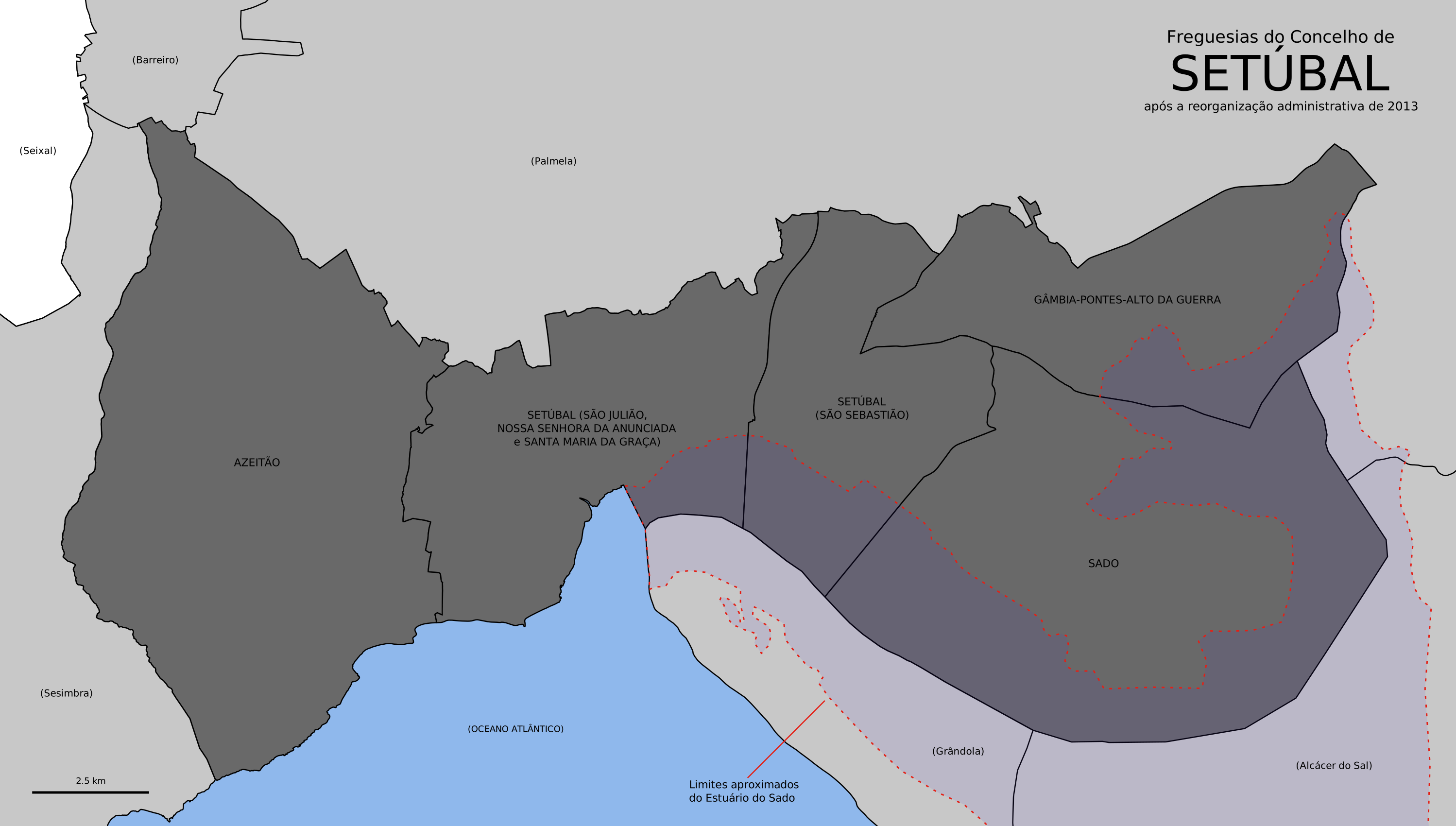
The reform reduced the number of freguesias to 5 through two mergers:
| # | Freguesia | Area | Population (2021) | Note |
|---|---|---|---|---|
| 1 | União das Freguesias de Setúbal (São Julião, N.S. da Anunciada, S.M. da Graça) | 36.77 km² | 37,757 | Merger of three central parishes |
| 2 | São Sebastião | 19.64 km² | 52,627 | 7th largest freguesia in Portugal |
| 3 | Azeitão (São Lourenço e São Simão) | 69.32 km² | 20,946 | Merger of two parishes |
| 4 | Sado | ~91.6 km² | 5,357 | Largest by area |
| 5 | Gâmbia-Pontes-Alto da Guerra | 32.96 km² | 6,809 | Unaffected by reform |
| Municipality — total | 230.3 km² | 123,496 | 2021 Census |
Five Freguesias: Profiles
União das Freguesias de Setúbal
The historic city center—a merger of three of the oldest parishes, each with its own identity:
- São Julião—the port district, the fishing quarter of Troino, Livramento Market, Avenida Luísa Todi
- Nossa Senhora da Anunciada—the commercial zone, Bocage Square, the Church of Jesus
- Santa Maria da Graça—the upper city, the fortress, panoramic views of Serra da Arrábida
The merger of three historic parishes into a single freguesia was one of the most painful aspects of the reform in Setúbal: each parish carried centuries of history, its own festivals, and its own identity.
São Sebastião
The most populous freguesia—52,627 residents (2021), making it the 7th largest freguesia in all of Portugal. This is a modern, urbanized district with high-rise buildings, shopping centers, and educational institutions (including the Polytechnic Institute of Setúbal).
São Sebastião is the district where a significant proportion of Setúbal’s working population is concentrated. It was here in the 1960s–1970s that workers settled, drawn by new industrial enterprises—the Setnave shipyards, the automobile plants.
Azeitão
Vineyards, palaces, cheese, and wine—Azeitão (the merger of São Lourenço and São Simão) is an altogether different world, geographically and culturally distinct from urban Setúbal. Here the famous Moscatel de Setúbal wine and Queijo de Azeitão goat cheese are produced.
Azeitão lies at the foot of Serra da Arrábida and possesses its own historical identity, linked to the palatial culture of the 15th–16th centuries (Quinta da Bacalhoa, Palácio dos Duques de Aveiro).
Sado
The largest by area (~91.6 km²) but least populated (5,357 people)—the Sado freguesia covers the vast territories of the Sado estuary, salt flats, the Mitrena peninsula (where the Lisnave/Setnave shipyards are located), and agricultural land.
This is a freguesia of contrasts: the industrial zone of Mitrena stands beside the nature reserve of the estuary, home to bottlenose dolphins.
Gâmbia-Pontes-Alto da Guerra
The rural northeastern zone—the freguesia least affected by the reform, which preserved its boundaries. A predominantly agricultural district with a dispersed population, linked to Setúbal but retaining its rural character.
Municipal Authority
Câmara Municipal
The freguesias are subordinate to the municipal government—the Câmara Municipal de Setúbal, headed by its president. Elections for the municipal president and parish councils take place simultaneously every four years.
Current Leadership
In the October 2025 elections, Maria das Dores Meira was elected president of the Câmara Municipal, nominated by the “Setúbal de Volta” movement with the support of PSD and CDS-PP. Meira won with 30% of the vote—a result reflecting the fragmentation of Setúbal’s political landscape.
This election marked the end of an era: CDU (the PCP and Green Party coalition) had governed Setúbal for 24 years, and the victory of a center-right candidate represented a historic turning point.
Assembleia Municipal
[UNVERIFIED] The Assembleia Municipal de Setúbal reportedly has 38 members representing various political forces.
Demographics
Population Distribution
The 2021 Census recorded significant unevenness in population distribution:
- São Sebastião (52,627)—over 42% of the entire municipality on less than 9% of the territory
- União das Freguesias (37,757)—the historic center, gradually losing population
- Azeitão (20,946)—a growing suburban area
- Gâmbia-Pontes-Alto da Guerra (6,809)—stable rural population
- Sado (5,357)—the least densely populated
Total municipal population: 123,496 (2021 Census).
This demographic picture reflects a tendency characteristic of all Portugal: population drift from historic centers to the periphery, where housing is more affordable and conditions for families are better.
Historical Perspective
From Church Parishes to Administrative Units
Setúbal’s freguesias carry within them the historical memory of centuries:
- São Julião, Nossa Senhora da Anunciada, Santa Maria da Graça—three parishes dating to medieval Setúbal, when the church parish formed the basis of territorial organization
- São Lourenço and São Simão—parishes of Azeitão, linked to the agrarian and palatial tradition
- São Sebastião—a district that radically changed character in the 20th century, transforming from a rural parish into the largest residential area
The 2013 reform erased some of these historic boundaries, but the memory of the parishes lives on: residents still identify themselves as being “from São Julião” or “from Anunciada” rather than “from the União das Freguesias.”
Key Dates
| Date | Event |
|---|---|
| May 30, 2012 | Law No. 22/2012 (Lei Relvas)—criteria for merging freguesias |
| January 28, 2013 | Law No. 11-A/2013—specific mergers determined |
| September 29, 2013 | Municipal elections; new division takes effect |
| 2021 | Census: 123,496 residents in 5 freguesias |
| October 2025 | Maria das Dores Meira elected president of Câmara Municipal |
See Also
- Municipal Governance of Setúbal—the authority structure above the freguesias
- “Red City”: Political History of Setúbal—political context of elections
- 1249 Charter and Order of Santiago—origins of territorial organization
- Modern Setúbal—demographic and economic trends
- Sado Estuary—the natural foundation of the Sado freguesia
The light is on for free. But someone has to clean the lantern.
☕ Support on Ko-fi