The Moorish Period
The Moorish period in the history of the Setubal region spans more than five centuries — from the Arab and Berber invasion of the Iberian Peninsula in 711 to the definitive Christian reconquest of the territory in the early 13th century. Specific information about the city of Setubal itself during this era is exceedingly scarce; most available data pertains to the fortress of Palmela and the region as a whole.
Note on reliability: This article has a status of verified and a confidence level of medium. General facts about the Moorish period and Palmela Castle have been confirmed across multiple sources. However, concrete information about the city of Setubal itself during this era remains sparse. Where possible, uncertainty is indicated with markers.
The Conquest
The Invasion of 711
In 711, an army of Umayyad Arabs and Berbers under the command of Tariq ibn Ziyad crossed the Strait of Gibraltar and within several years subjugated virtually the entire Iberian Peninsula. By 720, the territory of modern Portugal was fully occupied. The Setubal region became part of Al-Andalus — the vast Islamic state that encompassed most of Iberia.
The Arabic Name
Setubal received the Arabic name Shatubar (Andalusian Arabic: شَطُوبَر) — derived from the older pre-Roman name Caetobriga, transformed through a late Latin form. This was the intermediary link between Roman Cetobriga and the modern Portuguese name Setubal.
The Fortress of Palmela
A Key Stronghold
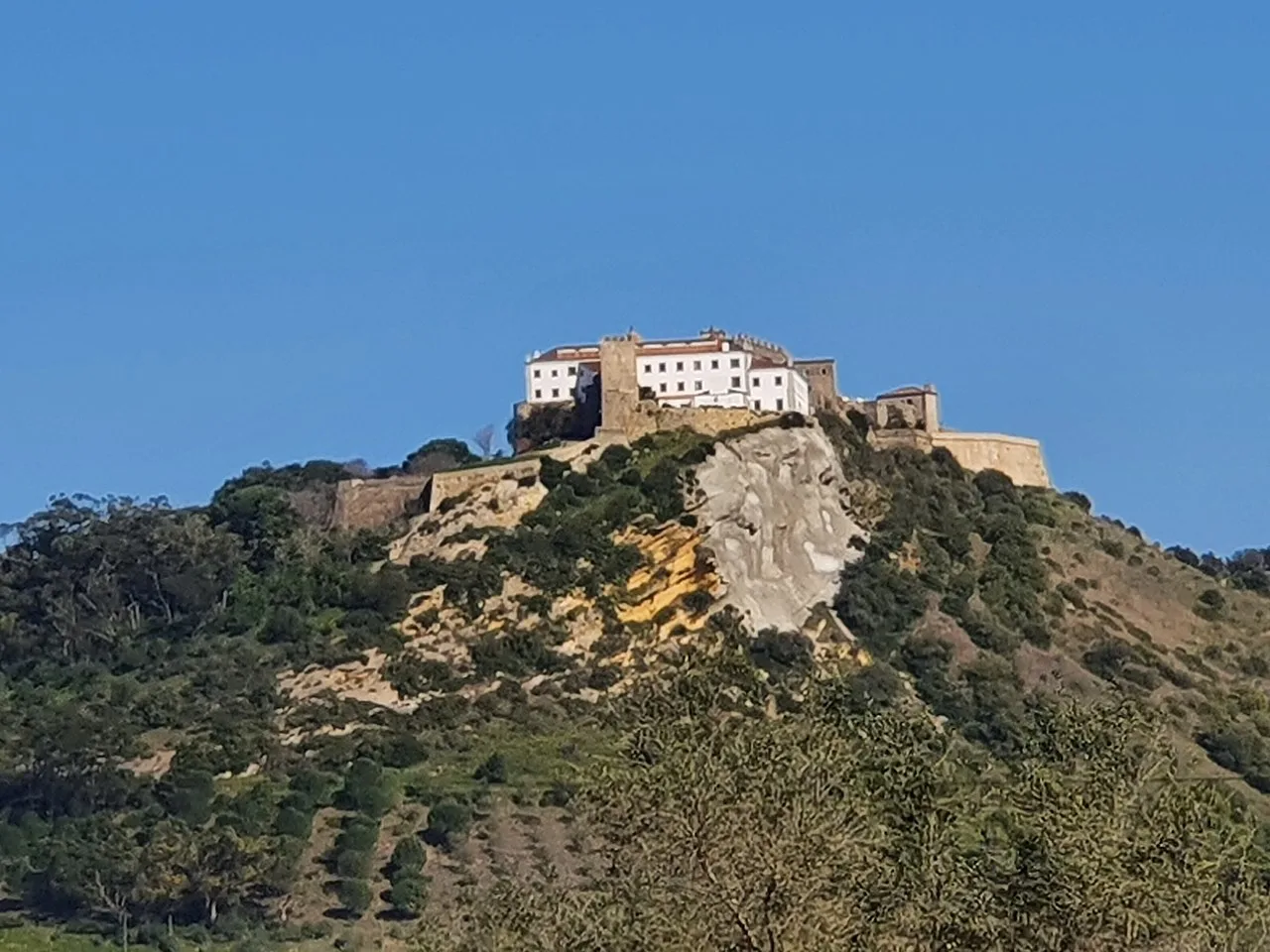
The fortress of Palmela (Castelo de Palmela) was the principal Moorish defensive position in the Setubal region. Perched on a strategic hilltop between the Tagus and Sado rivers, it commanded the entire Setubal Peninsula and the approaches to the estuary.
- Arabic name: Balmala (or Bal-mali)
- Type of fortification: hisn — a hilltop fortress, a form of fortification characteristic of Moorish military architecture
- Construction period: the first fortifications were erected by the Moors in the 8th–9th centuries
- The fortress remained under Moorish control for more than 400 years — until 1147
Architectural Traces
Elements of the Islamic period can still be discerned in the walls and layout of Palmela Castle:
- Horseshoe arches — a hallmark of Moorish architecture
- A fortification plan adapted to the contours of the hill, following the principles of Islamic military construction
- Fragments of taipa (rammed-earth) walls — a building technique typical of Moorish structures
[UNVERIFIED] The exact extent of surviving Moorish masonry within the present walls of Palmela Castle is difficult to determine, as the fortress was rebuilt many times after the Reconquista, particularly by the knights of the Order of Santiago.
Administrative Structure
The Region within Al-Andalus
[UNVERIFIED] During the Moorish period, the Setubal region was part of a kura (administrative province) centred presumably on Lisbon (Al-Ushbuna). However, the precise administrative affiliation of the territory changed repeatedly over five centuries:
- In the 8th–10th centuries, the region belonged to the Caliphate of Cordoba
- After the caliphate’s collapse in 1031 — to the taifa (petty Islamic kingdom) of Badajoz or Lisbon
- In the 12th century — under the rule of the Almoravids, then the Almohads
About the Town of Setubal
[UNVERIFIED] Virtually nothing is known about the settlement on the site of modern Setubal during the Moorish period. It remains unclear whether a significant urban centre existed here or whether the area was predominantly rural, with scattered settlements, fishing villages, and salt works. The only certainty is that the name Shatubar endured, which attests to some form of permanent habitation.
Cultural Legacy
Agriculture and Irrigation
The Moors brought advanced irrigation technologies to the Iberian Peninsula, including:
- Aqueduct and canal systems
- Norias (water-raising wheels)
- The practice of terrace farming on hillsides
In the Setubal region, Moorish agricultural traditions manifested in the cultivation of:
- Olives — the olive groves of Arrabida likely date back to this period
- Citrus fruits — oranges and lemons introduced by the Arabs
- Almonds — widely cultivated in southern Portugal
- Figs and pomegranates
[FOLKLORE] According to local tradition, the celebrated vineyards of the region — from which Moscatel wine would later be produced — were also planted by the Moors, though no reliable evidence supports this claim.
Linguistic Influence
Moorish rule left a deep imprint on the Portuguese language. More than 19,000 Portuguese words and expressions are of Arabic origin. Among the most commonly used:
Everyday vocabulary:
- alcachofra (artichoke) — from al-kharshof
- alecrim (rosemary) — from al-iklil
- almofada (cushion) — from al-mukhadda
- azulejo (ceramic tile) — from az-zulayj
Place names:
- The prefix al- (the definite article) in names such as: Alfarim, Almada, Alcacer
- The prefix azeit- (from az-zayt, “oil”): Azeitao — a district famed for its olive oil and cheese
Everyday expressions:
- “Oxala” (God willing) — from the Arabic “inshallah”
Architectural Influence
The Moorish architectural legacy in the Setubal region is evident in:
- Mosaic patterns on floors and walls
- Calcada (calcada) — the tradition of stone-paved streets, which evolved from Moorish precedents
- Narrow street layouts of the old quarters
- The use of azulejos (ceramic tiles) — a technique introduced by the Moors that became Portugal’s artistic hallmark
The Salt Works
[UNVERIFIED] Salt production along the banks of the Sado estuary, which had begun in the Roman period, in all likelihood continued under Moorish rule. Arabic culture placed a high value on salt for both culinary and preservation purposes. However, no specific evidence regarding the scale of salt production in Moorish Setubal has been found.
Fishing
Fishing in the Sado estuary and coastal waters undoubtedly continued during the Moorish period. Arabic culinary tradition made extensive use of seafood. Yet information about the scale and organisation of fishing during this era is extremely limited.
The Twilight of Moorish Rule
The First Blows of the Reconquista
The weakening of Moorish control over the Setubal region began in the mid-12th century:
- 1147 — first capture of Palmela Castle by King Afonso Henriques (the same year as the reconquest of Lisbon)
- 1147–1191 — the territory changed hands repeatedly; in 1186 Sancho I granted Palmela to the Order of Santiago, but in 1191 the Almohads recaptured the fortress
- 1201 — Sancho I permanently recovered Palmela; in 1205 the chapter of the Order of Santiago was re-established in the castle
For a detailed account of these events, see The Reconquista and the Medieval Period.
The Last Moorish Stronghold
Even after losing Palmela, the Moorish presence in the region persisted. The fortress of Alcacer do Sal — a major Almohad stronghold south of Setubal — remained in Muslim hands until 1217 and served as a staging ground for regular raids on Christian territories. Its fall is described in the article The Reconquista and the Medieval Period.
What Survives Today
Material traces of the Moorish period in the city of Setubal itself are virtually nonexistent. The principal surviving evidence includes:
- Palmela Castle — partially preserved elements of Moorish masonry within its walls
- Place names of Arabic origin in the region (Azeitao, Alcacer, Almada)
- Linguistic heritage — thousands of Arabic words in everyday Portuguese
- Agricultural traditions — olive groves, citrus orchards, irrigation systems
The five centuries of Moorish rule constitute the longest and, simultaneously, the least documented period in the history of the Setubal region. This is not a blank page but rather a palimpsest: traces of the Moorish presence show through in the language, cuisine, architecture, and agriculture, yet the specific events and people remain almost entirely unknown.
Image sources
See also
- Cetobriga — A Roman City
- The Reconquista and the Medieval Period
- Azeitao Cheese
- Moscatel de Setubal
- Santiago Fair
If this article was useful — help us write the next one.
☕ Support on Ko-fi