"Red City": Political History of Setúbal
When throughout Portugal the color red was associated with danger, arrest, and prison, in Setúbal it meant something else—solidarity, resistance, and hope. “Cidade vermelha”—“red city”—so called Setúbal by friends and foes, and this unofficial title the city carried through a century of dictatorship, revolution, and democracy.
Roots: Working-Class City
Industrial Base
Setúbal’s political history is inseparable from its economic: this was a working-class city—city of canning factories, salt works, port workers, and fishermen. By early 20th century, hundreds of Setúbal factories employed thousands of workers—predominantly women (conserveiras)—receiving meager wages under conditions lacking any legal protection.
This concentration of industrial proletariat created fertile ground for labor movement, union organization, and leftist politics. Setúbal was one of few Portuguese cities where class struggle had material foundation—not abstract ideas but daily experience of exploitation.
Early Workers’ Organizations
Even before the emergence of the Portuguese Communist Party (PCP), anarcho-syndicalist workers’ organizations operated in Setúbal. Unions of fishermen, conserveiras, and port workers were among the most active in the country. In 1911, Republican Guard killed two women workers on Avenida Luísa Todi during conserveiras strike—this episode became one of the early examples of labor movement clash with the state in Setúbal.
First Communists (1920-1921)
Grupo Comunista in Setúbal
In May 1920, a Grupo Comunista (Communist Group) was formed in Setúbal—one of the first in Portugal. The group organized commemoration of worker Bruno Palhares, including a lecture on social issues and theatrical performance based on Maxim Gorky’s work.
This event preceded formal founding of Portuguese Communist Party: in November 1920, meetings began in union headquarters to create revolutionary vanguard of working class, and in December an Organizational Commission was formed. On March 6, 1921, PCP was officially founded.
José Carlos Rates—From Canner to General Secretary
Setúbal’s most significant contribution to early PCP history was José Carlos Rates—worker at a Setúbal canning factory, elected General Secretary of PCP in 1923.
Rates is an ambiguous figure. As PCP leader, he pursued a line of rapprochement with social democrats and other leftist forces, which provoked opposition from the party’s radical wing. In 1926, he was removed from leadership for his “policy of alliances” not accepted by party leadership.
[DISPUTED] Rates’ further fate became even more controversial: in 1935 he began publishing articles in Setúbal press claiming that socialism had failed and that the alternative to capitalism was not communism but Salazar’s corporatism. Rates effectively switched to Estado Novo positions—a betrayal PCP neither forgave nor forgot.
Years of Dictatorship (1926-1974)
Military Dictatorship and Estado Novo
After the 1926 military coup and establishment of Estado Novo regime (formally—from 1933), all forms of legal leftist activity were banned. PCP went underground, and unions were replaced by state “sindicates” (sindicatos nacionais) controlled by the regime.
For Setúbal—a city with strongest workers’ and union tradition—this meant not disappearance of leftist politics but its going into shadow. Underground activity in Setúbal was among most intense in country.
Revolutionary Strike of January 18, 1934
On January 18, 1934, a revolutionary general strike was organized in Portugal against fascist dictatorship—the last mass attempt at open resistance to the regime until 1974.
In Setúbal, strike preparation was especially active, but the regime was not asleep: on January 15, three days before planned action, 60 bombs were discovered in the city, and on the night of January 17, the entire city organization was arrested. Despite this, the strike in Setúbal did take place, though in weakened form.
Repressions were harsh: 696 arrests nationwide, over 400 tried by military tribunals, many sentenced to imprisonment and exile.
Underground Press “Avante!”
The newspaper “Avante!”—PCP’s central organ—began publishing in February 1931, replacing predecessor “O Comunista” (1921). Throughout the dictatorship period, “Avante!” was published underground—in makeshift printing shops, in “conspiratorial apartments” (casas clandestinas), with constant risk of arrest.
[UNVERIFIED] According to some accounts, Setúbal was one of the centers of underground printing of “Avante!"—geography of PCP’s conspiratorial print shops remains subject of historical research, as the party carefully guarded its secrets.
PIDE and Surveillance
The regime’s secret police—PIDE (Polícia Internacional e de Defesa do Estado)—conducted constant work in Setúbal to identify and suppress underground communist activity. The city with its working base, port, and industrial enterprises was considered a zone of heightened attention.
Surveillance covered factories, port, fishing quarters. PIDE informers were embedded in workers’ collectives, and any manifestation of discontent—from strike to “suspicious” conversation—could lead to arrest, interrogation, and imprisonment.
Carnation Revolution and Workers’ Self-Management
April 25, 1974
The Carnation Revolution of April 25, 1974, ended 48 years of dictatorship. In Setúbal, news of revolution was met with jubilation: workers took to streets, political prisoners were freed, unions emerged from underground.
Committee of Struggle (Comité de Luta)
The revolutionary period of 1974-1975 in Setúbal was distinguished by extraordinary radicalism. The most impressive example of workers’ self-management was Comité de Luta (Committee of Struggle)—organ of direct democracy including representatives of neighborhood residents and delegates from two local barracks.
The Committee coordinated actions on:
- Workers’ self-management at factories—occupation and launch of enterprises abandoned by owners
- Housing policy—occupation of vacant buildings to resettle families from slums
- Supply—organization of food distribution
- Public order—coordination with military
This experience of direct democracy, though brief, remained in Setúbal’s collective memory as moment when workers actually governed the city.
Democratic Era: CDU in Power
Electoral Dominance
From first free municipal elections after 1974, CDU (Coligação Democrática Unitária—coalition of PCP and Green Party) consistently won in Setúbal. The city became one of the key “red bastions” of Portugal—along with Évora, Beja, Almada, and Palmela.
CDU received over half the votes in municipal elections, ensuring absolute control over Câmara Municipal and Assembleia Municipal. This electoral pattern persisted for decades, turning Setúbal into a kind of “socialist showcase”—city where leftist politics was realized in practice.
CDU Practical Politics
CDU municipal governance in Setúbal was characterized by:
- Social orientation—priority of housing programs, social support, accessible cultural events
- Protection of labor rights—support for municipal workers, unions
- Cultural policy—investments in Fórum Luísa Todi, A Gráfica, TAUS, Museum of Labor
- Preservation of historical memory—toponymy, monuments, memorial events
Gradual Transformation
Weakening of “Red Fortress”
Since 1990s, after Soviet Union collapse and fall of socialist bloc, PCP electoral positions in Portugal weakened. Setúbal, though remaining “red,” began demonstrating more complex political picture:
- Declining voter turnout
- Growing votes for PS (Partido Socialista—Socialist Party) and other forces
- Emergence of new political players—BE (Bloco de Esquerda—Left Bloc)
- Changing demographic composition—influx of population from outside “red belt”
Nevertheless, CDU maintained control over municipality until recent elections, testifying to depth and stability of leftist political culture in city.
“Red” Identity in 21st Century
Today, Setúbal’s “red” identity is not so much political program as cultural characteristic. It manifests in:
- Street names—toponymy of Setúbal preserves memory of labor movement, strikes, revolutionaries
- Festivals—April 25 festival (Carnation Revolution anniversary) celebrated with special scope
- Museums—Michel Giacometti Museum of Labor preserves memory of working history
- Daily culture—respect for labor, solidarity, skepticism toward wealth
This cultural matrix determines city character regardless of which party is in power.
Historical Significance
Setúbal occupies unique place in Portugal’s political history. This is city where:
- One of first communist circles in Portugal was created even before PCP founding (1920)
- Worker from canning factory became general secretary of communist party (1923)
- Underground resistance to dictatorship did not cease for 48 years (1926-1974)
- Workers’ self-management during PREC period (1974-1975) reached one of most radical forms in country
- Leftist forces consistently won elections for half century of democracy
This history is not only local: it reflects fate of European labor movement in 20th-21st centuries, its rises and crises, hopes and disappointments.
Image sources
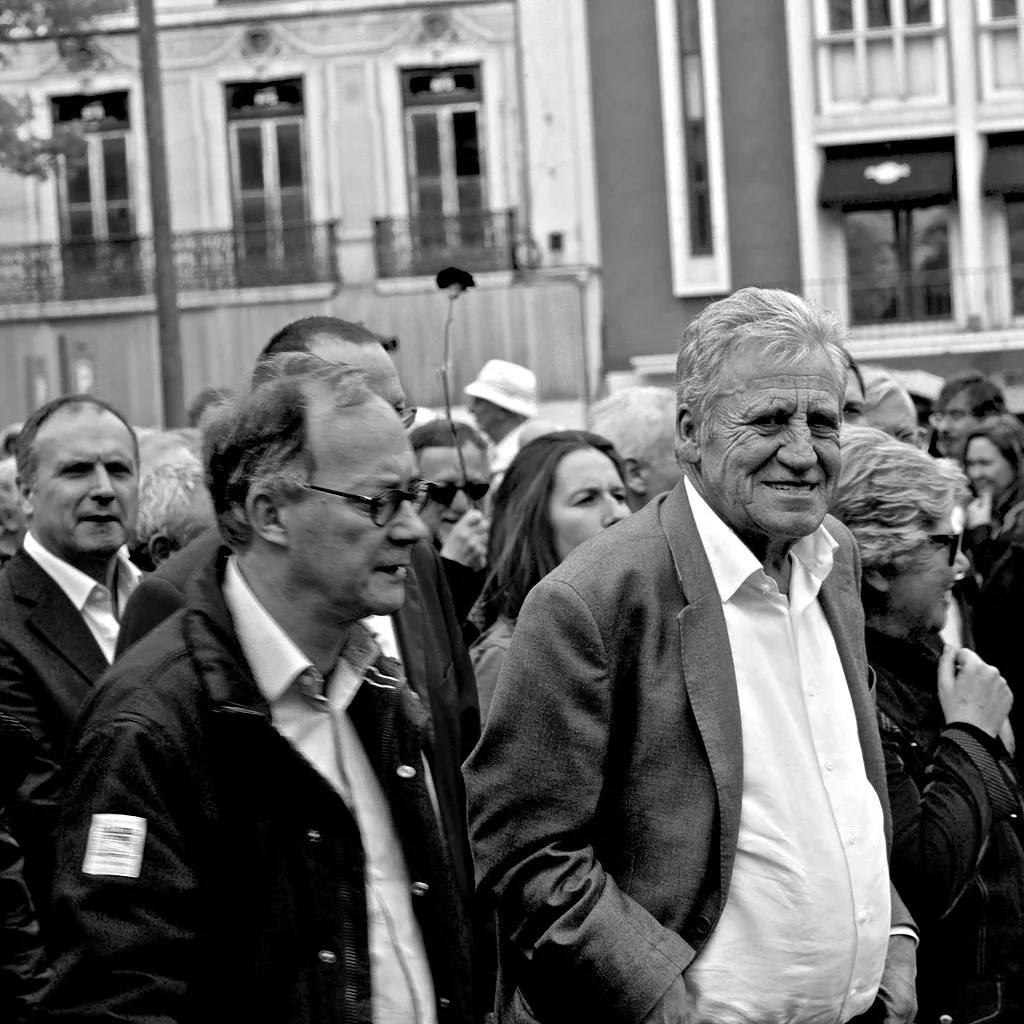
- pcp-25-abril.webp — Portuguese Communist Party demonstration after the Carnation Revolution, April 25. Source: Wikimedia Commons.
See Also
- Carnation Revolution—culmination of struggle for democracy
- Canning Industry—economic base of labor movement
- Estado Novo and Setúbal—period of suppression and underground
- Municipal Governance of Setúbal—city political system
- Michel Giacometti Museum of Labor—guardian of working memory
If this article was useful — help us write the next one.
☕ Support on Ko-fi