Retornados — Returnees from Africa
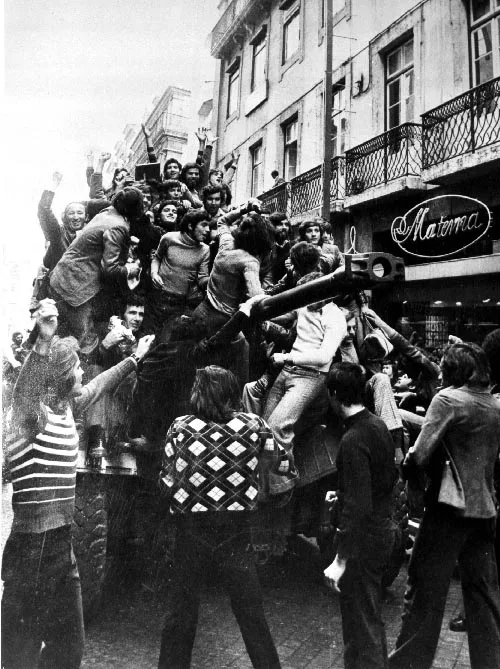
📷 Image credit
Photo: Unknown / Wikimedia Commons / CC BY 4.0
The retornados (“returnees”) were between half a million and one million Portuguese citizens who returned from the African colonies following the Carnation Revolution of 1974 and decolonisation. The Setúbal district was one of the three main reception centres for retornados, alongside Lisbon and Porto.
Scale and timeline
Overall figures
In 1975 Portugal’s population stood at approximately 9 million. The influx of retornados increased it by roughly 5%. The vast majority were white settlers from Angola and Mozambique, with smaller numbers from Guinea-Bissau, Cape Verde and São Tomé and Príncipe.
Timeline
| Period | Event |
|---|---|
| 25 April 1974 | Carnation Revolution – start of decolonisation |
| May–June 1974 | First wave (small) |
| Summer 1975 | Mass exodus: over 300,000 from Angola alone |
| June 1975 | In Vale da Amoreira (Setúbal district), retornados occupy unfinished housing |
| 1976 | Continued arrivals; gradual stabilisation |
| Late 1970s | Final waves |
Figures for the Lisbon and Setúbal districts
| Date | Retornados registered |
|---|---|
| 31 December 1975 | 10,701 |
| June 1976 | 30,255 |
| 30 December 1978 | 40,956 |
Over 50% of all retornados settled in three districts – Lisbon, Porto and Setúbal.
Settlement in the Setúbal area
Vale da Amoreira
A neighbourhood in the municipality of Moita (Setúbal district). In June 1975, lorries carrying soldiers and retornados from Angola, Guinea-Bissau, Cape Verde and Mozambique arrived here and occupied unfinished houses – many lacking basic habitable conditions. The area has retained its multicultural identity ever since: 33% Cape Verdean, 23% Angolan, 22% Guinean, 7% Mozambican, 8% São Toméan (later data).
Casal das Figueiras
A neighbourhood in Setúbal where a SAAL housing project was built to a design by architect Gonçalo de Sousa Byrne: 420 dwellings, construction begun in October 1976. [UNVERIFIED] A direct link between this project and the settlement of retornados has not been documented – the SAAL programme worked with local low-income communities.
IARN – the Institute for Returnee Assistance
The Instituto de Apoio ao Retorno de Nacionais (IARN) was the state body responsible for integrating retornados:
| Fact | Details |
|---|---|
| Created | 31 March 1975 (Decreto-Lei 169/75) |
| Predecessor | GADU (June 1974) – overwhelmed by the influx |
| Dissolved | 2 May 1981 (Decreto-Lei 97/81) |
| Headquarters | Lisbon |
| Delegations | Faro, Funchal, Porto, Vila Real, Viseu |
The institute funded accommodation (full board in hotels, guesthouses and public buildings), transport for people and luggage, legal assistance, family subsidies and study grants.
[UNVERIFIED] No IARN delegation in Setúbal itself has been confirmed – the district may have been served from the Lisbon office.
Economic impact
The influx of retornados expanded Portugal’s civilian labour force by 15% over 1974–1976. Scholars disagree on the consequences: some argue that the effect on wages and employment was modest; others point to a decline in average labour productivity. In 1975, at the peak of revolutionary turbulence, per-capita GDP fell to 52.3% of the EC-12 average.
At the same time, retornados brought skills and enterprise: doctors, teachers, engineers, business owners. Many started businesses in trade, services and the restaurant industry. Researchers note that the retornados often had higher levels of education than the national average.
Cultural impact
Music
Retornados and the African diaspora introduced new musical genres to Portugal:
- Semba – an Angolan genre popular since the 1950s
- Kizomba – developed in the 1980s from semba
- Luso-Afro beats – a contemporary movement blending Portuguese and African rhythms
Notable musicians include Bonga (José Adelino Barceló de Carvalho, b. 1942), an Angolan singer who moved to Lisbon after 1975.
Cuisine
Paradoxically, despite 500 years of colonial ties, African cuisine did not achieve mass popularity in Portugal. Of the entire heritage, piri-piri chicken and samosas are the items that entered the mainstream. Dozens of African restaurants (Angolan, Mozambican, Cape Verdean) operate in Lisbon; the African culinary scene in Setúbal is less documented.
Literary reflections
The retornados experience has been explored in contemporary Portuguese literature:
- Dulce Maria Cardoso (b. 1964) – grew up in Luanda, returned to Portugal in 1975. Her novel “O Retorno” (2011) tells the story of a retornado family spending a year in a Lisbon hotel, seen through the eyes of a teenager.
- Isabela Figueiredo (b. 1963, Lourenço Marques, Mozambique) – “Caderno de Memórias Coloniais” (2009), a raw account of the end of Portuguese colonialism. The French edition was a finalist for the Femina Foreign Prize.
Contemporary legacy
African communities remain a significant part of Portugal’s population. The 2011 census recorded over 160,000 Angolans and around 62,000 Cape Verdeans in the country. Most are concentrated in Lisbon, Porto and Setúbal.
Vale da Amoreira in the Setúbal district retains the multicultural character it acquired in the 1970s.
Key dates
| Year | Event |
|---|---|
| 1974 | Carnation Revolution; start of decolonisation and return |
| 1975 | IARN created; mass exodus from Angola and Mozambique; settlement of Vale da Amoreira |
| 1976 | Flow stabilises; SAAL construction begins in Setúbal |
| 1981 | IARN dissolved |
| 2011 | “O Retorno” by Dulce Maria Cardoso published |
See also
- The Carnation Revolution in Setúbal
- “Red City”: Political History
- Estado Novo and Setúbal
- SAAL Social Housing
- Modern Setúbal
All our knowledge is free. Creating it is not.
☕ Support on Ko-fi