River Transport on the Sado
📷 Image credit
Photo: Jules Verne Times Two / Wikimedia Commons / CC BY-SA 4.0
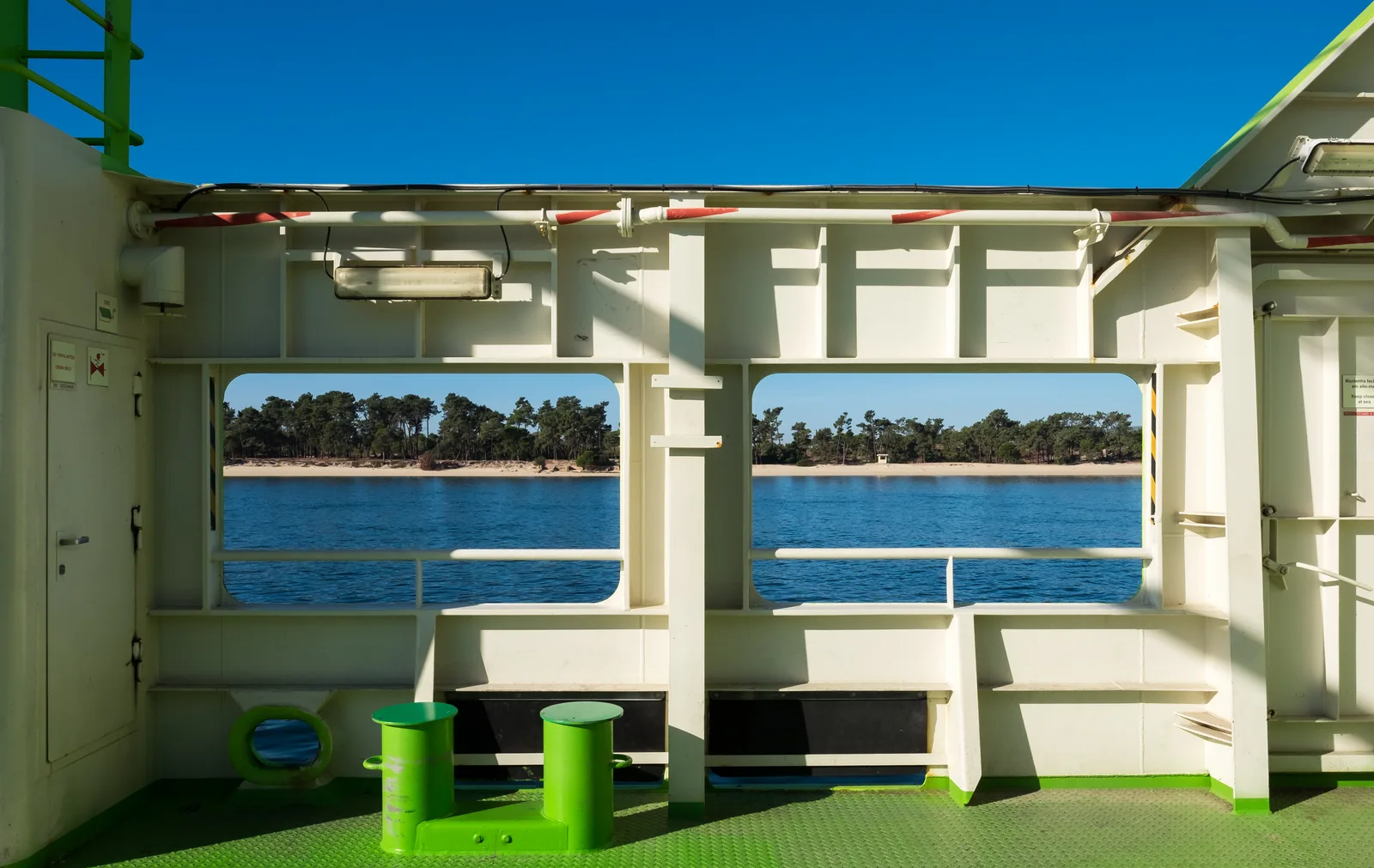
The Sado is the only major river in Portugal that flows from east to west. Its estuary between Setúbal and the Tróia Peninsula has served as a transport artery for millennia: from Roman ships laden with garum to the modern Atlantic Ferries fleet, which operates 16,000 crossings a year.
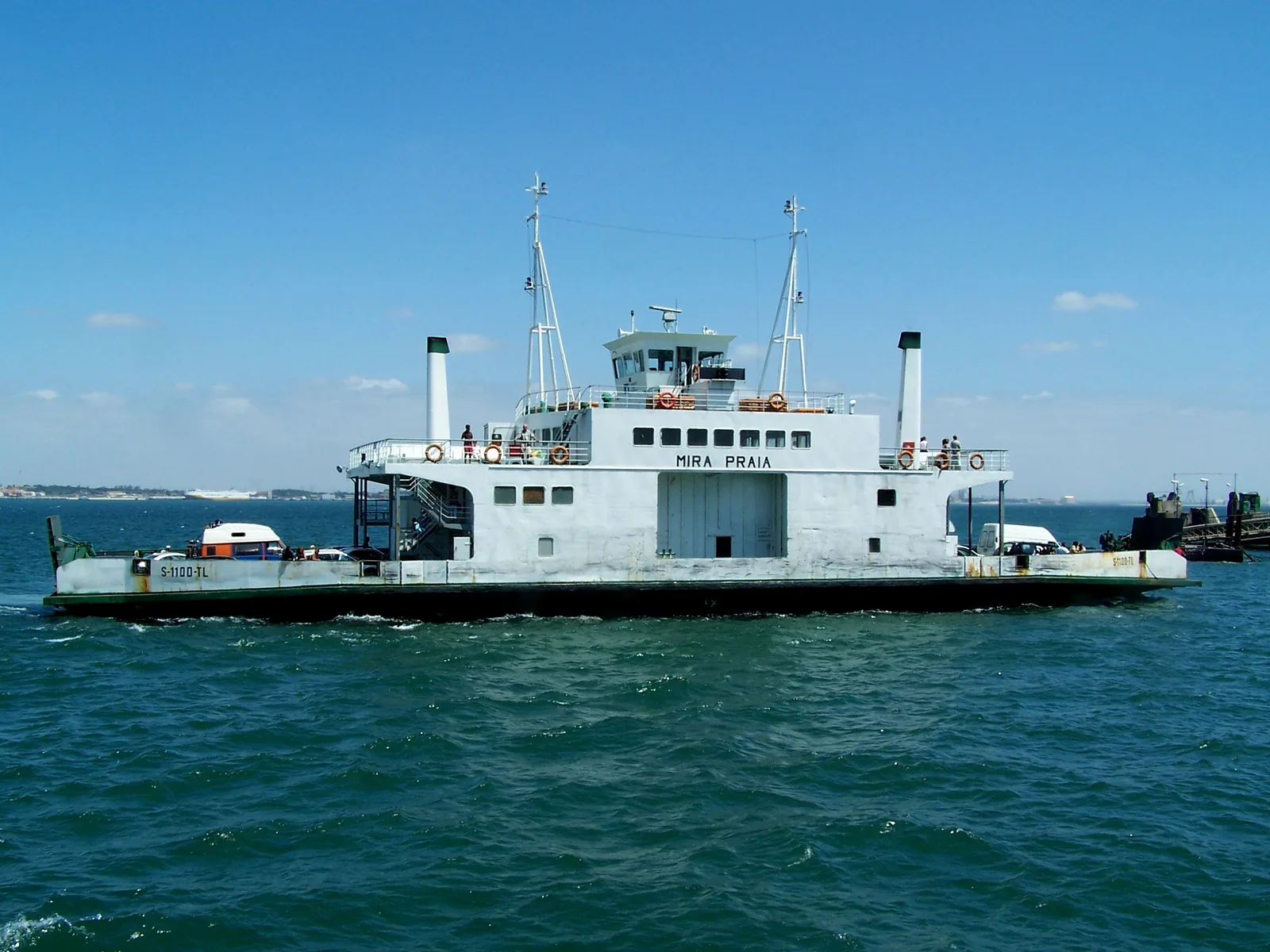
The Setúbal–Tróia ferry
The historic crossing
A ferry crossing of the Sado estuary existed long before the current service. The company Transado operated the route for over 30 years, ending on 7 October 2007. The concession was awarded by the Port Administration of Setúbal and Sesimbra (APSS) in 2005 for a period of 15 years.
Atlantic Ferries
Atlantic Ferries (part of the Sonae group) began operations in October 2007. All former Transado employees were transferred to the new company.
| Parameter | Value |
|---|---|
| Fleet | 2 ferries + 2 catamarans |
| Ferry capacity | up to 500 passengers + 60 vehicles |
| Catamaran capacity | up to 350 passengers |
| Crossings per year | ~16,000 |
| Crossing time | ~15 minutes |
| Operating hours | 24 hours |
| Punctuality | over 99% |
Fares (January 2025):
- Catamaran: €4.90 one way, €9.30 return
- Ferry with car (including driver): €21 one way
- Monthly pass: €99.30
The crossing provides key access to Tróia’s beaches and is an alternative to the ~130 km road detour via Alcácer do Sal.
Historical navigation
The Roman era
The Sado estuary was a major navigational centre with two key ports: Salacia (Alcácer do Sal) — an inland river port, and Caetobriga (Setúbal/Tróia) — a coastal port. The Tróia Peninsula housed one of the Roman Empire’s largest fish-salting and garum production centres: 25 workshops have been discovered (1st–6th centuries AD). Amphorae bearing Tróia maker’s marks have been found at Hadrian’s Wall (Britain), the Danubian frontier (Austria) and Volubilis (Morocco).
The Middle Ages and the Age of Discoveries
The Sado was used to transport wheat, olive oil and wine from the Alentejo interior. By the 14th century Setúbal was one of Portugal’s principal ports. King Afonso V sailed from the port of Setúbal in 1458 to conquer Alcácer-Ceguer (Morocco).
Alcácer do Sal literally means “Fortress of Salt” (Arabic al-Qasr). Salt has been harvested from the Sado marshes for over 2,000 years and exported to Northern Europe.
The Port of Setúbal
Modern operations
Administration: APSS (Administração do Porto de Setúbal e Sesimbra, S.A.).
| Indicator | Value |
|---|---|
| Cargo throughput 2024 | 6.5 million tonnes (+3.7% vs 2023) |
| Export share | ~60% |
| Containers | ~130,000–140,000 TEU/year |
| Ro-ro terminal | 155,000 m², ~300,000 vehicles/year |
Setúbal is Portugal’s leading port for ro-ro cargo handling, closely linked to the Volkswagen AutoEuropa plant in Palmela.
Terminals
- Sadoport (YILPORT, 100%) — containers and general cargo; 725 m berth, depth up to 15 m
- Tersado (YILPORT, 25%) — multipurpose terminal
- TGL (SAPEC) — liquid bulk
Tagus ferries (Transtejo / Soflusa)
History
In 1860, Frederico Burnay founded Vapores Lisbonenses — a fleet serving Cacilhas, Seixal and Montijo. On 17 December 1975, five private ferry companies were nationalised to form Transtejo. In 1993, Soflusa was spun off from Comboios de Portugal’s river operations (Barreiro–Lisbon route).
Routes
| Route | Crossing time |
|---|---|
| Cacilhas – Cais do Sodré | ~10 min |
| Seixal – Cais do Sodré | ~20 min |
| Barreiro – Terreiro do Paço | ~30 min |
| Montijo – Cais do Sodré | >30 min |
| Trafaria / Porto Brandão – Belém | ~20 min |
Annual passenger volume: approximately 19 million.
Fleet and electrification
Current fleet: 35 vessels (20 catamarans, 2 car ferries, 13 conventional ferries). Under the electrification programme, 10 electric ferry-catamarans have been ordered (544 passengers, 5–10 minute charging, 70-minute range). Total investment: over €96.6 million. The first vessel, Cegonha Branca, entered service in November 2023, but the programme has faced technical difficulties: by June 2025 only one of the six delivered vessels was fully operational.
Traditional boats of the Sado
Galeão do Sado
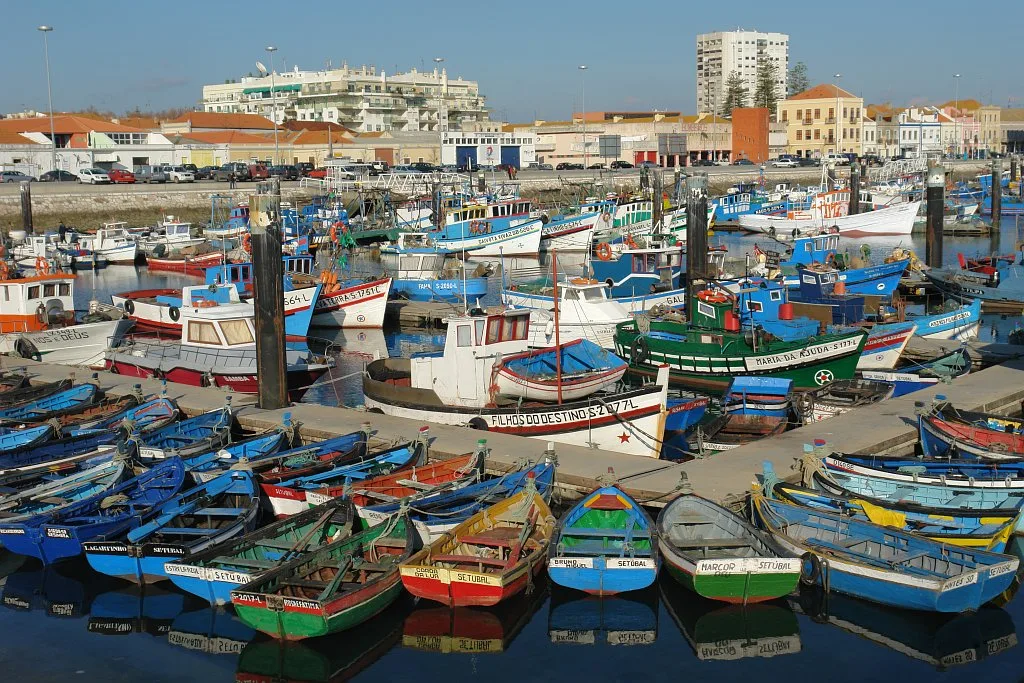
A cargo vessel of ~20 metres used to transport salt and goods. The surviving Pinto Luísa (1925, master builder Artur Santos) — 18.84 m long, capacity 50 people — was originally a salt carrier and converted to a pleasure craft in 1985. Today it is used for tourist cruises on the Sado from Alcácer do Sal.
Aiola
A traditional boat from Sesimbra, first designed in 1928 by Francisco Dias. Length 3.5–4.5 m, light, compact and stable even in rough seas. Used for artisanal fishing and as a support vessel for the beach seine (arte xávega).
Other types
- Canoa do Sado — a sailing boat for carrying people and cargo
- Bateira — a flat-bottomed boat with characteristic “two bows”
- Caíque — a vessel for deep-sea hook-and-line fishing
The Casa da Baía (Setúbal) houses an exhibition by Júlio Figueiras, a carpenter and fisherman who built accurate models of traditional Sado boats.
Pleasure and tourist boats
Dolphin watching
The Sado estuary is home to a resident population of bottlenose dolphins (Tursiops truncatus) — one of only three resident dolphin populations in European estuaries. Current numbers: approximately 25–27 individuals. In 2023, 6 calves were born — a record in 40 years of monitoring. The population is considered vulnerable.
Over 11 operators offer tours lasting 2–3 hours. Probability of seeing dolphins: ~95%. Prices (2025): €35–40 (adults).
Coastal tours along the Arrábida
Routes along the Arrábida Natural Park coastline include hidden caves, beaches (Praia de Galapinhos, Praia dos Coelhos), snorkelling and kayaking. The largest operator is Arrábida Sea Ventures (ASV): over 40 boats, 50 skippers.
📷 Image credit
Photo: Filipe Rocha (Sacavem1) / Wikimedia Commons / CC BY-SA 3.0
📷 Image credit
Photo: OsvaldoGago / Wikimedia Commons / CC BY-SA 3.0
See also
- The Sado Estuary
- The Roman City of Cetóbriga
- The Age of Discoveries
- Volkswagen AutoEuropa
- Arrábida Natural Park
If this article was useful — help us write the next one.
☕ Support on Ko-fi