The Salt Trade of Setubal
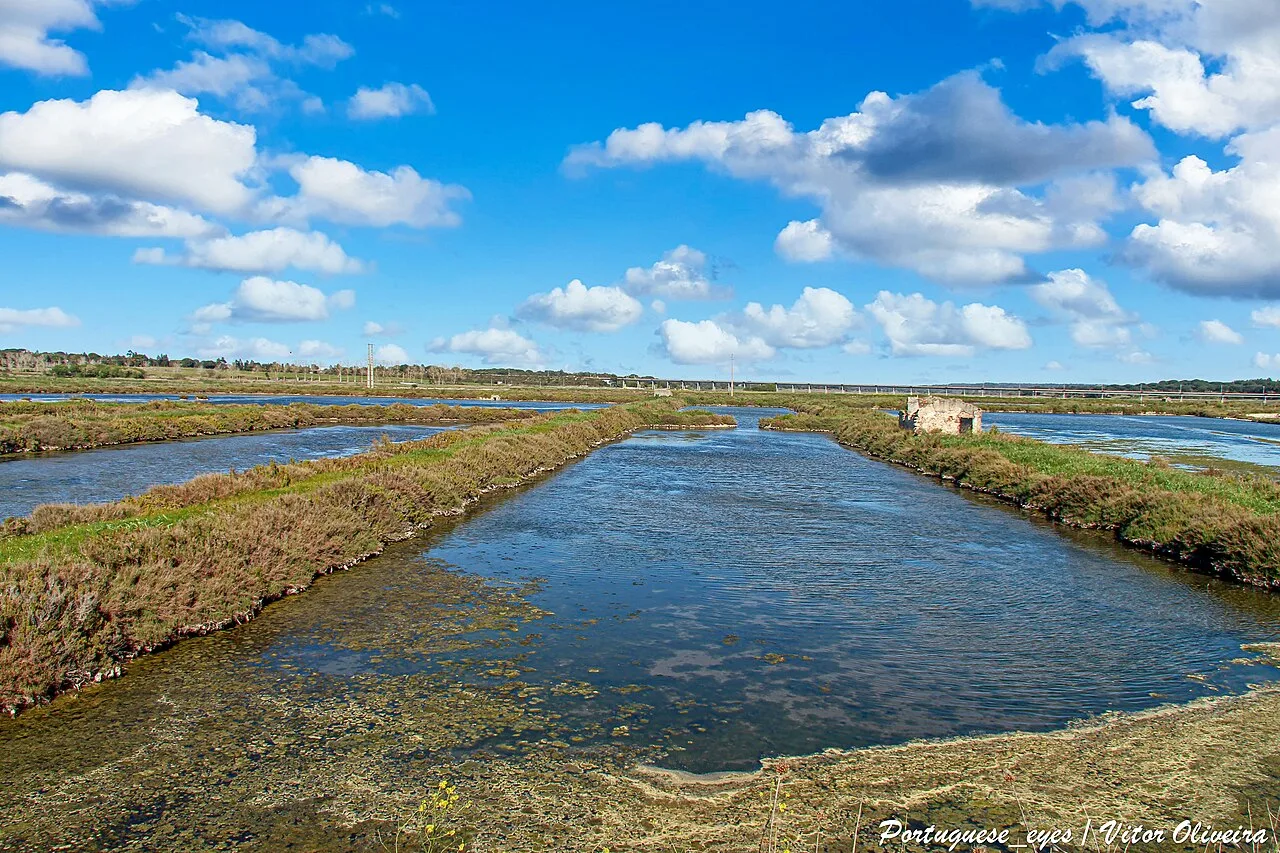
Salt – the “white gold” of the Middle Ages – was the foundation of Setubal’s economy for nearly two millennia. The salt pans (salinas) on the shores of the Sado estuary supplied salt to fish-curing enterprises as early as the Roman era, and by the medieval period they had become the source of one of Portugal’s principal exports. Salt from the Bay of Setubal, known across Europe under the name “St. Ubes bay salt,” was shipped to Flanders, England, the Baltic states, and even as far as Australia.
Origins: Salt before the Romans
Prehistoric Extraction
Archaeological research indicates that salt extraction on the territory of modern Portugal began as early as the 4th–3rd millennia BC. The Atlantic coastline and the estuaries of major rivers, including the Sado, provided natural conditions for evaporative production: shallow waters, hot summers, and regular tides that carried salt water deep into the estuary.
[UNVERIFIED] The precise date when salt extraction began directly on the banks of the Sado in the pre-Roman period has not been established. However, the existence of a developed fish-salting industry at Cetobriga from the 1st century AD suggests that the local salt pans were already being actively exploited by that time.
The Roman Era: Salt and Garum
Cetobriga as a Processing Centre
During the period of Roman rule, Cetobriga – the predecessor of Setubal – became one of the largest fish-salting production centres on the Iberian Peninsula. The complex on the Troia Peninsula comprised 182 salting vats in which the famous garum was produced – a fermented fish sauce prized throughout the Roman Empire.
The operation of this vast enterprise required enormous quantities of salt. The salinas on the shores of the Sado estuary ensured a continuous supply, and it was precisely this combination of “salt + fish + port” that determined the economic destiny of the region for the following two millennia.
Trade Routes
Roman Cetobriga was connected by roads to the key centres of Lusitania, including Lisbon (Olisipo), and served as a hub for maritime trade in both the Atlantic and the Mediterranean. Amphorae containing garum from Setubal have been found on the territory of modern Britain – as far north as Hadrian’s Wall.
The Middle Ages: Salt for Export
The Salinas of the Sado
After the Reconquista and the stabilisation of Christian authority in the region (12th–13th centuries), the salt works on the Sado received a new impetus. Traditional Portuguese salt pans (salinas) consist of systems of shallow basins in which seawater, introduced by the tides, gradually evaporates under the action of the sun and wind.
Portuguese salinas are divided into four regional types by method of operation: Algarvian, Sadoan, Tagian, and Figueira da Foz / Aveiro. The Sado type is among the oldest and most productive.
The town of Alcacer do Sal (Alcacer do Sal), situated further upstream on the Sado, carries in its very name a testament to the centuries-old role of salt in the region’s economy: “Sal” in its name means simply “salt.”
Northern Europe as a Market
In the late Middle Ages (14th–15th centuries), the fishing fleets of Northern Europe – Flanders, England, the Hanseatic cities – faced a growing need for salt to cure their catch. Local sources (the salt works of Luneburg, the marsh salt of Brittany) could not meet demand, and Iberian sea salt became a critically important commodity.
[DISPUTED] The precise volume of medieval salt exports from Setubal to specific ports in Flanders and England is only fragmentarily documented. Nevertheless, the overall picture is beyond doubt: Iberian sea salt was the primary source for the Northern European fishing industry. The vessels that carried this salt formed the so-called “salt fleets”.
“St. Ubes” – Setubal’s International Name
In English and Dutch trade documents, Setubal appeared under the phonetic transcription “St. Ubes” or “St. Ybes”. This distortion reflects how foreign sailors and merchants perceived the name. Under the brand “St. Ubes bay salt”, salt from the Bay of Setubal became a recognised trade name throughout Europe – and beyond.
The Age of Discoveries
Salt as a Driver of Expansion
In the 15th–16th centuries, during the Age of Discoveries, salt and salted fish remained the backbone of Setubal’s exports. Salt was essential for:
- Provisioning maritime expeditions – salting preserved food for long voyages in ships’ holds
- Export trade – salt was exchanged for goods from Northern Europe (textiles, timber, metals)
- Fish processing – cod (bacalhau), cured with Portuguese salt, became a national product
The port of Setubal flourished: ships arrived from England, Holland, Flanders, and the Hanseatic cities to load salt and salted fish.
18th–19th Centuries: Competition and Decline
Market Redistribution
By the 18th century, the geography of salt production in Portugal had begun to shift. The salinas of Lisbon and Aveiro were expanding their capacity, while in the 19th century, salt extraction on the Sado declined noticeably.
By the late 19th and early 20th century, Lisbon had become the dominant centre of national and international salt production, displacing Setubal from the position it had held for centuries.
A Final Export Surge
Despite the general decline, salt from Setubal was exported far beyond the borders of Europe. In the 1830s, “St. Ubes bay salt” was shipped as far as Australia – evidence that the international trade network established in the Middle Ages continued to function.
Salt-Making: The Technology
How the Salinas Work
The traditional salinas of the Sado estuary consist of a complex of shallow basins arranged on flat stretches of shoreline:
- Intake canal – seawater enters the system with the rising tide
- Concentrators (concentradores) – the water passes through a series of basins, progressively increasing in salinity
- Crystallisers (cristalizadores) – in the shallowest basins, salt precipitates under the action of the sun
- Harvesting – the salt worker (marnoteiro) collects the salt crystals by hand using a wooden tool
On the surface of the crystallisers forms flor de sal (“flower of salt”) – a thin layer of crystals harvested separately. Flor de sal is considered the most prized product and is sold today as a gourmet seasoning.
Seasonality
The production season runs from May to September – the period of greatest solar intensity and minimal rainfall. The salt worker’s task depends entirely on the weather: rain can destroy a harvest, while wind accelerates evaporation.
Present-Day Status
The Salinas of the Sado Today
According to available data, a number of salinas on the banks of the Sado continue to operate in the early 21st century, although the scale of production is incomparable with historical levels. Some of these salinas fall within the nature reserve of the Sado estuary and are valued not only as production sites but also as ecosystems – the salt pans serve as nesting and feeding grounds for numerous bird species.
Artisanal Salt
In the 21st century, artisanal salt-making is experiencing a revival as part of the movement to preserve traditional crafts. Portuguese artisanal salt and flor de sal have become sought-after gastronomic products, prized for the ecological sustainability of their production and their distinctive flavour.
Historical Perspective
The salt trade of Setubal is a thread that connects the ages:
| Period | Role of Salt |
|---|
| 4th–3rd millennia BC | First evidence of salt extraction in Portugal | | 1st–5th centuries AD | Salt for the garum of Cetobriga; export across the Roman Empire | | 12th–15th centuries | Medieval export to Flanders, England, the Baltic | | 15th–16th centuries | Provisioning of maritime expeditions; export trade | | 17th–18th centuries | Competition with Lisbon and Aveiro | | 19th century | Decline, yet exports reaching as far as Australia | | 21st century | Artisanal revival; flor de sal |
The same river, the same shores. From the salting vats of Cetobriga to the salt convoys bound for Northern Europe and the gourmet flor de sal in 21st-century restaurants – the salt of the Sado remains part of Setubal’s identity.
Image sources
- salt-sado-estuary.webp — Salt works in the Sado River estuary. Author: Epinheiro. License: CC BY 3.0. Source
- salt-salinas-samouco.webp — Salt pans — similar operations on the Sado. Author: Carlos Luis M C da Cruz. License: CC BY-SA 4.0. Source
- salt-salinas-samouco-detail.webp — Salt works detail — salt crystallization. Author: Carlos Luis M C da Cruz. License: CC BY-SA 4.0. Source
See also
- Cetobriga – A Roman City
- Sado Estuary
- Setubal and the Age of Discoveries
- The Canning Industry
- Fishing Culture
- Reconquista and the Medieval Period
- Troia Peninsula
All our knowledge is free. Creating it is not.
☕ Support on Ko-fi