The Setnave Shipyards
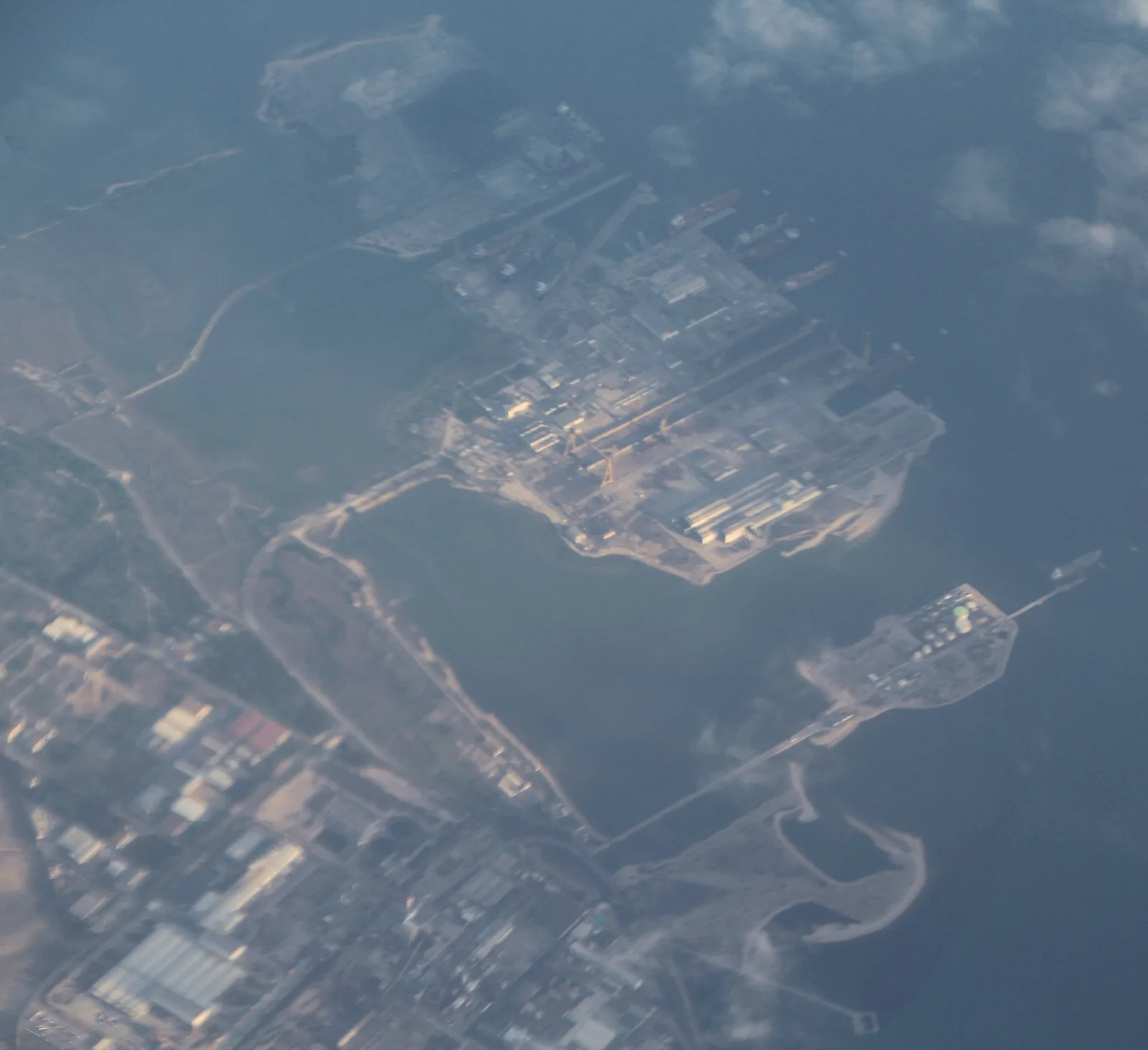
📷 Image credit
Photo: Bjoertvedt / Wikimedia Commons / CC BY-SA 4.0
On the Mitrena peninsula, in the waters of the Sado estuary, stand dry docks that were once a symbol of hope for an entire generation. The Setnave shipyards—the largest industrial enterprise in the history of Setúbal—traveled a path from a construction site of the dictatorship’s final years to a nationalized giant of the revolutionary era, and finally to a quiet decline in the years of privatization. The story of Setnave is the story of Portugal itself after April 25: radical dreams, harsh realities, and the price paid by workers.
Foundation and Construction
The Last Project of Estado Novo
Estaleiros Navais de Setúbal, SARL (Setnave) was established on May 27, 1971—in the final years of Estado Novo, when the Caetano regime was attempting to modernize the Portuguese economy. The shipyards were located on the Mitrena peninsula, on the southern shore of the Sado estuary—a strategic site with deep-water access, ideal for shipbuilding.
Construction of the shipyards was part of a large-scale program of industrialization in Setúbal during the 1960s–1970s, which also included Ford and British Leyland automobile plants. This new wave of industry transformed the city, attracting thousands of workers and reinforcing its proletarian character.
Inauguration in Revolutionary Days
The chronology of Setnave is intertwined with the chronology of the Carnation Revolution:
- May 27, 1971—legal establishment of the company
- April 25, 1974—the Carnation Revolution; the shipyards are still under construction
- May 27, 1974—the first workers’ commission (Comissão de Trabalhadores da Setenave, CTS) is elected, exactly three years after the company’s founding
- August 6, 1974—official inauguration of the shipyards, already within the revolutionary process
Thus Setnave—an enterprise conceived under dictatorship—was born and began operating in a free Portugal.
The Revolutionary Period (1974–1975)
The Workers’ Commission
The Comissão de Trabalhadores da Setenave (CTS)—the workers’ commission elected on May 27, 1974—became one of the most radical organs of workers’ self-management in revolutionary Portugal.
The first commission held moderate positions, but the second and third commissions adopted a sharply anti-capitalist orientation. They advocated for:
- Full workers’ control over the enterprise
- Nationalization of the entire shipbuilding industry
- Social guarantees for workers—housing, healthcare, education
- Democratic management—all key decisions made by general workers’ assembly
The First Ship
On June 16, 1975, the first vessel was launched from the Setnave slipways—the “Montemuro.” This event became a symbol that workers could not only fight for their rights but also build ships. The launch of “Montemuro” occurred at the height of the revolutionary process (PREC—Processo Revolucionário Em Curso), when Portugal’s future was utterly uncertain.
Nationalization
On September 1, 1975, the Vasco Gonçalves government nationalized Setnave by Decreto-Lei 478/75. The nationalization was part of a massive wave of property socialization during the “hot summer” of 1975, when the revolutionary process reached its zenith.
For the workers of Setnave, nationalization was a victory: the enterprise passed into state ownership, and the workers’ commission gained real influence over management. For critics, it was the beginning of economic problems that would ultimately lead to the enterprise’s decline.
Peak and Crisis
Peak Employment
The Setnave workforce grew rapidly:
| Year | Workers | Note |
|---|---|---|
| 1971 | — | Company established |
| 1974 | 2,414 | Year of inauguration |
| 1979 | 6,253 | Peak employment |
| 1987 | ~4,200 | Mass layoffs begin |
| 1988 | ~2,900 | Accelerated decline |
| 1998 | ~700 | Before Lisnave absorption |
The peak of 6,253 workers was reached in 1979—after the stabilization of the revolutionary process. Setnave became the largest employer in the region, and the lives of thousands of Setúbal families depended on the shipyards.
The Beginning of Decline
Setnave’s decline was determined by several factors:
- Global shipbuilding crisis—from the late 1970s, demand for new vessels fell sharply due to the oil crisis and a surplus of world tonnage
- Competition from Asian shipyards (South Korea, Japan) with radically lower costs
- Management problems—conflicts between the workers’ commission, management, and the state complicated strategic decision-making
- Technological lag—investment in modernization was insufficient
- Political instability—frequent changes of government in Portugal prevented the development of long-term industrial policy
The Human Cost
The layoff figures over ten years paint a picture of social catastrophe:
- 1980–1987—approximately 2,000 workers departed
- 1988—another 1,300 layoffs in a single year
- By 1998—only 700 people remained at the shipyards out of what had once been over six thousand
Each figure represents a family that lost its source of income. For working-class Setúbal, where Setnave was the principal employer, mass layoffs meant not merely unemployment but the destruction of an entire way of life.
Privatization and End
From Setnave to Lisnave
The privatization process stretched over a decade:
- 1989—management concession transferred to Solisnor
- 1997—protocol signed with Grupo Mello (owners of Lisnave) for restructuring
- 2000—Setnave definitively absorbed by Lisnave, ceasing to exist as an independent enterprise
Privatization completed a process that had begun with the dream of workers’ self-management and ended with corporate absorption. For many Setnave veterans, this was a betrayal of the Revolution’s ideals.
Lisnave Today
Today Lisnave continues to operate on the Mitrena peninsula, but the scale of activity is incomparable with the Setnave era:
- Territory: 1,500,000 m²
- Infrastructure: 6 dry docks, 9 repair berths
- Specialization: exclusively ship repair—construction of new vessels has ceased
- Employment: significantly fewer than the 6,253 workers of the peak period
Lisnave remains an important enterprise for Setúbal’s economy but no longer defines the city’s life as Setnave did in the 1970s–1980s.
Monument and Memory
The Monument to April 25
One of the most significant symbols of Setnave’s working-class heritage is the Monument to April 25 (Monumento ao 25 de Abril) in Setúbal. This monument was created by the shipyard workers themselves: approximately 3,000 hours of voluntary labor were invested in its construction.
The monument is not only a tribute to the Carnation Revolution but also testimony to the spirit of collectivism and solidarity that defined life at Setnave in its best years. Workers who built ships also built a monument to their freedom—with their own hands, in their own time.
Scholarly Study
The history of the labor movement at Setnave has been studied in the dissertation of Jorge Fontes—“História do movimento operário na Setenave (1974–1989),” defended at the University of Lisbon. This research documents not only facts but also the voices of the workers themselves—their hopes, disappointments, and assessments of what they lived through.
Setnave in the Context of Setúbal
The Third Wave of Industrialization
Setnave represented the third wave of industrialization in Setúbal:
- 19th–early 20th century—the canning industry: sardines, women workers, 400 factories
- 1960s—automobile plants (Ford, British Leyland)
- 1970s–1990s—Setnave: shipbuilding, 6,253 workers, nationalization
Each wave shaped Setúbal’s working class, reinforced its political tradition, and determined the city’s fate. And each wave ended in crisis and deindustrialization—a pattern that has become part of Setúbal’s modern history.
Key Dates
| Date | Event |
|---|---|
| May 27, 1971 | Establishment of Estaleiros Navais de Setúbal (Setnave) |
| April 25, 1974 | The Carnation Revolution |
| May 27, 1974 | First workers’ commission (CTS) elected |
| August 6, 1974 | Official inauguration of the shipyards |
| June 16, 1975 | Launch of first vessel “Montemuro” |
| September 1, 1975 | Nationalization (Decreto-Lei 478/75) |
| 1979 | Peak employment: 6,253 workers |
| 1989 | Solisnor concession |
| 1997 | Protocol with Grupo Mello |
| 2000 | Absorption by Lisnave |
See Also
- Estado Novo and Setúbal—the regime under which the shipyards were conceived
- Modern Setúbal—deindustrialization and transformation
- “Red City”: Political History of Setúbal—political context of the labor movement
- Carnation Revolution—the revolution that determined Setnave’s fate
- The Canning Industry—the preceding wave of industrialization
If this article was useful — help us write the next one.
☕ Support on Ko-fi