Underwater Archaeology of Tróia
On the floor of the Sado estuary and in the coastal waters of the Tróia Peninsula lie traces of two millennia of maritime life: Roman amphoras, remains of fish-salting factories, sunken vessels from different epochs. The underwater archaeology of Tróia complements the picture provided by the terrestrial ruins – one of the largest industrial fish-processing complexes of the Roman Empire.
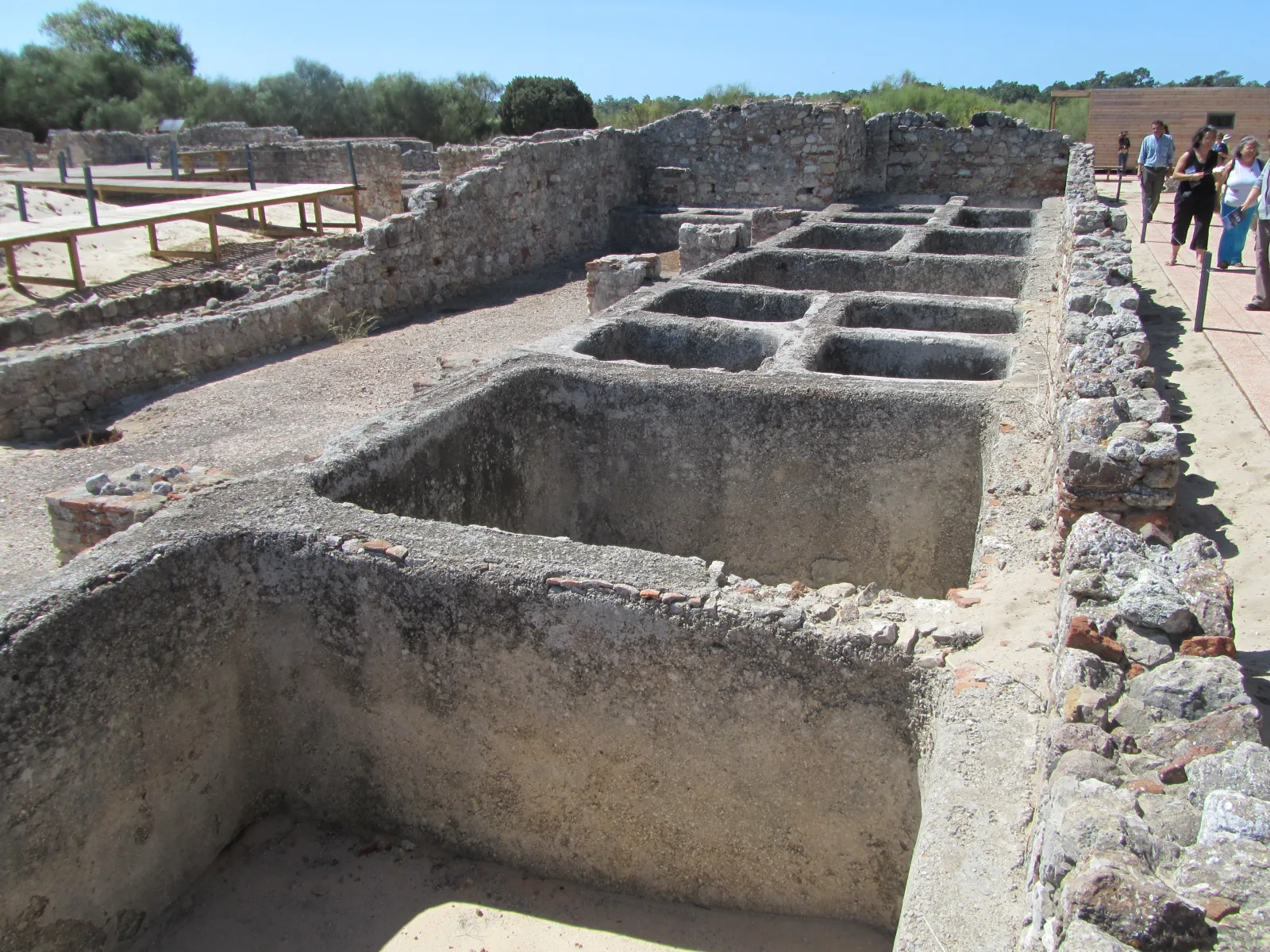
The Roman complex at Tróia
Scale of production
The Roman ruins of Tróia represent the largest known complex of fish-salting factories (cetariae) in the Roman Empire. During its peak (1st–5th centuries AD), garum was produced here – a fermented fish sauce that was one of the most valuable commodities in Roman trade.
The complex included:
- Salting tanks (cetariae) – approximately 182 stone vats across 25+ workshops for preparing garum and salting fish
- Warehouses for amphoras and finished products
- Residential quarters – baths, mosaics, a necropolis
- A quay for loading onto trading vessels
The products were exported throughout the Mediterranean, primarily to Rome.
Connection to Cetobriga
On the opposite bank of the estuary stood Cetobriga – a Roman city that probably served as the administrative centre for the Tróia industrial complex. The name “Cetobriga” may derive from Celtic ceto-briga (“fortress on the water”), underlining the settlement’s bond with the sea.
Underwater finds
Amphoras
The Sado estuary and the coastal waters of Tróia are a rich source of archaeological finds. Among the most significant:
- Dressel 14 amphoras – the standard container for transporting garum and salted fish, mass-produced on the peninsula. Fragments and complete specimens have been discovered both on land and on the seabed
- Almagro 51c amphoras – a later type (3rd–5th centuries), used for exporting fish products in the late Roman period
- Ballast stones and anchor stones from trading vessels
[UNVERIFIED] The precise number of underwater finds and their systematic cataloguing require consultation of DGPC (Direção-Geral do Património Cultural) databases.
Shipwrecks
In the waters of the Sado estuary and the coastal zone between Tróia and Setúbal, remains of vessels from different periods have been discovered. The sandy bottom and relatively calm waters of the estuary have aided the preservation of wooden structures.
[UNVERIFIED] Detailed information on specific shipwrecks in the Tróia zone has not been found in open sources. Data may be available through the Centro Nacional de Arqueologia Náutica e Subaquática (CNANS).
Research methods
Portuguese underwater archaeology
Underwater archaeology in Portugal is managed by CNANS – the National Centre for Nautical and Underwater Archaeology, part of the DGPC. The centre coordinates:
- Registration of underwater cultural heritage
- Licensing of underwater archaeological work
- Creation of a national finds database
Specific conditions of the Tróia zone
The Sado estuary creates particular conditions for underwater archaeology:
- Low visibility – silty bottom and tidal currents limit visibility to a few metres
- Dynamic seabed – sand movement periodically exposes and re-covers artefacts
- Biological impact – marine organisms (particularly the shipworm Teredo navalis) destroy wooden structures
- Anaerobic preservation – objects buried in silty sediment can be preserved significantly better
Significance
The underwater archaeology of Tróia is important for several reasons:
- Complements terrestrial data – while the land-based ruins reveal garum production, underwater finds (amphoras, quay structures, vessels) document transport and trade
- The estuary’s oldest port – the finds confirm continuous navigation in the Sado estuary since the 1st century AD, connecting the Roman period with the modern port
- Trade connections – amphora typology allows the reconstruction of export routes (Rome, North Africa, Gaul)
Timeline
| Period | Event |
|---|---|
| 1st c. AD | Beginning of industrial garum production at Tróia |
| 1st–5th c. | Peak of the fish-salting complex |
| 3rd–5th c. | Transition to Almagro 51c amphoras |
| 5th–6th c. | Decline and abandonment of the complex |
| 1850s | First archaeological descriptions of the Tróia ruins |
| 1956–1962 | Systematic excavations |
| 1970s–1990s | Development of underwater archaeology in Portugal |
| 2006+ | Modern research (Tróia Resort project) and conservation of the complex |
See also
Image sources
- cetariae-troia-roman-ruins.webp — Roman fish-salting tanks (cetariae) on the Tróia Peninsula. Author: Semsjp. License: Public Domain. Source
All our knowledge is free. Creating it is not.
☕ Support on Ko-fi