Cabo Espichel Dinosaur Tracks
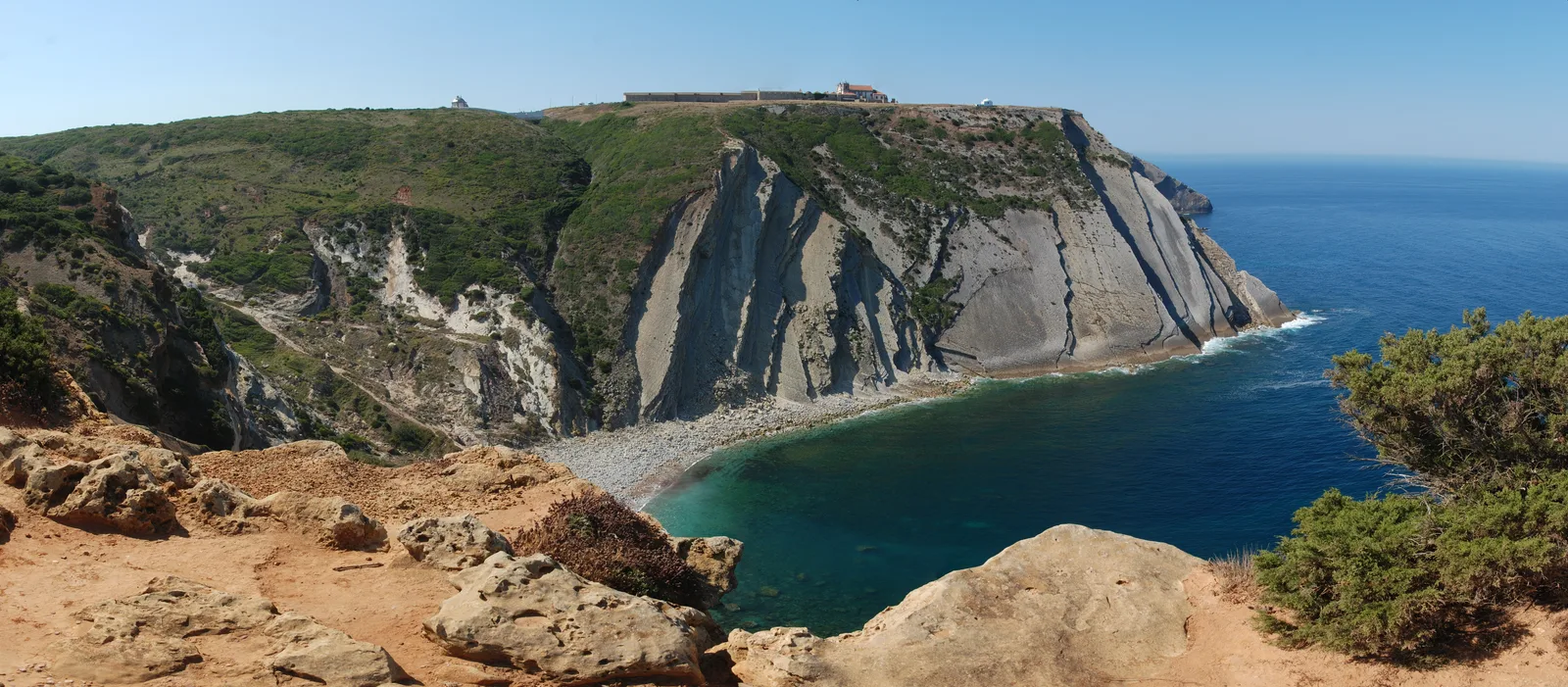
📷 Image credit
Photo: Arseniop / Wikimedia Commons / CC BY-SA 4.0
The coastal cliffs around Cabo Espichel (Sesimbra municipality) preserve hundreds of dinosaur tracks from two geological ages – the Late Jurassic (~160 million years ago) and the Early Cretaceous (~130 million years ago). The complex is one of the most important palaeoichnological sites in Western Europe.
Main sites
Pedra da Mua
| Parameter | Value |
|---|---|
| Age | Late Jurassic (~160 Ma) |
| Track levels | At least 8 |
| Sauropod trackways | 38 |
| Theropod trackways | 2 |
| Estimated individuals | ~37 |
| Location | Coastal cliff south of the cape |
Pedra da Mua is the main palaeontological site. The tracks belong predominantly to sauropods – giant quadrupedal herbivores whose rounded footprints reach 80 cm in diameter. Two three-toed trackways were left by theropods – bipedal predatory dinosaurs.
For centuries, local people interpreted the prints as “footprints of the Virgin’s mule” (pegadas da mula da Nossa Senhora), giving rise to the legend that underlies the pilgrimage sanctuary.
Lagosteiros
| Parameter | Value |
|---|---|
| Age | Early Cretaceous (~130 Ma, Barremian) |
| Track levels | 2 |
| Total tracks | 541 (as of 2021) |
| Dominant type | Herbivores (336 tracks) |
Lagosteiros is Portugal’s only known Cretaceous dinosaur tracksite. Three types of tracks have been identified:
- Sauropods – large rounded prints
- Ornithopods – three-toed herbivorous bipeds
- Theropods – three-toed predators
In 2021, over 600 new prints were discovered here.
Boca do Chapim and Areia do Mastro
Palaeontological sites on the coast 2 km north of the cape. In addition to tracks, skeletal remains of dinosaurs have been found in the Papo-Seco and Areia do Mastro formations:
- Megalosauridae, Baryonyx walkeri (predators)
- Iguanodon, ornithopods (herbivores)
- Pelorosaurus (sauropods)
- Crocodilians, turtles, pterosaurs
In 2016, a partially exposed dinosaur skull was found on Areia do Mastro beach.
Geological context
The tracks are preserved in limestone deposited on the floor of shallow lagoons during the Mesozoic Era. Dinosaurs walked across soft muddy beds, leaving impressions that were rapidly buried under sediment and lithified.
Two different ages reflect two periods:
- Late Jurassic (Pedra da Mua) – 160 Ma, when the area was part of extensive lagoons on the Iberian Peninsula
- Early Cretaceous (Lagosteiros) – 130 Ma, Areia do Mastro Formation
History of research
| Year | Event |
|---|---|
| 1884 | First scientific description by geologist Nery Delgado |
| 1950s–1970s | Systematic studies by Portuguese and French researchers |
| 2000s | Inclusion in conservation programmes; geopark designation |
| 2021 | Discovery of 600+ new prints at Lagosteiros beach |
| 2022 | Publication of Areia do Mastro tracksite data (ScienceDirect) |
Nery Delgado described the tracks before palaeoichnology had emerged as a formal discipline. His 1884 paper is one of the earliest scientific descriptions of dinosaur tracks in the world.
Conservation
The sites lie within the Arrábida Natural Park and are protected under palaeontological heritage legislation. Pedra da Mua is viewed from a clifftop lookout (descending to the rocks is dangerous). Lagosteiros is accessible from the beach.
Conservation challenges:
- Natural erosion (waves, wind) is gradually destroying the prints
- Tourist footfall
- Sesimbra municipality restricts access in the most fragile zones
Practical information
| Parameter | Value |
|---|---|
| Distance from Setúbal | ~40 km (via Azeitão or Sesimbra) |
| Best time | Low tide (for Lagosteiros); any time (Pedra da Mua – viewed from above) |
| Access | Free; car park at the Cabo Espichel sanctuary |
| Tips | Binoculars for viewing Pedra da Mua; sturdy footwear |
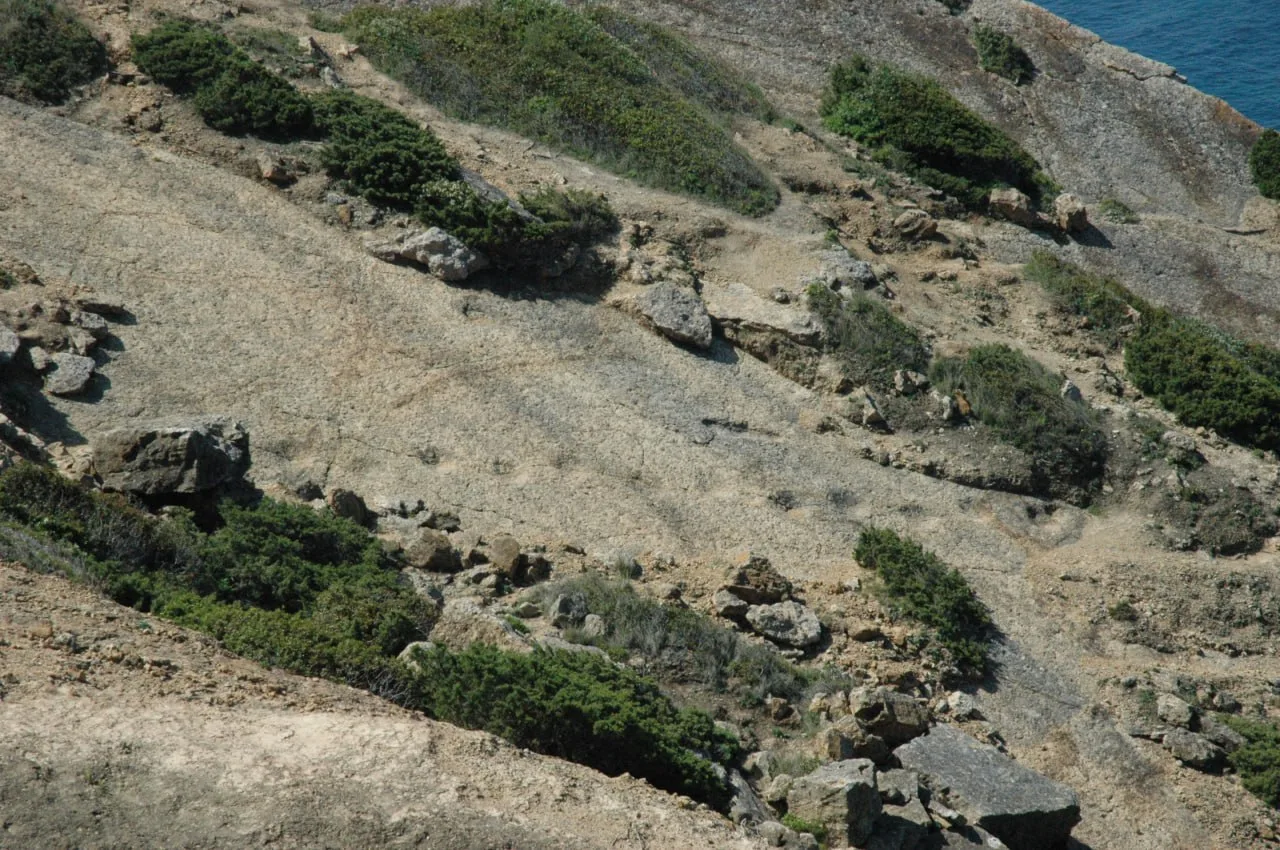
📷 Image credit
Photo: Britoca / Wikimedia Commons / CC0

📷 Image credit
Photo: The Cosmonaut / Wikimedia Commons / CC BY-SA 4.0
See also
All our knowledge is free. Creating it is not.
☕ Support on Ko-fi