Sado Estuary
The Sado Estuary (Estuario do Sado) is the second-largest estuary in Portugal, situated near the city of Setubal. The Sado Estuary Natural Reserve (Reserva Natural do Estuario do Sado), established in 1980, protects an extensive wetland system that provides habitat for over 200 bird species and for Portugal’s only resident population of bottlenose dolphins.
Geography
The Sado River
The Sado River (Rio Sado) rises in the Serra da Vigia (230 m) near the town of Ourique in the Alentejo region and flows northward for approximately 175–180 km before emptying into the Atlantic Ocean near Setubal. It is the only major river in Portugal that flows from south to north. The river lies entirely within Portuguese territory.
The estuary
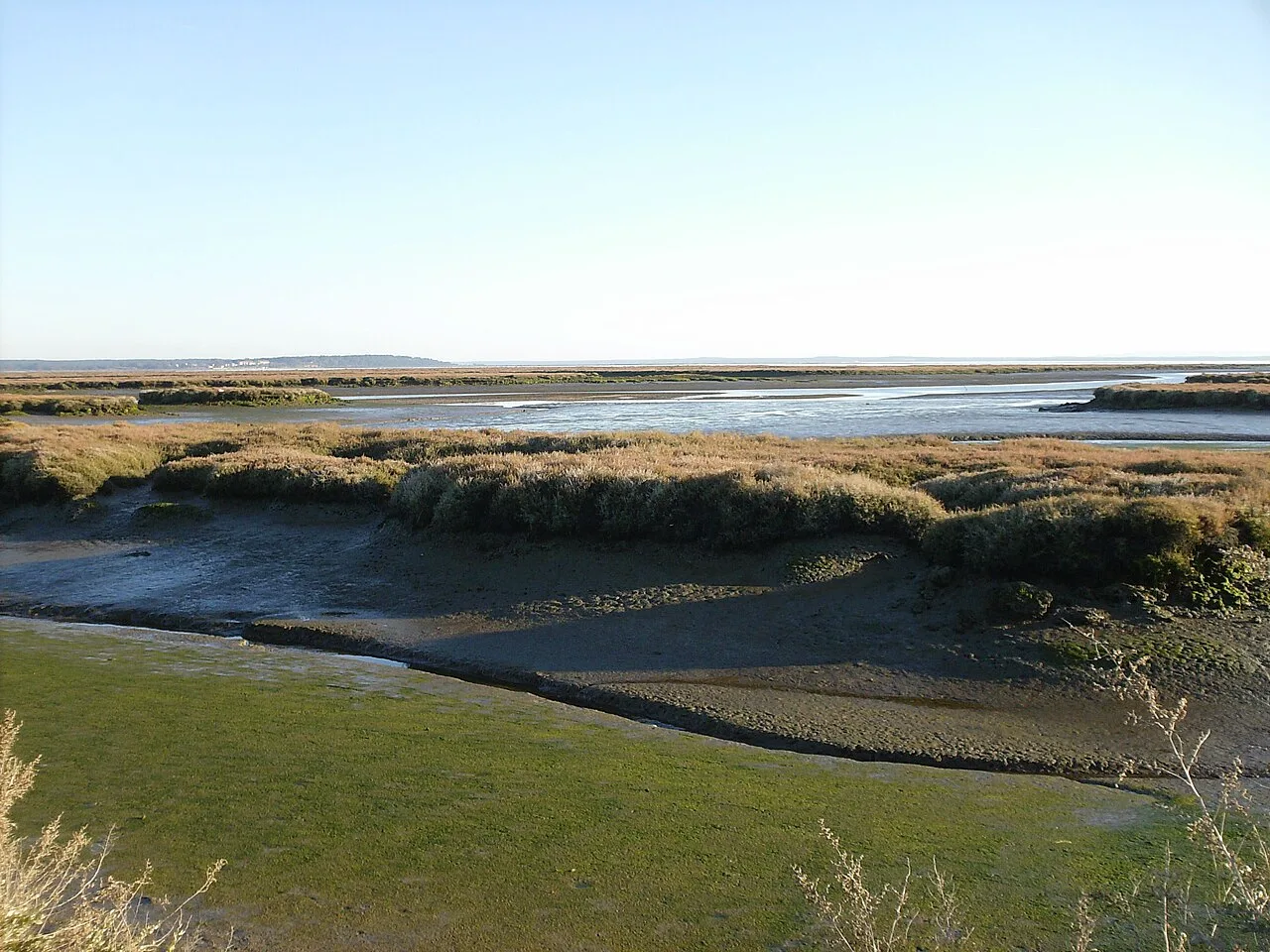
The estuary forms where the Sado meets the ocean and is separated from it by the sand spit of the Troia Peninsula. It is a broad lagoonal system of sandy and muddy flats exposed at low tide, extensive salt marshes and reedbeds.
Centre coordinates: approximately 38.47° N, 8.82° W.
The nature reserve
The Reserva Natural do Estuario do Sado was established on 1 October 1980. The reserve covers approximately 23,160 hectares (239.71 km2). Its territory takes in estuarine waters, floodplain land, dunes, and marine and river beaches within the municipalities of Alcacer do Sal, Grandola, Palmela and Setubal.
Ecosystem
Habitats
The Sado Estuary comprises a mosaic of interconnected ecosystems:
- Salt marshes – extensive areas of halophytic vegetation, flooded by the tides
- Mudflats – the principal feeding grounds for waders and other waterbirds
- Salt pans (salinas) – traditional saltworks that create additional bird habitats
- Rice paddies – flooded rice fields that broaden the range of available biotopes for birds
- Dunes and sandy beaches – along the coast and on the Troia Peninsula
- Reedbeds – areas of freshwater vegetation
Birdlife
The Sado Estuary is one of the most important ornithological sites in Portugal. More than 200 bird species have been recorded here. In winter, the estuary regularly hosts 20,000 or more waterbirds.
Most notable species:
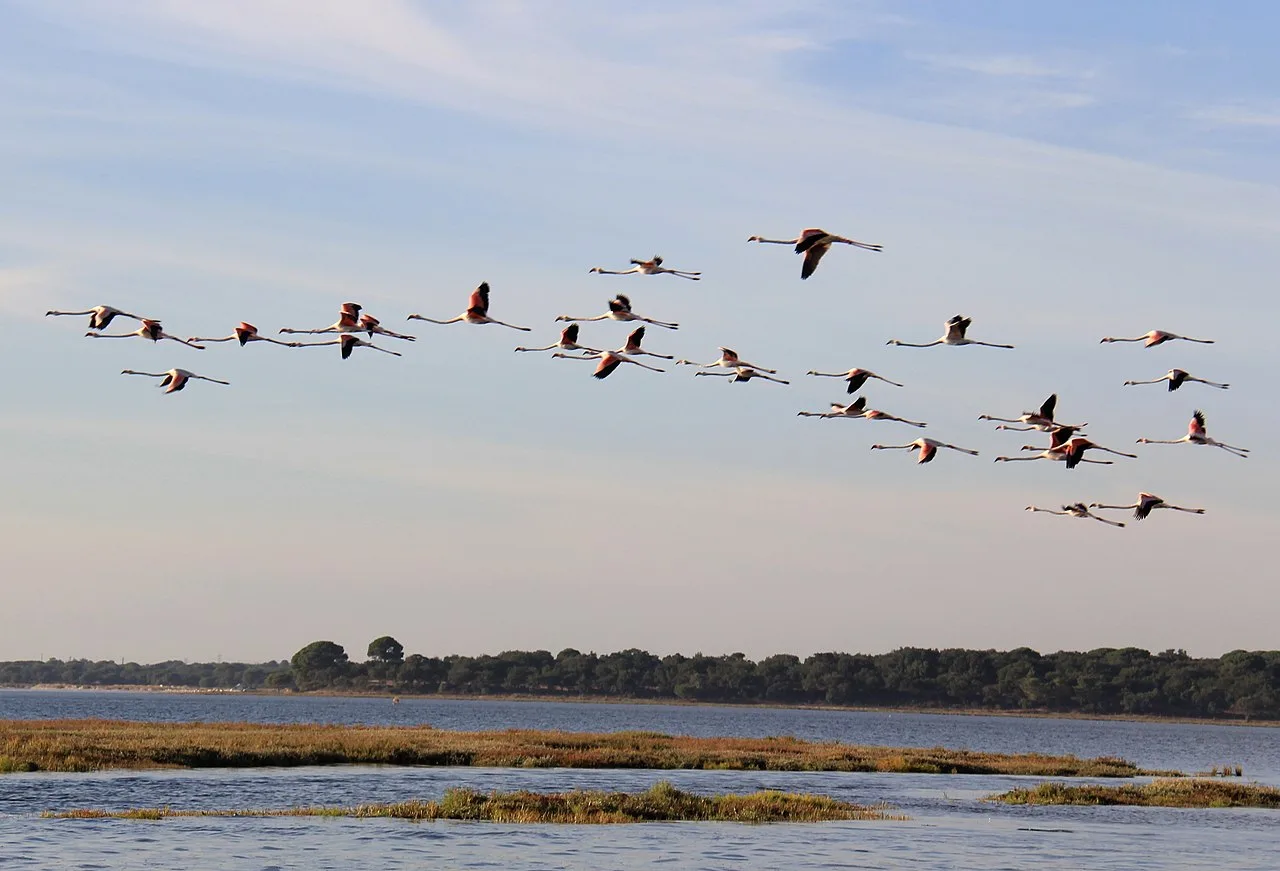
- Greater flamingo (Phoenicopterus roseus) – large flocks feed on the shallows
- White stork (Ciconia ciconia) – abundant nests on church bell towers and power-line pylons, particularly around Alcacer do Sal
- Eurasian spoonbill (Platalea leucorodia)
- Great egret (Ardea alba)
- Grey heron (Ardea cinerea)
- Glossy ibis (Plegadis falcinellus)
Waders and shorebirds:
- Black-winged stilt (Himantopus himantopus)
- Pied avocet (Recurvirostra avosetta)
- Common greenshank (Tringa nebularia)
- Common redshank (Tringa totanus)
- Common ringed plover (Charadrius hiaticula)
- Eurasian oystercatcher (Haematopus ostralegus)
- European golden plover (Pluvialis apricaria)
- Northern lapwing (Vanellus vanellus)
- Eurasian curlew (Numenius arquata)
- Whimbrel (Numenius phaeopus)
- Dunlin (Calidris alpina)
- Common snipe (Gallinago gallinago)
The winter period (November–February) is the best time for watching waterbirds.
Marine mammals
The estuary is home to a resident population of bottlenose dolphins (Tursiops truncatus) – see the dedicated article Sado Dolphins. This is the only such population in Portugal and one of the few resident estuarine dolphin populations in Europe.
Reptiles and amphibians
Various reptile species inhabit the estuary and its surroundings, including several species of lizard and snake. Some sources mention the presence of the Mediterranean chameleon (Chamaeleo chamaeleon) in the vicinity; however, the main populations of this species in Portugal are concentrated in the Algarve (Ria Formosa Natural Park).
Fish
The estuary serves as an important spawning and feeding ground for many fish species. Commercial fishing and aquaculture take place here, including oyster farming. The brackish waters of the estuary provide favourable conditions for European sea bass, flatfish and other commercially important species.
Conservation status
The Sado Estuary enjoys multiple layers of international and national protection:
- Portuguese Nature Reserve (Reserva Natural) – since 1980
- Ramsar Wetland – designated 8 May 1996, area 25,588 hectares (site No. 826)
- Important Bird Area (IBA) – under BirdLife International criteria, owing to the regular wintering presence of more than 20,000 waterbirds
- Special Protection Area (SPA) – within the Natura 2000 network
- Important Marine Mammal Area (IMMA) – due to the resident bottlenose dolphin population
More than 80% of the reserve falls within the Natura 2000 network.
Threats
Industrial pollution: The northern shore of the estuary is lined with the industrial belt of Setubal, including pulp and paper mills, pesticide and fertiliser plants, shipyards and a thermoelectric power station. These facilities discharge pollutants, including heavy metals. Historic exploitation of pyrite deposits in the Sado basin (until the 1960s) has led to the accumulation of metals in the sediment.
Port operations: The port of Setubal and associated activities require regular dredging, which disturbs benthic habitats, increases turbidity and damages seagrass meadows – the foundation of the estuarine food web.
Urban run-off: Discharge of municipal wastewater from the city of Setubal.
Agricultural pressure: Rice cultivation and farming in the Sado valley involve the use of pesticides and fertilisers.
Growing tourism: Increasing recreational pressure, including dolphin-watching activities.
People and nature
Salt production
Salt harvesting in the Sado Estuary has a centuries-old history. Salt pans (salinas) were a cornerstone of the regional economy for hundreds of years. By the mid-20th century, a large proportion of the saltworks had been abandoned or dismantled – of those operating in the 1950s, fewer than a dozen remain active today. Nevertheless, the surviving salt pans hold considerable cultural and symbolic value and perform an ecological function by providing bird habitat.
Rice cultivation
Rice growing in the Comporta area on the banks of the Sado began around 1760. A major expansion took place around 1950, following the construction of the Pego do Altar and Vale de Gaio dams, which supplied irrigation channels to both banks of the river. Today, Comporta and the Sado valley as a whole form the largest and most productive rice-growing district in Portugal. Rice cultivation is one of the most important economic activities in the entire estuary.
Fishing and aquaculture
Traditional fishing in the estuary is complemented by modern aquaculture, including oyster farming and fish farms.
What to see
Birdwatching
The estuary is one of the finest birdwatching destinations in central Portugal. Key observation points:
- Pontal de Musgos – a superb panorama of mudflats and marshes
- Mourta area and the nearby saltworks
- Rice fields near Alcacer do Sal – white stork colonies on power-line pylons
Dolphin watching
Excursion boats depart from Setubal to observe the Sado dolphins (subject to restrictions – see the relevant article).
Water routes
Kayak routes through the estuary’s channels offer views of marshes, saltworks and bird colonies from the water.
Practical information
- Getting there: From Setubal, follow the N253 and EN10 along the northern bank of the estuary; from Alcacer do Sal, along the southern bank. A ferry runs to the Troia Peninsula from Setubal.
- Best time to visit: Winter (November–February) for watching waterbirds and flamingos; spring for wildflowers and storks; summer for beaches and dolphins.
- Restrictions: The reserve has established visitor regulations. Dolphin watching is regulated by ICNF. Fishing and navigation are restricted in certain zones.
- Visitor centre: The reserve’s nature interpretation centre is located in the Mourta area.
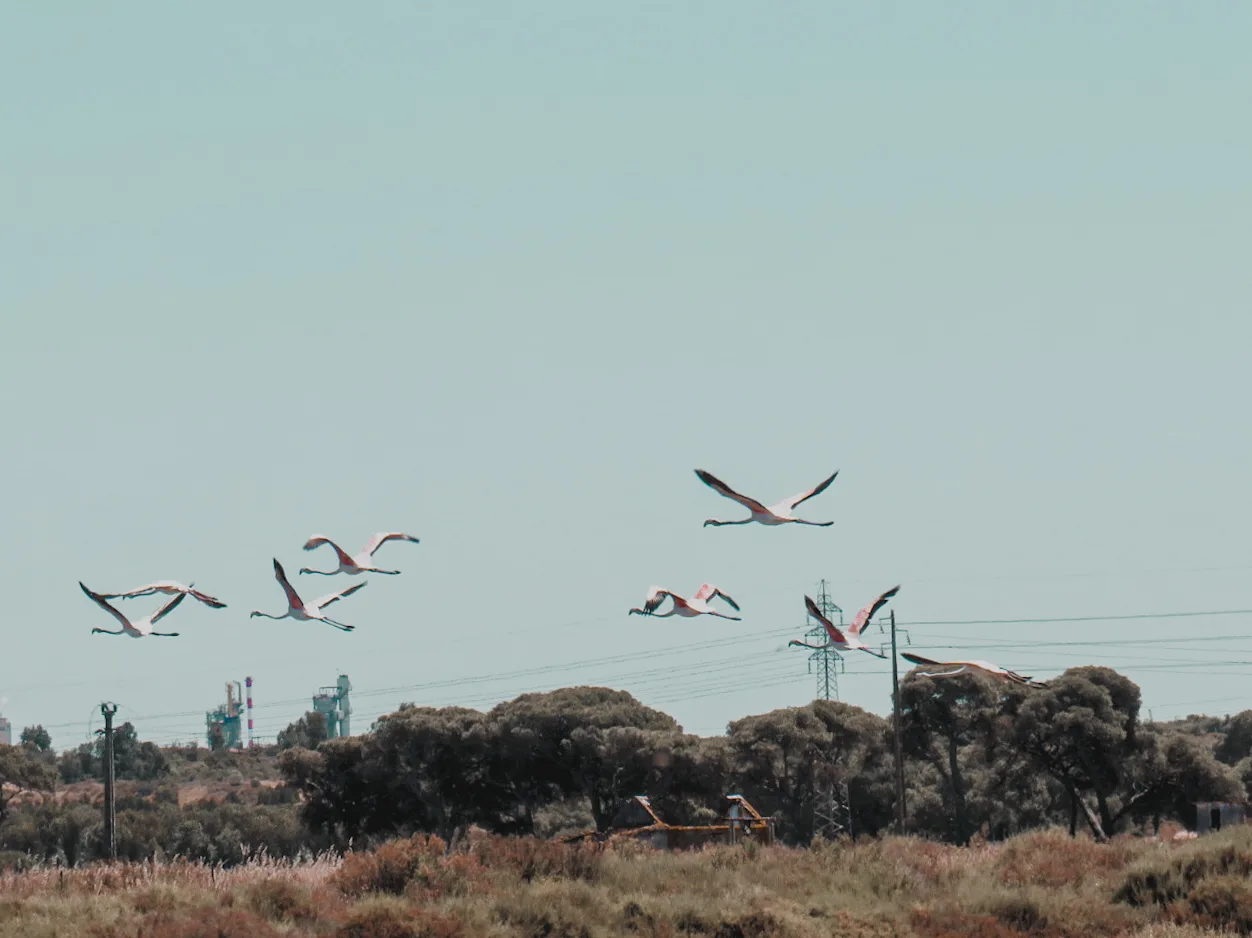
Image sources
- estuario-do-sado.webp — Sado Estuary. Author: Epinheiro. License: CC BY 3.0. Source
- flamingos-estuario-sado.webp — Flamingos in the Sado Estuary. Author: CristianaBPGomes. License: CC BY-SA 4.0. Source
- flamingos-voar-sado.webp — Flamingos flying over the Sado Estuary. Author: TiagooDiass. License: CC BY-SA 4.0. Source
See also
If this article was useful — help us write the next one.
☕ Support on Ko-fi