Baixa — Historic Center of Setúbal
📷 Image credit
Photo: Guilherme Guimas / Wikimedia Commons / CC BY-SA 4.0
From Praça do Bocage to the Sado waterfront, through the rows of the Livramento market and beneath the walls of the Monastery of Jesus, Baixa pulses with the rhythm of five centuries of uninterrupted urban life — here, Setúbal remains true to itself.
Administrative Status and Territory
Baixa, the historic center of Setúbal, administratively belongs to the União das Freguesias de Setúbal (Union of Parishes of Setúbal) — a merged parish created during the 2013 administrative reform by uniting three previously independent parishes: São Julião, Nossa Senhora da Anunciada, and Santa Maria da Graça.
The unified parish covers an area of 36.77 km² and has a population of 37,757 according to the 2021 census. The term “Baixa” itself is an informal, popular name for the city’s historic core, stretching from Praça do Bocage to the Sado River waterfront. This is the zone of greatest concentration of historical monuments, commercial establishments, and public spaces in Setúbal.
Historical Formation of the Center
The territory of modern Baixa began to take shape as an urban center during the medieval period, when Setúbal, having received its first foral from the Order of Santiago, developed around two poles — the fortress walls on the heights and the river port at the foot of the hills.
In the 15th and 16th centuries, during the Age of Discoveries, Setúbal became one of Portugal’s most important ports. It was in Baixa, near the waterfront, that warehouses were built for storing salt — the city’s primary export commodity, along with the offices of merchants trading with Flanders, England, and the Hanseatic cities. The wealth accumulated through the salt trade found expression in grand construction: in 1490, the Monastery of Jesus was founded — the first Manueline-style monument in Portugal, which became the architectural landmark of the center for centuries.
The 1755 earthquake inflicted serious damage on Baixa, although considerably less than on Lisbon. The reconstruction carried out in the second half of the 18th century gave the city center its present appearance: regular street planning, three-story buildings with tiled facades, and wide squares for trade and public gatherings.
Praça do Bocage — Heart of the City
Praça do Bocage is the main square of Setúbal and the symbolic center of not only Baixa but the entire city. Named after the poet Manuel Maria Barbosa du Bocage (1765–1805), a native of Setúbal, the square is a rectangular space framed by 18th- and 19th-century buildings.
At the center of the square stands the monument to Bocage, erected in 1871 — one of the first secular monuments in Portugal. Around the square are traditional cafes with terraces, bookshops, and offices of civic organizations. Most walking tours of the historic center begin here, and it is here that the main city celebrations take place — from the Bocage Festivals to New Year’s festivities.
Avenida Luísa Todi and the Commercial Belt
Avenida Luísa Todi is Baixa’s main commercial artery and one of Setúbal’s longest urban thoroughfares. Laid out in the 19th century and named after the great singer, the avenue connects the western part of the city with the port waterfront.
Shops, restaurants, pharmacies, and banks line both sides of the avenue. Despite competition from shopping centers on the outskirts, Avenida Luísa Todi retains its status as the city’s business and commercial center. The Fórum Luísa Todi — Setúbal’s main concert venue — is also located here.
Baixa’s commercial character is complemented by a dense network of side streets and alleys where traditional shops have survived — from dried cod stores (bacalhoarias) to shoe repair workshops — creating the atmosphere of a provincial Portuguese city that cannot be replicated in shopping malls.
Mercado do Livramento — Gastronomic Temple
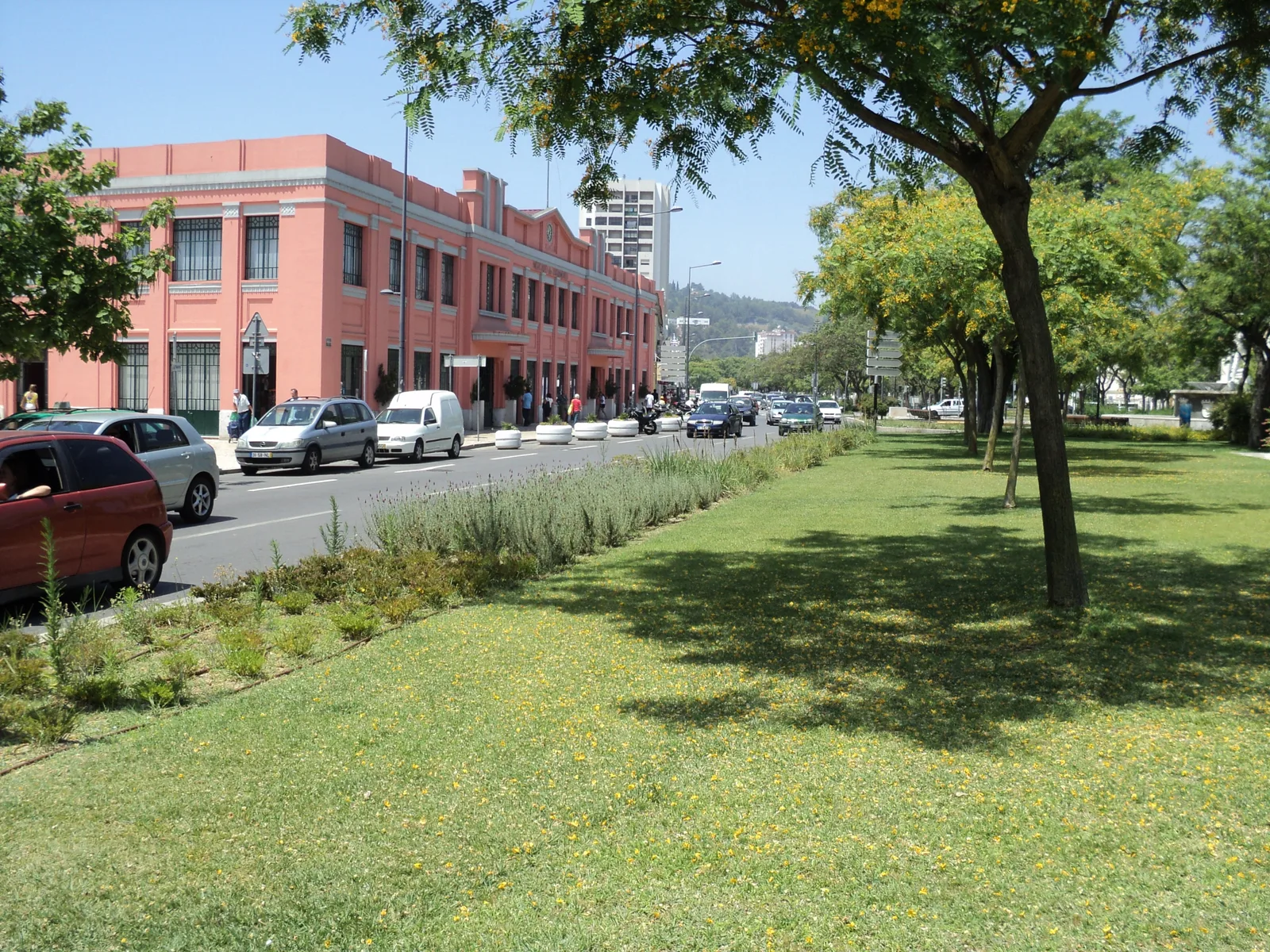
The Mercado do Livramento is one of Baixa’s main attractions and, according to many publications, one of the best food markets in the world. Built in 1930 in Art Deco style with Art Nouveau elements, the market occupies an entire block in the central part of Baixa.
The interior is striking: the walls are decorated with azulejo panels depicting scenes of fishing, agriculture, and traditional crafts. Over 150 market stalls offer the freshest fish and seafood, fruits from the Arrábida orchards, Queijo de Azeitão cheese, Moscatel wines, and other regional delicacies.
For Baixa residents, the market is not merely a shopping venue but a crucial social space where news is exchanged, politics discussed, and neighborly ties maintained. The morning trip to the market remains an unchanging ritual for many families in the central quarters.
Igreja de São Julião and Religious Heritage
The Igreja de São Julião (Church of São Julião), located in the very heart of Baixa, is one of Setúbal’s oldest functioning churches. Founded presumably in the 13th century, it was rebuilt several times after earthquakes and fires, acquiring its present form in the 18th century.
The church interior is adorned with magnificent 18th-century azulejo panels depicting scenes from the life of Saint Julian, as well as Baroque altarpieces with gilded woodwork (talha dourada). Nearby stands the Igreja de Santa Maria da Graça, the second major church of the historic center, forming together with São Julião the spiritual axis of Baixa.
The center’s religious heritage is also manifested in numerous processions and festivals that regularly pass through the streets of Baixa, temporarily transforming commercial streets into routes for religious parades with figures of saints, flowers, and music.
Nightlife and Cultural Scene
After dark, Baixa transforms. The narrow streets between Praça do Bocage and the waterfront fill with music from bars, restaurants, and clubs. This zone, informally called “bairro das copas” (“quarter of glasses”) by locals, has become the main center of Setúbal’s nightlife.
In recent years, Baixa’s cultural scene has been enriched by contemporary art galleries, book cafes, and independent theater venues. Street art appearing on the walls of old buildings creates a contrast between historical facades and contemporary visual language, emphasizing the cultural layering of the district.
Baixa’s restaurants offer the full spectrum of Setúbal gastronomy — from traditional choco frito to haute cuisine based on local seafood. Summer terraces on the squares and waterfront create the atmosphere of a Southern European city where the boundary between everyday life and celebration dissolves in the warm evening air.
Contemporary Challenges
Twenty-first-century Baixa faces the typical problems of historic centers in Southern Europe. The process of gentrification and the growth of short-term tourist rentals are gradually displacing permanent residents, especially the elderly. A number of 18th- and 19th-century buildings are in urgent need of restoration, and competition from shopping centers is forcing traditional shops to close.
The municipality is implementing programs to retain residential populations in the center, including rental subsidies for young families and support for traditional crafts. Pedestrianization of several streets and the creation of cycling infrastructure are underway, aimed at making Baixa more comfortable for everyday life rather than solely for tourist consumption.
Despite all difficulties, Baixa remains a living organism — a place where morning coffee at a cafe on Praça do Bocage, buying fish at the Livramento market, and an evening stroll along the Sado waterfront continue to define the rhythm of city life, just as they have for five centuries.
See Also
- Praça do Bocage — Heart of Setúbal
- Monastery of Jesus — Manueline Masterpiece
- Mercado do Livramento — Portugal’s Finest Market
- Avenida Luísa Todi
- Troino — Fishing Quarter
- Canning Industry of Setúbal
The light is on for free. But someone has to clean the lantern.
☕ Support on Ko-fi