Fontainhas — District of Fishermen and Salt Workers
On the shores of the Sado estuary, where freshwater river meets salty sea, Fontainhas spreads out — a quarter where for centuries the fates of northern fishermen, salt craftsmen, and industrial workers have intertwined.
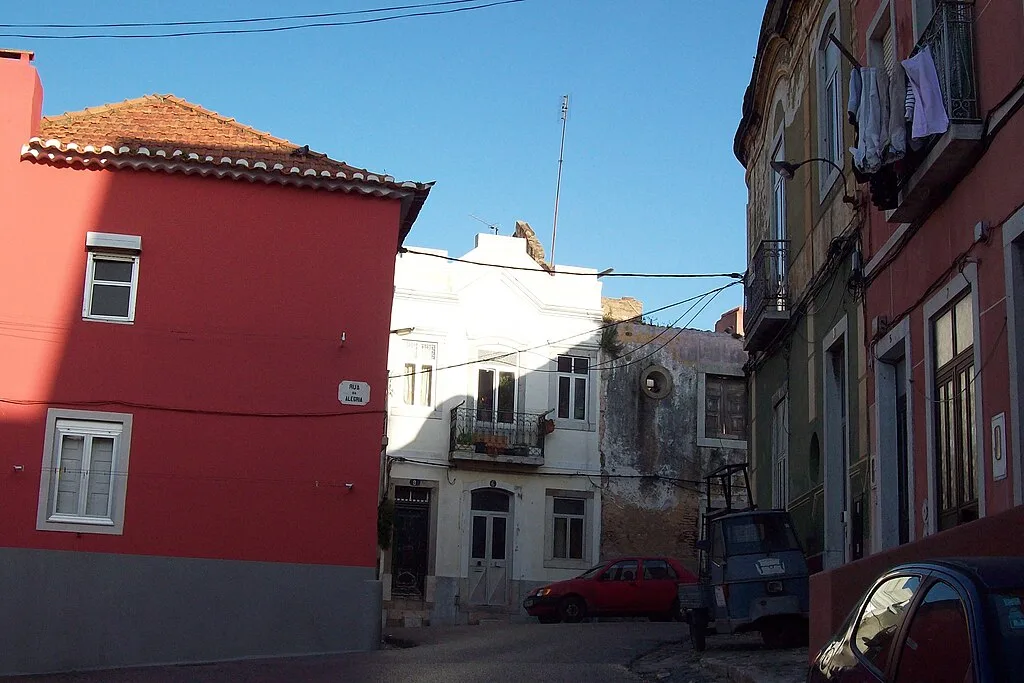
First Mentions and Origin of the Name
Fontainhas (lit. “little fountains” or “springs”) was first documented in the Carta de Desmembração — a royal charter of 1553 that defined the administrative boundaries of the municipality of Setúbal. The district’s name is connected to numerous natural sources of fresh water that surfaced in this coastal zone, which was critically important for settlements in an era when centralized water supply was absent.
However, archaeological evidence points to a much more ancient history of territorial development. Finds of Roman amphorae and remains of salt pans attest that already in the first centuries AD, there existed seasonal settlements engaged in extracting sea salt — the “white gold” of antiquity.
In the medieval period, the territory of Fontainhas remained sparsely populated due to vulnerability to pirate raids by Barbary corsairs who terrorized the Portuguese coast until the 17th century. The situation changed only after the construction of a system of coastal fortifications and the stabilization of maritime trade.
Formation of the Settlement in the 17th-18th Centuries
Systematic settlement of Fontainhas began in the 17th century and was connected with the development of three main activities: artisanal fishing, salt extraction, and agriculture. Unlike neighboring Troino, where Algarve settlers dominated, the population of Fontainhas formed primarily through migration from northern regions of Portugal — Minho, Douro, and Beira Litoral.
Northern fishermen brought their own maritime fishing traditions, distinct from those of the Algarve. They specialized in coastal net fishing (pesca de arrasto) and trap fishing (armadilhas), as well as harvesting mollusks in the Sado estuary. Their techniques were adapted to the specific conditions of the estuarine environment where fresh and salt waters mix.
Salt workers (salineiros) represented a special professional group engaged in extracting sea salt from shallow evaporation basins (salinas) located along the shore. This work required deep knowledge of tidal cycles, temperature regimes, and crystallization technologies. Salt from Fontainhas was renowned for its purity and was used not only in cooking but also in the canning industry.
Agricultural workers (trabalhadores agrícolas) cultivated small gardens and vineyards on the slopes surrounding the quarter. Their produce was supplied to the city market, creating an additional source of income for families.
Industrial Transformation of the 20th Century
The true transformation of Fontainhas occurred in the first half of the 20th century with the rapid development of the canning industry. By the 1930s, more than a dozen canning factories (fábricas de conservas) operated on the quarter’s territory and in immediate proximity, processing sardines, anchovies, mackerel, and other small fish.
Industrial concentration radically changed the district’s social structure:
- Traditional artisan fishermen became wage workers on the fleets of canning companies
- Women were massively involved in factory work, performing manual fish processing (arranjadoras)
- Salt workers transitioned to work as technical specialists at factories where salt was used for preservation
- Tenement houses (casas de renda) were built to accommodate arriving workers from rural areas
Working conditions at canning factories were extremely harsh: 12-14-hour workdays, absence of labor protection, low wages, harmful conditions (constant contact with salt solutions, high humidity, fish smell). Women arranjadoras received particularly little, despite the fact that their manual work required high skill and speed.
By the 1970s, at the peak of industrialization, more than 3,000 people were employed in Fontainhas’s canning industry, which constituted about a third of the quarter’s working-age population. Factory whistles regulated the rhythm of life for the entire district: morning signal at 6:00, lunch break at 12:00, end of shift at 18:00 or 19:00.
Social Memory and Photo Archive (2019)
After the crisis of the canning industry in the 1980s-1990s, many factory buildings were abandoned or repurposed, and the district’s collective identity was threatened with extinction. In response, the municipality of Setúbal launched the innovative cultural project “A memória das Fontainhas vive nas fotografias dos seus moradores” (“The Memory of Fontainhas Lives in the Photographs of Its Residents”) in 2019.
The project represented a large-scale campaign to collect private family photo archives of the quarter’s residents. More than 2,000 photographs spanning the period from the 1920s to the 2000s were collected and digitized. The images document:
- Daily life of fishing families (mending nets, drying fish, family meals)
- Work at canning factories (workshops, conveyor belts, women arranjadoras)
- Religious processions and patron saint festivals (especially the feast of Saint Anthony)
- Children’s games on the streets (football, traditional games)
- Salt pans at the moment of salt collection
- Weddings, baptisms, public gatherings
The digitized archive was presented at a public exhibition in 2019, which attracted more than 5,000 visitors. Many elderly residents recognized themselves, their relatives, and neighbors in the photographs, which triggered a wave of nostalgic memories and activated intergenerational dialogue. The younger generation saw for the first time visual evidence of their grandparents’ lives.
The project received high praise from UNESCO as an example of best practice in preserving intangible cultural heritage through participatory methodology. Importantly, the initiators of photo collection were the residents themselves, not external researchers, which ensured the authenticity and completeness of the materials.
Contemporary Challenges and Prospects
Today Fontainhas is at a crossroads between preserving historical identity and the necessity of economic adaptation. Old canning factories are being transformed into cultural spaces, coworking areas, and residential lofts, which attracts young professionals and artists, but simultaneously leads to rising real estate prices and the displacement of traditional residents.
The municipality is trying to find a balance through social housing programs and cultural tourism, positioning Fontainhas as a “living museum” of Setúbal’s industrial history. Several traditional artisan workshops are preserved where old masters teach youth the technique of net mending and making traditional fishing tools.
The fishing tradition, though on a limited scale, continues: about 30 families still engage in artisanal fishing, supplying fresh fish to the famous Mercado do Livramento. Their catches are in special demand among gourmets who value the quality and environmental friendliness of artisanal fishing.
Image sources
- fontainhas.webp — Fontainhas district, Setúbal. Source: Wikimedia Commons.
See Also
- Troino — Fishing Quarter of Setúbal
- Canning Industry of Setúbal
- Fishing Culture and Traditions
- Mercado do Livramento — Market on the River Bank
All our knowledge is free. Creating it is not.
☕ Support on Ko-fi