Palmela — Neighboring Municipality
From the hilltop, where the fortress of the Order of Santiago for centuries guarded roads and vineyards, Palmela looks down on its industrial neighbor Setúbal — two brothers who chose different paths: one preserves the memory of rural Portugal, the other became a maritime port and factory city.
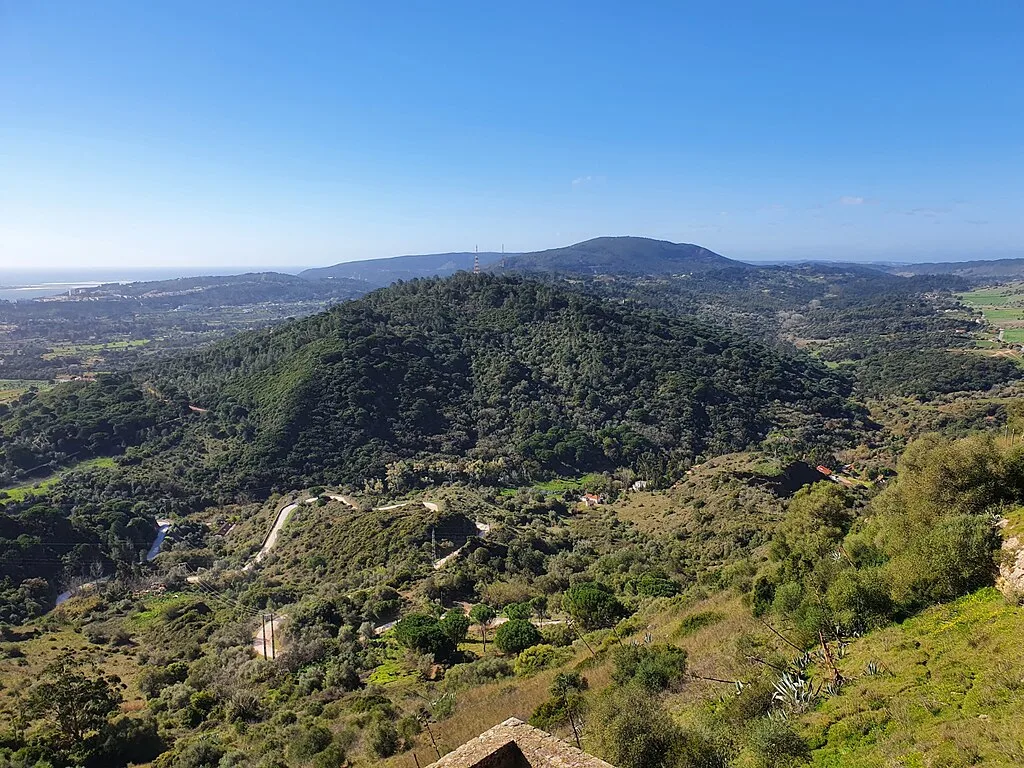
Geographic Location and Connection with Setúbal
Municipality of Palmela (Concelho de Palmela) is located immediately north of Setúbal, forming with it a unified agglomeration of the Setúbal Peninsula (Península de Setúbal). Administratively independent, the two cities are closely connected economically, demographically, and culturally.
Geographic data:
- Area: 465.9 km² (one of the largest municipalities in the region)
- Population: 68,856 inhabitants (2021 census)
- Administrative center: city of Palmela (5,620 inhabitants)
- Distance from Setúbal: 10 km (Palmela center), municipal boundary immediately adjacent
The territory includes 5 parishes (freguesias):
- Palmela — historic center with castle
- Pinhal Novo — railway junction, largest settlement (26,000 inhabitants)
- Quintinhas — agricultural zone
- Marateca — vineyards and olive groves
- Poceirão e Marateca — united parish community
Contrast with Setúbal: While Setúbal developed as a port and industrial city (canning factories, shipbuilding, chemical industry), Palmela preserved a predominantly agrarian and tourist profile. This complementarity created a functional division of labor: Setúbal — jobs in industry and services, Palmela — agricultural production and cultural tourism.
Castelo de Palmela and the Order of Santiago
The landscape’s dominant feature and main historical symbol is Castelo de Palmela, a medieval fortress atop a 230-meter hill, from which opens a panoramic view of the Sado estuary, Serra da Arrábida, and the Lisbon region.
Military History
The fortress was founded by Moors in the 8th-9th centuries as a fortified point on the road between Lisbon (al-Ushbuna) and Setúbal (Shatúbar). Strategic position ensured control over routes between coast and interior territories.
In 1147, parallel with the liberation of Lisbon by crusaders led by Afonso Henriques, Palmela was taken by Christian forces. However, final consolidation occurred only in 1165 after the Almoravid counteroffensive.
In 1186, King Sancho I transferred the fortress to the Military Order of Santiago (Ordem Militar de Santiago da Espada), the Portuguese branch of the Castilian Order of Saint James. From that moment until the dissolution of military-monastic orders in 1834, Palmela remained the order’s headquarters in Portugal.
Religious-Military Complex
The Order of Santiago transformed the fortress into a monastery-fortress (convento-fortaleza), combining military and religious functions:
- Keep (torre de menagem) — main defensive tower
- Church of Santiago (Igreja de Santiago) — 15th-century Gothic church within the walls
- Monastic quarters — cells, refectory, library
- Cisterns for rainwater collection (ensured autonomy during siege)
- Defensive walls with towers and bastions
Official establishment of the order in Palmela occurred May 14, 1482, when the Grand Master (Mestre) moved headquarters here. This date is annually commemorated with ceremonial events.
After dissolution of the order, the fortress fell into decline and was used as a military barracks. In the 1940s, large-scale restoration was conducted, and part of the premises was transformed into a pousada (Pousada Castelo de Palmela) — a hotel in a historic building, managed by a state network.
Winemaking Region: DOC Palmela
The municipality of Palmela is the heart of the DOC Palmela (Denominação de Origem Controlada Palmela) winemaking region, one of the most important in Portugal. The region specializes in red wines from the autochthonous Periquita variety (official name Castelão).
Terroir and Wine Characteristics
The uniqueness of DOC Palmela wines is determined by:
- Soils: limestone and sandy-clay, with good drainage
- Climate: Mediterranean with Atlantic influence, moderated by daily sea breezes
- Relief: hilly vineyards at 50-200 meters elevation
- Periquita/Castelão variety: produces wines with high acidity, medium-intensity tannins, aromas of red berries and spices
DOC Palmela wines are represented mainly by reds (minimum 67% Castelão variety), but whites and rosés are also produced. Style varies from fresh young wines (vinho jovem) to premium reserves aged in oak (reserva).
Largest producers in the region:
- Adega Cooperativa de Palmela — cooperative uniting 220 winegrowers
- José Maria da Fonseca (headquarters in neighboring Azeitão)
- Quinta de Alcube — boutique winery with organic viticulture
- Ervideira — family estate with 100-year history
Total vineyard area in the municipality — about 3,000 hectares, which constitutes approximately 30% of agricultural land.
Festa das Vindimas: Grape Harvest Festival
The annual Grape Harvest Festival (Festa das Vindimas de Palmela) has been held since 1963 and has become one of the region’s main cultural events, attracting more than 100,000 visitors over 10-12 days (usually late August — early September).
Festival Program
September 23 — Opening, evening mass
September 24 — Pilgrimage processions from surrounding villages:
- Procession from Sesimbra (12 km on foot)
- Procession from Aldeia do Meco (8 km)
- Bus deliveries of pilgrims from distant parishes
September 25 (Sunday) — Main day:
- Solemn mass (Missa Solene) at 11:00 with participation of Setúbal bishop
- Procession with statue of Our Lady around sanctuary
- Blessing of the sea (bênção do mar) — priest blesses ocean, praying for fishermen’s safety
- Fair (feira) with traditional products, crafts
- Concert of folklore ensembles in evening
September 26 — Closing, farewell mass
Attendance
In the 18th century, the festival gathered 10,000-15,000 people. Today attendance is about 5,000-7,000 people, mainly:
- Elderly pilgrims — retirees preserving tradition
- Tourists — attracted by spectacle and landscape
- Youth — participates in cultural events but less in religious ones
The church and municipality of Sesimbra are trying to rejuvenate the tradition through educational programs in schools, contemporary music concerts, social media marketing.
Other Cultural Events
Feira Medieval (Medieval Fair)
Held in June in Palmela’s historic part and inside the fortress. For three days, the town transforms into a medieval settlement with:
- Reconstruction of knightly tournaments
- Artisan workshops (blacksmiths, potters, weavers)
- Street theater and jugglers
- Medieval cuisine (without potatoes and tomatoes, which appeared after the discovery of America)
- Costumed population
The fair attracts about 50,000 visitors and is considered one of Portugal’s best medieval reconstructions.
Festival do Moscatel (Moscatel Festival)
Though Moscatel is traditionally associated with Setúbal and Azeitão, Palmela also produces fortified wines of this type. The annual festival (May) includes tastings, winemaker master classes, gastronomic pairings “Moscatel + local cheeses/sweets.”
Rural Character and Contrast with Setúbal
Palmela has preserved rural identity, contrasting with Setúbal’s industrial past:
- Landscape: vineyards, olive groves, pastures instead of factory buildings
- Employment: about 25% of population works in agriculture vs. 3% in Setúbal
- Architecture: traditional quintas (estates), montes (farmhouses) instead of industrial construction
- Rhythm of life: slow, seasonal, connected to agricultural cycles
This contrast doesn’t mean isolation. On the contrary, the two cities form a functional system:
- Palmela residents work at industrial enterprises in Setúbal
- Setúbal residents buy agricultural products and visit Palmela wineries
- Palmela students study at Setúbal’s polytechnic institute
- Common transport infrastructure (railway, bus lines)
Regional authorities promote the concept of Área Metropolitana de Lisboa (Lisbon Metropolis), which includes both municipalities, emphasizing complementarity rather than competition.
Development Prospects
Palmela actively develops agrotourism and wine tourism as an alternative to mass industrial development:
- Wine routes (Rotas do Vinho) with overnight stays at wineries
- Gastronomic workshops on preparing traditional dishes
- Ecological agriculture — several farms certified as organic
- Walking and cycling routes through winemaking territories
Main challenge — finding balance between tourist development and preserving authenticity of rural life. The example of neighboring Azeitão shows risks of excessive touristification. Palmela tries to avoid this through construction limits, support for family producers, and educational programs for youth in winemaking and agronomy.
Image sources
- palmela-municipality.webp — Panorama of Palmela with fortress and vineyards. Source: Wikimedia Commons.
See Also
- Castelo de Palmela — Fortress of the Order of Santiago
- Regional Wines of Setúbal
- Reconquista and Medieval History
If this article was useful — help us write the next one.
☕ Support on Ko-fi