Social Housing and the SAAL Program
In the labyrinths of Setúbal’s shacks, where 11,000 people crowded into tin huts without water or electricity, the revolution of April 25, 1974, ignited hope for a genuine right to the city — not given from above, but conquered from below.
Housing Crisis Before 1974: Scale of the Catastrophe
At the time of the Carnation Revolution, Setúbal was the most affected city in Portugal in terms of housing crisis. According to the municipal census of 1973, more than 11,000 people (about 15% of the city’s population) lived in barracas — improvised dwellings made of tin, cardboard, boards, and other makeshift materials, lacking basic sanitary conditions.
Shacks concentrated in several zones:
- Periphery of historical quarters (Troino, Fontainhas) — chaotic extensions to old houses
- Industrial wastelands near canning factories and port warehouses
- Hill slopes on the city’s outskirts (Casal das Figueiras, Monarquina)
- Abandoned quarries and filled ravines
Living conditions in the barracas were inhuman:
- No water supply (water delivered from public fountains in buckets)
- No sewage system (cesspits, open drains)
- No electricity (kerosene lamps, fires)
- Constant dampness, mold, diseases (tuberculosis, typhus, intestinal infections)
- Overcrowding (families of 8-10 people in one room of 15-20 m²)
- Lack of legal protection (illegal settlements on others’ land, constant threat of demolition)
The housing crisis was a direct consequence of Salazar regime policy, which ignored social needs and stimulated rural migration to industrial cities without creating corresponding housing infrastructure. Canning factories hired workers but didn’t provide them housing, considering it a “private problem.”
Birth of SAAL: Revolutionary Bottom-Up Methodology
August 6, 1974 — three and a half months after the revolution — the government created SAAL (Serviço de Apoio Ambulatório Local, “Local Ambulatory Support Service”) — a revolutionary social housing program, unprecedented in world practice.
The key distinction of SAAL from all previous programs lay in the bottom-up methodology instead of the traditional top-down approach:
- Residents themselves determined their needs, not bureaucrats
- Residents participated in housing design through general assemblies and committees
- Residents controlled the budget and timelines through elected councils
- Architects and engineers performed the role of technical consultants, not authoritarian designers
To implement this methodology, ambulatory brigades (brigadas ambulatórias) were created — multidisciplinary teams of architects, social workers, engineers, and lawyers working directly in the shack settlements, not in offices. Brigades lived among residents, studied their way of life, conducted hours-long meetings, taught self-construction techniques.
This approach reflected the revolutionary spirit of 1974-1975, when it seemed that genuine participatory democracy was possible, overcoming alienation between state and people.
Six SAAL Districts in Setúbal: Projects and Implementation
In Setúbal, 6 SAAL projects were launched, covering about 1,050 families:
1. Casal das Figueiras — 420 units
The largest SAAL project in Setúbal, located on the northwestern outskirts of the city. The brigade was led by architect Joaquim Braancamp. The project envisioned construction of three-story blocks with communal green zones, playgrounds, and a public services center.
Distinctive feature: residents insisted on preserving several large fig trees (figueiras) that gave the district its name, which required changing the original construction plan.
2. Monarquina — 230 units
Located on a hill overlooking the Sado estuary. Architect Manuel Graça Dias. The project included an innovative terraced construction system adapted to complex terrain.
Distinctive feature: residents organized a self-construction cooperative, performing 40% of the work themselves, which significantly reduced costs and created a sense of ownership.
3. Castelo Velho / “O Grito do Povo” (Castelo Velho / “The People’s Cry”) — 78 units
The smallest but symbolically important project, receiving the second name “The People’s Cry” in honor of a revolutionary newspaper. Architect António Sérgio Rocha.
Distinctive feature: located on the site of a former quarry, which required complex engineering preparation of the territory. Residents insisted on creating a communal center with a library and workshops.
4. Bairro dos Pinheirinhos — 180 units
Located near a pine forest on the southern outskirts. Architect José Rodrigues Madeira. The project was inspired by the “garden city” concept.
Distinctive feature: part of the pine grove was preserved, creating a system of pedestrian paths integrating residential zones with nature.
5. Bairro da Liberdade (“Freedom District”) — 100 units
Symbolic name given by the residents themselves. Architect Pedro Botelho. The project included an experimental system of collective land ownership, not individual plots.
Distinctive feature: a collective management cooperative was created, still operating today and controlling the district’s public spaces.
6. Terroa de Baixo — 41 units
The smallest project but with a unique social history. Architect João Santa-Rita. Residents — predominantly Roma community (ciganos), which required consideration of specific cultural needs (large family courtyards, workshops).
Distinctive feature: the first experience in Portugal of participatory housing design for the Roma community with respect for their cultural traditions.
Crisis and Incompleteness: Political Changes of 1976
Most SAAL projects throughout Portugal remained incomplete or were substantially curtailed after the right turn of 1976 and the change of government. The new administration considered SAAL “too revolutionary” and financially irrational program.
In Setúbal, out of 6 projects:
- Fully completed (100% of planned units): Castelo Velho
- Completed with reduction (70-80% of plan): Casal das Figueiras, Monarquina, Pinheirinhos
- Partially completed (50-60% of plan): Liberdade, Terroa de Baixo
Dozens of families who participated in design and partially built their houses were left without housing. Many returned to shacks or received standard municipal housing in typical blocks, lacking the individuality of SAAL projects.
Nevertheless, the SAAL experience left a deep mark on Portuguese urban planning culture, proving that participatory methodology is possible and effective. Many constructed districts became exemplary in terms of social cohesion and low crime rates.
Modernity: NBNC Program and New Wave of Rehabilitation
Since 2015, the Portuguese government has launched the NBNC program (Novo Bairro, Novo Conceito, “New Quarter, New Concept”), reviving some SAAL principles in the context of the 21st century. In Setúbal, under this program, rehabilitation projects of the Bela Vista and Manteigadas districts are being implemented with a total budget of more than 6 million euros.
The new program includes:
- Physical rehabilitation of buildings (thermal insulation, plumbing, sewage)
- Social integration through educational and cultural programs
- Economic activation through support for small businesses and cooperatives
- Participatory management through residents’ councils
Although NBNC is less radical than SAAL, it acknowledges the importance of involving residents and refuses a purely technocratic approach. The SAAL experience of the 1970s is studied as a historical precedent of participatory democracy in urban planning.
Image sources
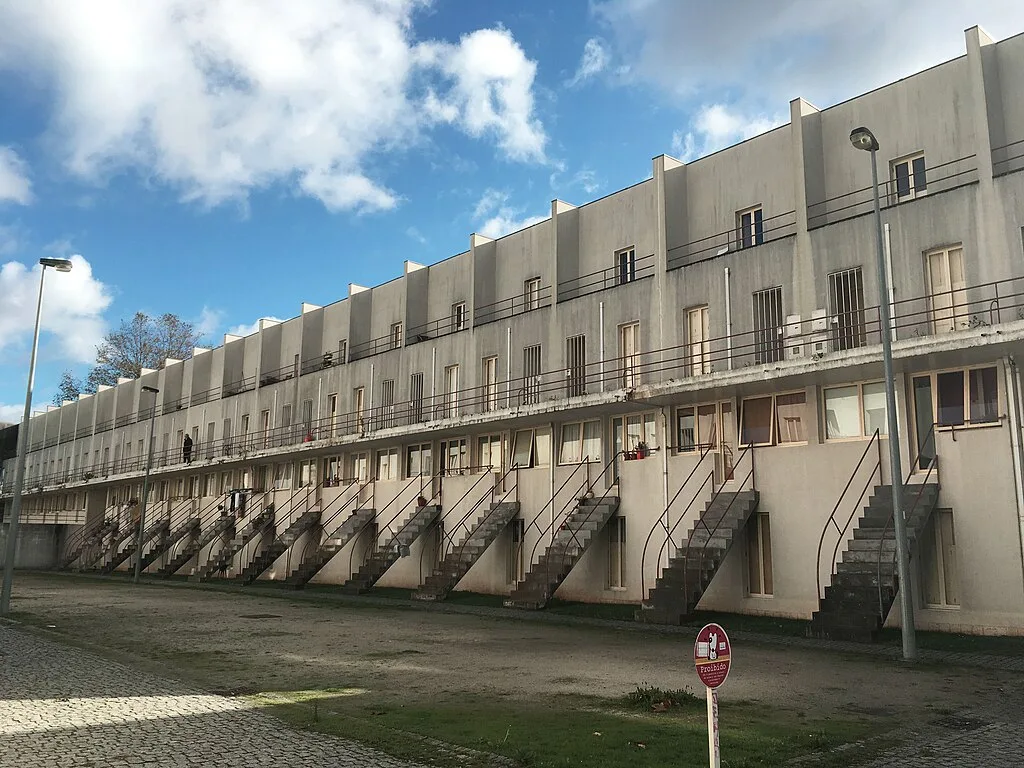
- saal-bouca-porto.webp — SAAL Bouça housing complex in Porto, designed by Álvaro Siza Vieira — example of the SAAL program. Source: Wikimedia Commons.
See Also
- Carnation Revolution and Its Legacy
- Troino — Fishing Quarter of Setúbal
- Fontainhas — District of Fishermen and Salt Workers
All our knowledge is free. Creating it is not.
☕ Support on Ko-fi