Troino — Fishing Quarter of Setúbal
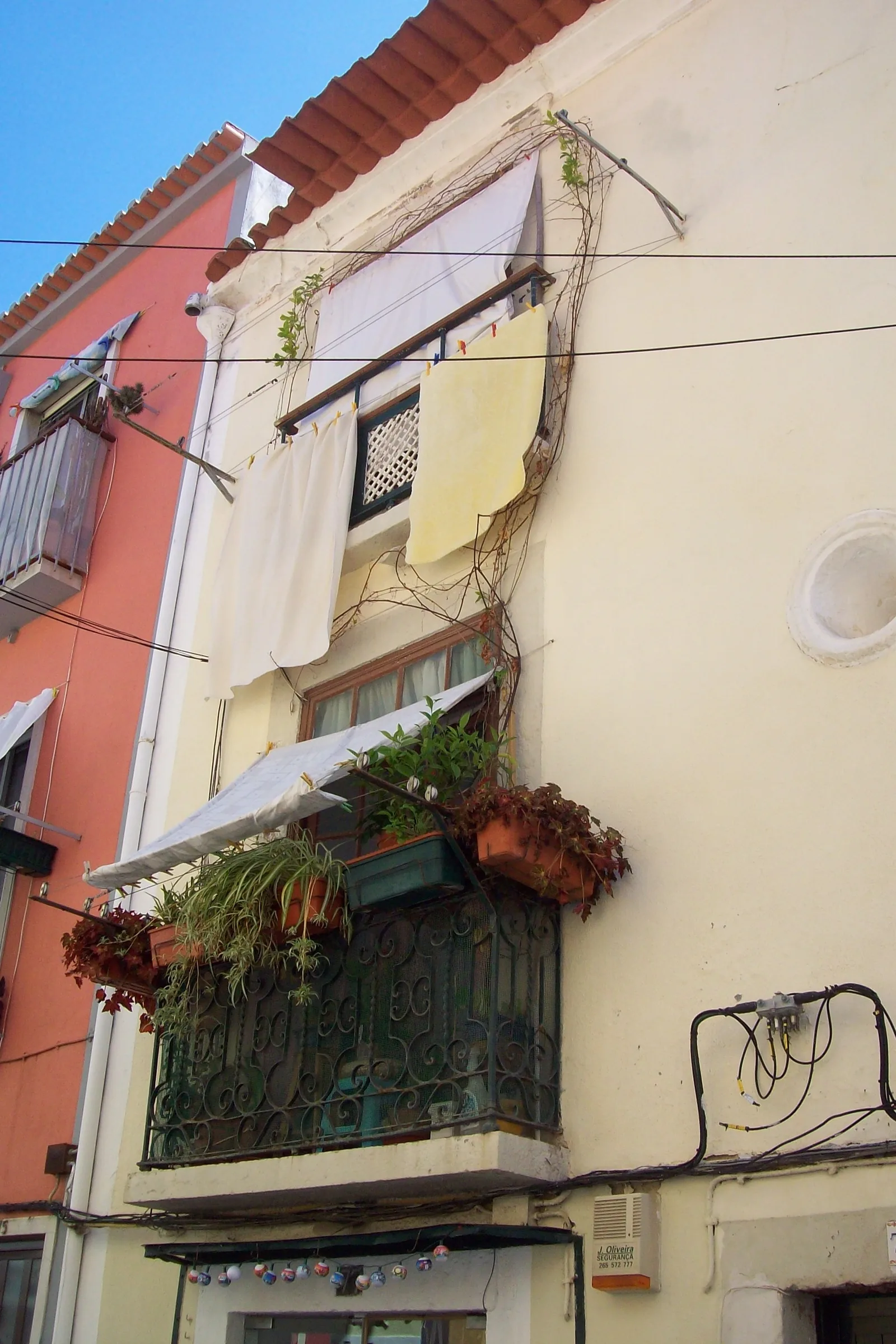
📷 Image credit
Photo: Viet-hoian1 / Wikimedia Commons / CC BY-SA 4.0
In the labyrinth of narrow Troino streets, where fishing nets once hung to dry, the voices of centuries echo — from Roman fishermen to Algarve settlers, whose “charroco” dialect still colors Portuguese speech.
Roman Roots and Medieval Formation
Troino is Setúbal’s oldest residential quarter, whose origins are lost in the times of Roman occupation of the Iberian Peninsula. Archaeological finds in the area attest to the continuous presence of fishing settlements from the 1st century AD, when Romans established here a center for producing garum — the famous fish sauce exported throughout the empire.
In the medieval period, between the 13th and 15th centuries, the territory of modern Troino represented an arrabalde — a settlement beyond the city’s fortified walls. Here lived craftsmen and fishermen, whose occupation was considered insufficiently prestigious for residence in the protected part of the city, but necessary for its economic survival.
The official formation of the quarter as an independent administrative unit occurred in the 18th century, when the growth of the canning industry required a massive influx of labor. Owners of the first canning factories began actively building up the area, providing housing for workers at their enterprises.
Algarve Migration and Identity Formation
One of Troino’s defining characteristics was the massive migration of fishermen from the Algarve region in the 19th century. Escaping poverty and overpopulation of the southern coast, entire families moved to Setúbal, bringing with them unique cultural traditions, culinary recipes and, most importantly, their own dialect — charroco.
This dialect, representing a mixture of Algarve Portuguese with archaic Moorish borrowings, became the quarter’s calling card and was preserved until the mid-20th century. Linguists note that charroco used a specific intonation, distinct from the Lisbon norm, and preserved phonetic features that had disappeared in the standard language.
Troino’s cultural identity formed at the intersection of maritime fishing and industrial production: in the morning, men went to sea in their barco de xávega (traditional fishing boats), while during the day, women worked at canning factories processing the catch.
Earthquake of November 11, 1858
A turning point in the quarter’s history was the devastating earthquake of November 11, 1858, with a magnitude of 7.1, whose epicenter was located in the strait between Setúbal and the Troia peninsula. Troino suffered more than all other city districts: 181 residential buildings were almost completely destroyed, 6 people died, and dozens were injured.
The quarter’s reconstruction became a large-scale national project. Materials from a dismantled monastery in Palmela were used for reconstruction, including the famous azulejos — traditional Portuguese tiles. On many Troino buildings, ceramic memorial plaques can still be seen with the inscription “Beneficência 11 de novembro de 1858” (“Charity November 11, 1858”), commemorating the aid the city received for reconstruction.
The new construction was conducted according to a more orderly plan than the chaotic medieval structure, but preserved the characteristic narrowness of streets and low building heights typical of fishing quarters. In the postwar years, the quarter also suffered from a typhus epidemic caused by unsanitary conditions in overcrowded tenement houses.
Famous Residents of Troino
The Troino quarter became the birthplace of several outstanding figures in Portuguese history.
Luísa Todi (1753-1821) — one of the greatest opera singers of the 18th century, was born in Troino. Her international career, including triumphant performances at the courts of Prussia and Russia, began in a modest fishing house on a street that would later be named after her. Despite worldwide fame, Todi maintained a connection with her native quarter, regularly helping its poorest residents.
Ana de Castro Osório (1872-1935) — pioneer of Portuguese feminism, writer and educator — lived in Troino for the first 23 years of her life. Her observations of women’s hard labor at canning factories and in households formed the basis of the first Portuguese feminist manifesto “Às Mulheres Portuguesas” (1905). The house where she lived with her family before moving to Lisbon is preserved in the quarter.
Modernity: From Decline to Revival
By the mid-20th century, Troino entered a period of economic decline. The crisis of the canning industry in the 1960s-1970s left thousands of residents jobless, and many families were forced to emigrate to Lisbon or France. Old houses deteriorated, and the quarter became associated with poverty and marginality.
Modern residents ironically call Troino “Bairro Alto de Setúbal” — by analogy with Lisbon’s bohemian quarter, although the socio-economic realities of the two districts differ dramatically. Nevertheless, since the beginning of the 21st century, Troino has experienced a process of gentrification and cultural revival.
The municipality launched a program for restoring historical buildings, artists and musicians began renting workshops in old warehouses, and several authentic tascas (traditional taverns) became popular tourist routes. Annual festivals of traditional music and gastronomy attract thousands of visitors seeking to feel the atmosphere of historical Setúbal.
At the same time, a balance is maintained between tourist development and protection of authentic cultural heritage: traditional fish shops continue to operate in the quarter, residents still celebrate patronal religious holidays, and in several old houses, one can still hear echoes of the charroco dialect from elderly fishermen.
See Also
- Luísa Todi — Prima Donna of European Stages
- Ana de Castro Osório — Pioneer of Feminism
- Canning Industry of Setúbal
- Fishing Culture and Traditions
If this article was useful — help us write the next one.
☕ Support on Ko-fi