José Mourinho — From Setúbal to World Football
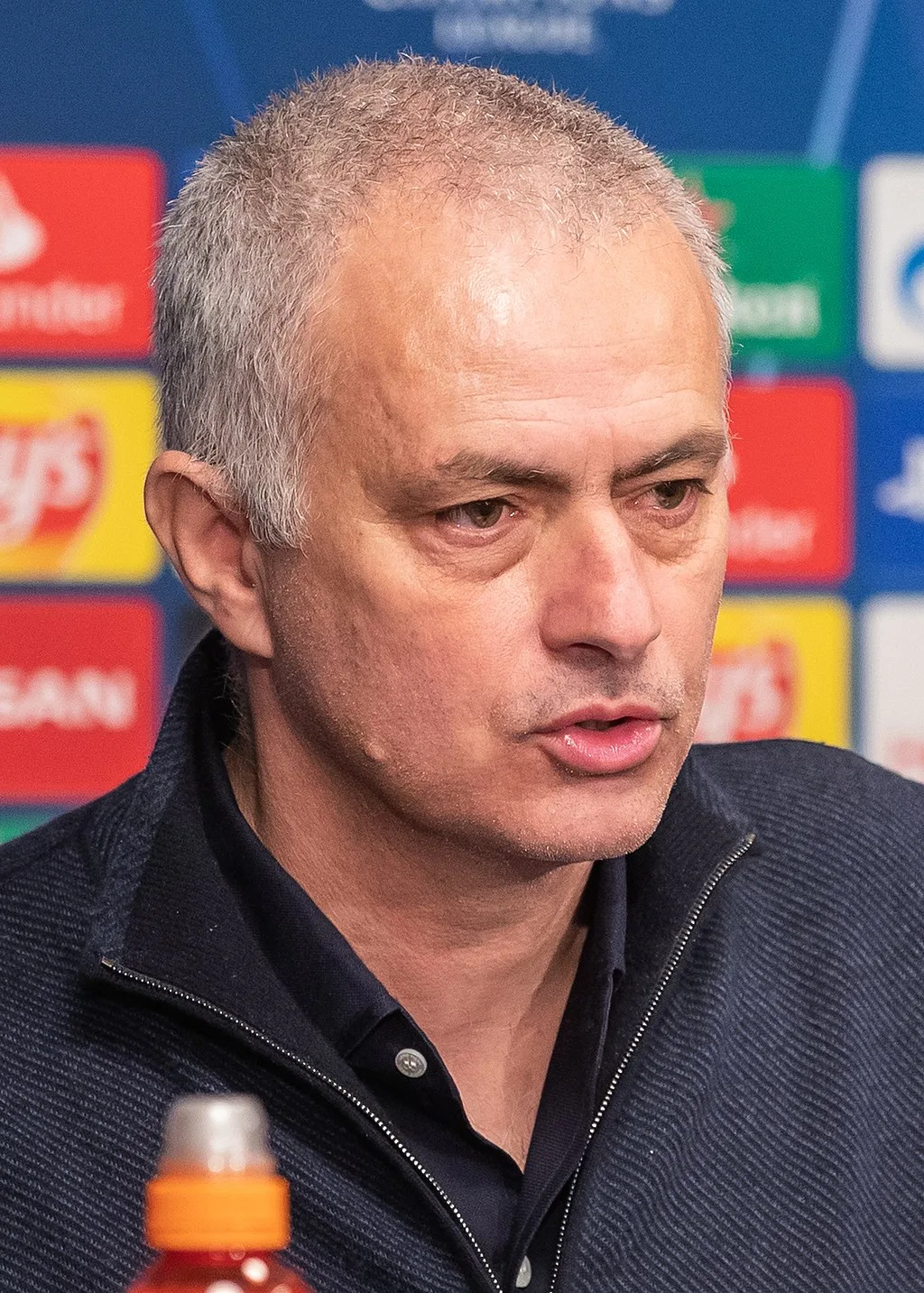 Photo: Steffen Prößdorf, CC BY-SA 4.0. Wikimedia Commons.
From the hills of Setúbal, where a little boy watched his father defend Vitória’s goal, began the journey of a man who would revolutionize world football, proving that a coach can be a star brighter than any player.
Birth and Childhood in Setúbal (1963-1980)
José Mário dos Santos Mourinho Félix was born January 26, 1963 in Setúbal, in the family of professional footballer Félix Mourinho and elementary school teacher Maria Júlia Carvalho dos Santos.
His father, Félix Mourinho, was a goalkeeper for the football club “Vitória de Setúbal” (Vitória Futebol Clube) — the legendary city team, experiencing its golden period in the 1960s-1970s. Félix played over 300 matches for Vitória and was one of the most beloved players in the club’s history.
José grew up in a football environment:
- From age 5 attended Vitória training sessions with his father
- Watched tactical analyses in the locker room
- Absorbed the atmosphere of professional sports — discipline, ambition, psychological pressure
- Listened to his father’s conversations with coaches and players about strategies, transfers, club politics
Félix later became a coach, which gave José the opportunity to see football “from the other side of the barricades.” He accompanied his father to matches, helped analyze video recordings (rare practice in the 1970s), compiled statistics.
Unlike many footballers’ children, José did not become a professional player. He played in youth teams of Vitória and later Rio Maior, but did not possess outstanding physical attributes or technique. In his own words:
“I was a mediocre player, but I understood the game better than many talented footballers.”
This sober self-assessment led him to the decision to become a coach — a profession where analytical mind is more important than speed and strength.
Education and Early Career (1980-1992)
After finishing high school in Setúbal, José enrolled at Instituto Superior de Educação Física (ISEF, “Higher Institute of Physical Education”) in Lisbon — Portugal’s leading university for training coaches and physical education teachers.
At the institute he studied:
- Sports physiology — energy systems, training loads
- Biomechanics — movement analysis, strike technique, running
- Sports psychology — motivation, working with pressure, group dynamics
- Tactics and strategy — game systems, defensive and attacking schemes
Mourinho stood out for academic performance and obsession with details. Classmates recall that he spent hours analyzing video recordings of matches, composing schemes, arguing with professors about tactics.
After graduation in 1987, he began his coaching career in lower divisions:
- “Vitória de Setúbal” (1987-1989) — assistant coach of youth team
- “Estrela da Amadora” (1990) — assistant coach
- “Comércio e Indústria” (1992) — first position as head coach (lower division)
These years were a period of learning through practice: work with young players, limited budgets, necessity to compensate lack of resources with tactical inventiveness.
Breakthrough: Bobby Robson’s Translator (1992-1996)
The career breakthrough occurred in 1992 when Sir Bobby Robson — legendary English coach — was appointed head coach of Lisbon’s Sporting. Robson did not speak Portuguese, and most translators did not understand football terminology.
Mourinho, fluent in English (studied at the institute and independently), was hired as translator-assistant. But he did not limit himself to simple translation — he:
- Participated in tactical discussions, proposing his own ideas
- Analyzed opponents, compiling detailed reports
- Communicated with players on behalf of Robson, often adding his own psychological nuances
- Learned methodology from one of the world’s greatest coaches
Robson quickly appreciated the young Portuguese’s abilities and began giving him more responsibility. When in 1993 Robson moved to Porto, he took Mourinho with him — no longer as a translator but as assistant coach.
In 1994 they moved together to Barcelona, where Mourinho gained invaluable experience working at one of the world’s largest clubs. He observed:
- Management of world-class stars (Romario, Stoichkov, Guardiola)
- Media pressure from Catalan press
- Club politics and confrontation with Real Madrid
- Tactical innovations of Robson and his successor Louis van Gaal
When in 1996 Robson left Barcelona, Louis van Gaal — the new coach — asked Mourinho to stay. This was recognition of his professionalism: van Gaal, known for his demandingness, rarely trusted others’ assistants.
Porto: First European Glory (2002-2004)
After positions as head coach at Benfica (9 matches, conflict with management) and União de Leiria (successful season), Mourinho in January 2002 headed Porto — the club where he once worked as an assistant.
In two and a half years he transformed Porto into a European force:
Achievements
- Portuguese Champion (2002-03, 2003-04)
- Portuguese Cup (2002-03)
- UEFA Cup (2002-03) — victory over Celtic in the final
- UEFA Champions League (2003-04) — sensational victory, defeating Manchester United, Lyon, Deportivo, Monaco
The 2004 Champions League victory was a football miracle: Porto with a budget tens of times smaller than the giants won, playing total pressing, compact defense, and speed counterattacks. Mourinho proved that tactical genius can compensate for budget differences.
“The Special One”
At his Chelsea presentation in summer 2004, Mourinho uttered a phrase that became legendary:
“Please don’t call me arrogant, but I’m a European champion and I think I’m a special one.”
The British press dubbed him “The Special One” — a nickname that became a brand.
Peaks of World Career (2004-2026)
After Porto, Mourinho worked at the world’s largest clubs:
Chelsea (2004-2007, 2013-2015)
- 3 Premier League titles
- 3 League Cups
- 1 FA Cup
- Revolution of English football: implementation of video analysis, nutritionists, psychologists
Inter Milan (2008-2010)
- 2 Italian championships
- 2010 Champions League — historic treble (championship + cup + CL)
- Tactical masterclass in the final against Bayern
Real Madrid (2010-2013)
- 1 La Liga title (record 100 points)
- 1 Spanish Cup
- Confrontation with Guardiola’s Barcelona — the greatest tactical rivalry of the era
Manchester United (2016-2018)
- 2017 Europa League
- League Cup
- Conflict with management and players
Roma (2021-2023)
- 2022 Conference League — first European cup in club history
Fenerbahçe (2024-present)
Working in Turkey, attempting to return titles to the club.
Connection with Setúbal: Pride and Memory
Despite world fame, Mourinho maintains connection with Setúbal:
- Regularly visits his father’s grave at Setúbal cemetery
- Supports “Vitória de Setúbal” financially (club experiencing economic difficulties)
- Mentions Setúbal in interviews as the place where his character was formed
- Attended the opening ceremony of Vitória museum in 2018
In a 2019 interview he said:
“Setúbal taught me to be a fighter. This is not Lisbon, not the capital. Here you must prove yourself every day. This mentality I kept forever.”
In 2020 the municipality of Setúbal awarded him the city’s medal of honor for “contribution to popularizing Setúbal’s name in the world.”
Father’s Legacy: Félix Mourinho
Félix Mourinho (1938-2017) remains a legend of Vitória de Setúbal:
- 341 matches for the club (1958-1974)
- Participation in the club’s golden period (Cup Winners’ Cup final 1966-67)
- Coaching career after ending playing career (worked at Belenenses, Vitória, lower divisions)
José often said that “everything I became, I owe to my father.” Félix instilled in his son:
- Work ethic — “talent without work is worth nothing”
- Tactical thinking — “football is played with the head, not just feet”
- Respect for club history — “the club is bigger than players and coaches”
After Félix’s death in 2017, José canceled training at Manchester United and flew to Setúbal for the funeral. The farewell speech at the cemetery was an emotional moment:
“I lost not only a father, but the first coach, first mentor, first friend.”
Style and Philosophy: “Mourinhism”
Mourinho’s coaching style is characterized by:
- Pragmatism — result is more important than beauty of play
- Defensive compactness — first don’t lose, then win
- Psychological warfare — playing with media, provoking opponents, protecting players
- Detailed preparation — analysis of every aspect of the match
- Charismatic leadership — cult of coach’s personality, absolute loyalty
Critics call his style “anti-football” for excessive focus on defense. Supporters point to effectiveness: Mourinho is one of few coaches who won the Champions League with two different clubs.
See Also
- Troino — Fishing Quarter of Setúbal
- Luísa Todi — Prima Donna of European Stages
- Carnation Revolution and Its Legacy
The light is on for free. But someone has to clean the lantern.
☕ Support on Ko-fi