Luisa Todi -- Singer of the Ages
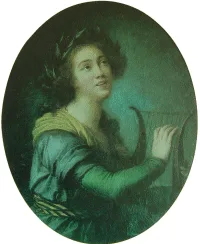
Luisa Rosa de Aguiar Todi (1753–1833) was the greatest Portuguese opera singer of the 18th century, a mezzo-soprano whom contemporaries called “the Singer of the Ages” (la Chanteuse de tous les siecles). Born in Setubal, she conquered the leading opera stages of Europe – from London and Paris to Saint Petersburg and Venice – performing before Catherine the Great, Frederick William II and a young Beethoven.
Origins and early years
Luisa Rosa de Aguiar (port. Luisa Rosa de Aguiar) was born on 9 January 1753 in Setubal. Her father was a musician and theatre worker, a background that ensured the future singer’s early exposure to the world of the arts. The musical environment in which Luisa grew up proved fertile ground for her exceptional talent.
In 1765, when Luisa was twelve, the family moved to Lisbon, where her father took a position as a musical arranger (composer of incidental music) at the Teatro do Bairro Alto – one of the leading theatres of the Portuguese capital. The move to Lisbon opened before the young Luisa the world of metropolitan theatre and music that would define her entire life.
The start of an artistic career
Acting debut
Luisa’s stage career began not with singing but with acting. In 1767 or 1768 (the exact date varies across sources), she first appeared on stage as an actress in Moliere’s Tartuffe at the Teatro da Rua dos Condes. The debut demonstrated her theatrical gifts, yet Luisa’s true calling lay in vocal art.
Marriage and the beginning of a vocal career
In 1769, Luisa married the Italian violinist Francesco Saverio Todi. This marriage proved a turning point in her life. On her husband’s advice, Luisa began taking singing lessons from Davide Perez – an Italian composer who held the prestigious post of Kapellmeister of the Portuguese Royal Chapel. Perez became the decisive teacher in her vocal career, laying the professional foundation that would later conquer all of Europe.
In 1770, Luisa Todi launched her singing career, making her operatic debut in Giuseppe Scolari’s “Il Viaggiatore Ridicolo” (“The Ridiculous Traveller”) at the Teatro do Bairro Alto – the very theatre with which her father’s work had been connected.
International career
London (1777–1778)
In the winter of 1777, at the age of twenty-four, Luisa Todi made her first foreign appearance – at the King’s Theatre on the Haymarket in London. From November 1777 to June 1778, she performed in six operatic productions in the genre of dramma giocoso per musica (comic opera set to music). The London season demonstrated to the European musical world the scale of the Portuguese singer’s gift and launched her brilliant international career.
Paris – triumph at the Concerts Spirituels (1778–1783)
In 1778, Luisa Todi arrived in Paris, where she sang at the celebrated Concerts Spirituels – the most prestigious concert series of the day, held in the Tuileries. Her performances were triumphal: the French public and critics hailed her as the finest foreign singer ever to appear in France.
The Parisian period marked the beginning of Luisa Todi’s pan-European fame. Performances in Paris and Versailles left an indelible impression, and her name was firmly established in the front rank of European vocalists.
Rivalry with Gertrud Elisabeth Mara
In 1782, the celebrated German soprano Gertrud Elisabeth Mara arrived in Paris, and the director of the Concerts Spirituels deliberately fostered an atmosphere of rivalry between the two great singers. He spread rumours of a grand confrontation and alternated their appearances at concerts. The Parisian public responded with unconcealed enthusiasm.
Critics praised both performers, but audiences quickly split into two camps:
- Todistes – supporters of Luisa Todi
- Maratistes – admirers of Gertrud Mara
The contest became the talk of the Parisian salons, reaching well beyond the sphere of musical criticism. It turned into one of the major cultural events of 1780s Paris – comparable in intensity to the literary and philosophical debates of the Age of Enlightenment.
In the end, the French public bestowed on Luisa Todi the title of “Singer of the Nation” (la Chanteuse de la Nation) – an extraordinary recognition for a foreign artist. Though the rivalry was in essence a promotional strategy, it nonetheless demonstrated the genuine admiration of the French for the Portuguese mezzo-soprano’s talent.
Russia and Empress Catherine the Great (1784–1788)
In 1784, Luisa set out for Russia with her husband and children, arriving in Saint Petersburg on 7 June 1784. The Russian period became one of the most brilliant chapters in the singer’s biography.
At her very first concert, where Luisa performed works by the Italian composer Giuseppe Sarti (then serving at the Russian court), Empress Catherine the Great was so impressed that she afterwards presented the singer with two diamond bracelets. The empress continued to bestow jewels on the singer, described by contemporaries as gifts “of incalculable worth.”
Luisa was appointed singing teacher to the grand duchesses – a mark of the highest trust at the Russian court.
In gratitude for the imperial patronage, Luisa and her husband composed the opera “Pollinea” (Pollinia) and dedicated it to the empress. The premiere took place in October, with the participation of the celebrated castrato Luigi Marchesi – one of the most famous singers of the age.
The four years in Russia (1784–1788) were a period of supreme recognition and material prosperity in the life of Luisa Todi. The jewels bestowed by Catherine the Great would later serve as both a symbol of that triumph and a source of tragic loss.
Berlin and the encounter with Beethoven (1788–1790)
In 1788, having left Russia, Luisa Todi performed at the court of the Prussian king Frederick William II in Berlin. In 1790, she embarked on a triumphal tour of the German lands.
During her stay in Bonn, Luisa performed before the young Ludwig van Beethoven – a fact that links her name to one of the greatest composers in the history of music. In 1790, Beethoven was twenty; he was not yet the Beethoven the world would come to know, but already a promising musician at the Bonn court. This meeting of two eras – the departing 18th century in the person of Todi and the dawning Romanticism in the person of Beethoven – stands as one of the remarkable crossroads of musical history.
Italy – the “Year of Todi” (1790–1791)
At the end of 1790, Luisa travelled to Italy – the birthplace of opera, where winning recognition was an especially formidable challenge for a foreign singer. She appeared in Venice at the Teatro San Samuele in the opera “La Didone Abbandonata” (“Dido Abandoned”). For this performance, Luisa wore the jewels presented to her by Empress Catherine the Great, which made an additional impression on the Venetian audience.
The Italian season of 1790–1791 entered musical history as the “Year of Todi” (l’Anno di Todi) – so overwhelming was her success on the Italian stage. For a Portuguese singer to achieve such acclaim in Italy – a country that considered itself the undisputed mistress of the operatic world – was an accomplishment of the first order.
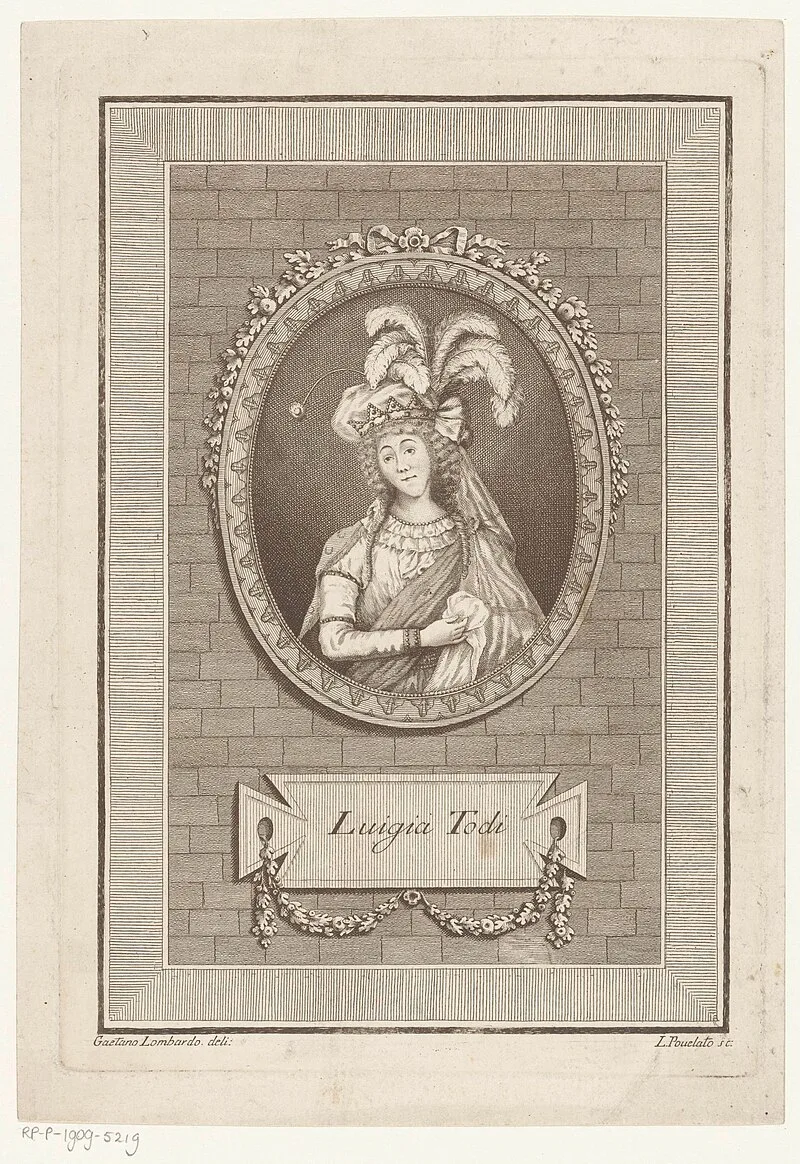
It was with the Venetian performance of 10 February 1791 that an engraving is associated which later inspired the sculptor Sergio Vicente to create the monument to Luisa Todi in Setubal.
Madrid (1792–1796)
From 1792 to 1796, Luisa Todi sang in Madrid at the Teatro de los Canos del Peral – the principal opera house of the Spanish capital. This four-year Spanish period brought to a close the long series of European triumphs.
Farewell concert in Naples (1799)
In 1799, Luisa Todi gave a farewell concert in Naples, officially ending her international career. Over more than three decades, she had performed on the leading stages of Europe – from London to Saint Petersburg, from Paris to Venice – leaving her mark on the musical culture of every country where she sang.
Geography of a European career
| Period | City / Country | Venue | Notes |
|---|---|---|---|
| 1770 | Lisbon | Teatro do Bairro Alto | Operatic debut |
| 1777–1778 | London | King’s Theatre | First foreign season |
| 1778–1783 | Paris | Concerts Spirituels | “Singer of the Nation” |
| 1784–1788 | Saint Petersburg | Court of Catherine the Great | Singing teacher to the grand duchesses |
| 1788–1790 | Berlin, Bonn | Prussian court | Encounter with Beethoven |
| 1790–1791 | Venice | Teatro San Samuele | “Year of Todi” |
| 1792–1796 | Madrid | Teatro de los Canos del Peral | Spanish period |
| 1799 | Naples | – | Farewell concert |
Recognition in her lifetime
While Luisa Todi was still alive, her talent received the highest formal recognition. In 1814, the French composer and music theorist Antoine Reicha (Antoine Reicha), in his Traite de melodie (Treatise on Melody), called Luisa Todi “the Singer of the Ages” (la Chanteuse de tous les siecles). This epithet – one of the loftiest honours in the history of 18th- and 19th-century vocal art – has remained attached to her name ever since and became her chief honorary title.
Final years, blindness and death
The losses of the Peninsular War
After concluding her international career, Luisa Todi returned to Portugal – first to Porto. Her husband Francesco Saverio Todi died in 1803.
When the Peninsular War (1807–1814) – a series of Napoleonic invasions of the Iberian Peninsula – erupted, Luisa found herself caught up in the upheaval. In the course of the war, she lost all the diamonds and jewels received in Russia from Empress Catherine the Great. The gifts that had once symbolised the pinnacle of her fame were lost in the chaos of wartime – a bitter irony for an artist whose talent had once enthralled imperial courts.
Blindness
In 1811, Luisa moved to Lisbon, where she spent the rest of her life. By 1823, she had gone completely blind – a devastating blow for a woman whose life had been devoted to the performing arts. The final decade of her life was passed in darkness, far from the stages on which she had once reigned.
Death
Luisa Rosa de Aguiar Todi died on 1 October 1833 in Lisbon following a stroke suffered in July of that year. She was eighty years old. She was buried in the cemetery of the Church of the Incarnation (Igreja da Encarnacao) near the Chiado district.
[UNVERIFIED] According to some accounts, Luisa Todi died in utter poverty – a fate that tragically echoes that of her contemporary Bocage, who also died destitute. However, the circumstances of her final years and her precise financial situation at the time of death are described differently by various biographers.
In Setubal today
Setubal cherishes the memory of its great daughter. The name of Luisa Todi is among the most visible in the city’s public spaces.
Forum Municipal Luisa Todi (Forum Municipal Luisa Todi)
The main concert hall and cultural centre of Setubal bears the singer’s name. The building was inaugurated on 24 July 1960 and passed into municipal ownership in 1990. It was designed by the architect Fernando Silva in a modernist style; construction began in 1958.
Between 2009 and 2012, the hall underwent a thorough renovation that modernised its technical facilities and adapted the space to the requirements of contemporary performing arts.
In front of the main entrance stands a sculptural ensemble by the sculptor Sergio Vicente, dedicated to Luisa Todi. The three-metre sculpture was inspired by the engraving distributed at the singer’s performance on 10 February 1791 at the Teatro San Samuele in Venice. The sculpture was donated to the city by the Buhler-Brockhaus Foundation (Fundacao Buhler-Brockhaus).
The Forum Luisa Todi is the centre of Setubal’s cultural life: concerts, opera performances, theatrical productions and conferences are held here.
Avenida Luisa Todi
The main street of Setubal, running along the waterfront, bears the singer’s name – Avenida Luisa Todi. It is one of the city’s liveliest thoroughfares, lined with shops, restaurants and cafes. The street name is an everyday reminder to residents and visitors of the city’s great native daughter.
Bust and monuments
A monument with a bust of Luisa Todi stands in the city, complementing the system of memorials dedicated to Setubal’s famous sons and daughters.
Significance for musical history
The career of Luisa Todi is unique in several respects:
- She was the first Portuguese singer to achieve pan-European fame in the field of opera.
- Her career spanned all the major musical capitals of 18th-century Europe – London, Paris, Saint Petersburg, Berlin, Venice, Madrid and Naples.
- She performed before three royal courts – French, Russian and Prussian.
- Her name is linked to key figures of European music – from Davide Perez to Ludwig van Beethoven.
- Recognition in Italy – the homeland of opera – was an achievement exceedingly rare for non-Italian singers of the 18th century.
The life of Luisa Todi traces a complete dramatic arc: from childhood in provincial Setubal, through the triumphs of European capitals, to blindness and poverty in Lisbon. In her fate is mirrored the history of Portugal itself in the 18th and 19th centuries – a country whose talents conquered the world, yet whose own standing steadily waned.
Key dates
| Year | Event |
|——|——-| | 1753 | Born in Setubal (9 January) | | 1765 | Family moves to Lisbon | | 1767/1768 | Acting debut in Moliere’s Tartuffe | | 1769 | Marriage to Francesco Saverio Todi | | 1770 | Operatic debut at the Teatro do Bairro Alto | | 1777–1778 | Performances in London (King’s Theatre) | | 1778 | Triumph at the Concerts Spirituels in Paris | | 1782 | Rivalry with Gertrud Mara; title of “Singer of the Nation” | | 1784–1788 | Saint Petersburg; patronage of Catherine the Great | | 1788–1790 | Performances in Berlin and Bonn; encounter with Beethoven | | 1790–1791 | “Year of Todi” in Italy | | 1792–1796 | Performances in Madrid | | 1799 | Farewell concert in Naples | | 1803 | Death of her husband | | 1807–1814 | Loss of jewels during the Peninsular War | | 1814 | Named “Singer of the Ages” in Reicha’s treatise | | 1823 | Complete loss of sight | | 1833 | Dies in Lisbon (1 October) |
Image sources
See also
- Bocage – Setubal’s Poet
- Zeca Afonso and the Carnation Revolution
- Monastery of Jesus
- The 1755 Earthquake
- Bocage Festival and City Day
The light is on for free. But someone has to clean the lantern.
☕ Support on Ko-fi