Odeith — Master of Three-Dimensional Graffiti
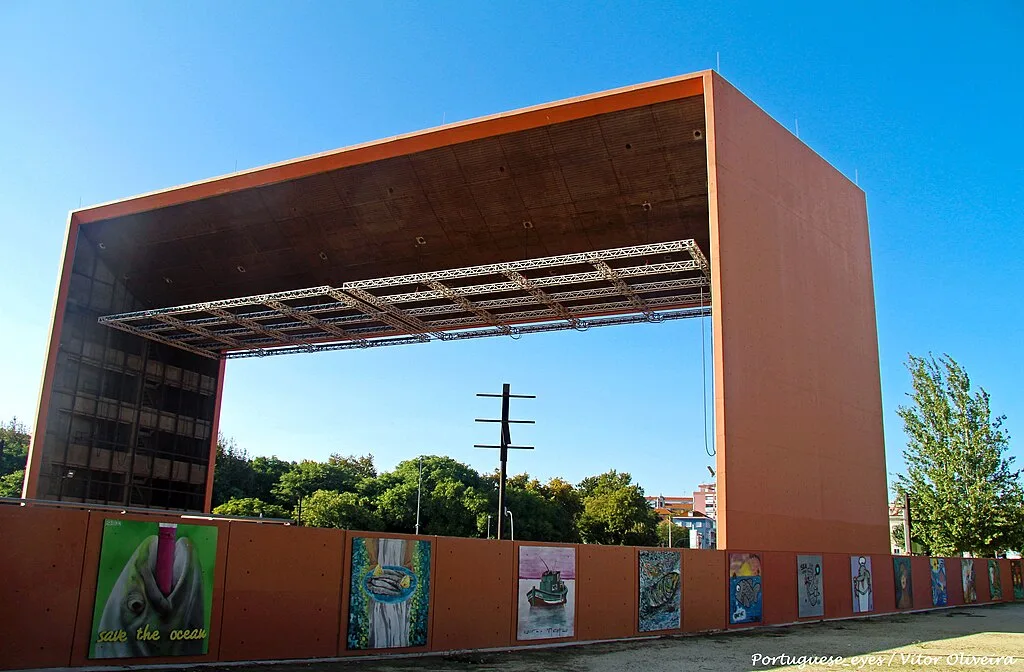 Photo: Vitor Oliveira, CC BY-SA 2.0. Wikimedia Commons.
On the walls of abandoned buildings, where others see a gray surface, Sérgio Odeith creates optical illusions that make passersby doubt reality — insects the size of cars, letters hovering in the air, shadows casting shadows.
Early Years: Damaia and Birth of Graffiti Culture (1976-1990s)
Sérgio Odeith was born in 1976 in Damaia — a densely populated working-class suburb of Lisbon, known for social housing, high concentration of immigrants, and, since the 1980s, active hip-hop and graffiti culture.
Damaia of the 1980s was:
- Social contrasts: concrete high-rises, barracas (slums), unemployment after deindustrialization
- Cultural diversity: Portuguese, people from African colonies (Angola, Mozambique, Cape Verde), Roma
- Street culture: breakdancing, rap, graffiti as a form of self-expression for marginalized youth
Odeith began drawing graffiti in the mid-1980s, around age 12-13. This was the time of Portuguese graffiti movement’s birth, inspired by American hip-hop culture penetrating through films (“Style Wars,” “Beat Street”), music, and magazines.
First works — typical tags (signatures) and throw-ups (quick inscriptions of 2-3 colors) on electric train walls, bridges, abandoned buildings. The pseudonym “Odeith” (pronunciation close to “Odete” — a Portuguese female name) was chosen randomly but became a recognizable brand.
At 15 Odeith dropped out of school to devote himself entirely to art. This decision — typical for graffiti culture of that time — meant a break with the traditional social elevator (education → work → stability) and the choice of a marginal but creatively free path.
Self-Education and Technical Mastery (1990-2005)
Odeith is self-taught (autodidata). He never studied at art school, never took lessons from academic painters. Everything he learned came through:
- Practice: thousands of hours drawing on streets
- Observation: studying works of other graffiti artists
- Experiments: trying various techniques, materials, styles
- Visual culture: comics, science fiction, films
In the 1990s he developed classical graffiti skills:
- Calligraphy (lettering) — stylized letters, the foundation of graffiti
- Characters — images of people, animals, monsters
- Background — clouds, stars, abstract elements creating depth
- Color transitions (fades, blends) — smooth gradients between colors
By the early 2000s Odeith was recognized in the Portuguese graffiti community as a technically perfect artist, but did not yet have a unique recognizable style that would distinguish him from hundreds of other talented graffiti writers.
Tattoos and Commercialization of Skills (1999-2008)
To earn a living, Odeith became a tattoo artist in 1999, opening a studio in Lisbon. Tattoo work gave him:
- Stable income — ability to support family without abandoning art
- Work with details — tattooing requires microscopic precision
- Understanding of anatomy and perspective — critically important for future 3D style
- Client base — many clients became customers for graffiti works
In parallel he continued drawing on streets, but now could afford expensive paints, more time for preparation, trips to other cities to participate in graffiti festivals.
In 2008 he moved to London, where he worked as a tattoo artist and actively integrated into the international street art scene. The London experience was pivotal: he saw how street art commercializes, becoming part of the art market and attracting attention of galleries, collectors, corporate clients.
Breakthrough: Anamorphic 3D Technique (2005-present)
Odeith’s unique style — anamorphic 3D graffiti — began forming around 2005. The technique is based on perspective distortion: the image is drawn in such a way that from a certain viewing point it looks three-dimensional, as if hovering in space or protruding from the wall.
Principle of Anamorphism
Anamorphism is a technique known since the Renaissance (famous example: the skull in Holbein’s “The Ambassadors,” 1533). The image is constructed so that from one viewpoint it looks realistic, and from others — distorted.
Odeith adapted this principle to graffiti on building corners, where two walls meet at a right angle. Drawing on both walls and on the floor, he creates the illusion that the object (insect, letter, mechanism) physically exists in the corner space, casting shadows and reflections on both surfaces.
Technical Characteristics
- Photorealistic detail — every scale, hair, light reflection is drawn
- Shadows and highlights — create illusion of volume and interaction with real lighting
- Scale — often huge sizes (insects 3-5 meters), enhancing the impression
- Choice of corners — prefers interior corners of abandoned buildings, creating “theatrical effect”
Odeith photographed his first 3D works and posted them online (Flickr, later Instagram). The viral effect was instant: people couldn’t believe it was painted, not Photoshop-assembled. Skeptics demanded video of the work process, which Odeith began filming and publishing.
Cult Works
- Giant spider (2009) — one of the first viral works, 4-meter spider in the corner of abandoned warehouse
- Shark (2011) — realistic shark “swimming” from the wall
- 3D letters (series from 2010) — his pseudonym “Odeith,” executed in levitating 3D form
- Flies and wasps (series from 2012) — photorealistic insects of giant sizes
Work in Setúbal: Auditório José Afonso (“Arte em Toda a Parte” project)
As part of the municipal program “Arte em Toda a Parte” (“Art Everywhere”), Odeith created a monumental 3D work 20 meters high on the external wall of Auditório José Afonso — Setúbal’s main concert hall, named after the legendary Portuguese singer and anti-fascist activist.
Work Concept
The work represents an anamorphic portrait of José Afonso, integrated with abstract letters in Odeith’s signature style. From a certain viewing point (the square in front of the building), the elements connect into a single composition, creating an illusion of depth.
The color scheme — black, gray, white with red accents — references the aesthetics of Portuguese anti-fascist posters of the 1970s and simultaneously corresponds to the minimalist style of contemporary street art.
Creation Process
- Preparation: 2 weeks on sketch development, mathematical perspective calculations, test photographs
- Execution: 10 days of work on a cherry picker (height up to 20 meters)
- Materials: special facade paints resistant to Setúbal’s maritime climate
- Assistants: team of 3 for logistics and safety
The work was unveiled in 2019 and became one of the most photographed attractions of the city, attracting tourists and street art lovers.
Symbolic Meaning
The choice of José Afonso as subject is symbolic:
- Cultural memory — Afonso is considered the voice of the 1974 Carnation Revolution
- Connection of past and present — classical musical icon through the prism of contemporary street art
- Urban identity — monumental art as a way to rethink public space
International Career and Corporate Clients
Since the early 2010s, Odeith has become a globally recognized artist, working in 30+ countries. His clients include:
Corporate Projects
- Coca-Cola — advertising campaign with 3D bottle
- Samsung — Galaxy S10 launch with 3D installation
- Shell (London) — monumental work at headquarters
- Nike — store design in Europe and Asia
- Red Bull — sponsorship of graffiti tours
Festivals and Exhibitions
- Meeting of Styles (global network of graffiti festivals) — regular participant
- Pow! Wow! (Hawaii, Long Beach, Taiwan) — creation of monumental works
- Cans Festival (London) — curatorial project by Banksy
- Solo exhibitions in galleries of Lisbon, London, Los Angeles
Works are sold to collectors at prices from 5,000 to 50,000 euros (depending on size and complexity). This places him among commercially successful graffiti artists, which causes contradictory reaction in the graffiti community (criticism of “selling out” vs. recognition of professionalism).
Philosophy and Positioning
Odeith positions himself as a professional artist, not an underground graffiti writer:
- Legal works — almost all projects after 2010 are legal (by contract with building owners)
- Commercial openness — does not hide cooperation with corporations
- Technical perfection — priority of quality over quantity
- Social media — active promotion through Instagram (1.5+ million followers)
In a 2020 interview he said:
“I’m not a vandal. I’m an artist who uses the city as a canvas. If someone is willing to pay me to beautify their wall, why should I refuse?”
This position distinguishes him from graffiti “purists” who believe that authentic graffiti must be illegal, non-commercial, and anonymous. For Odeith, graffiti is a profession, not a subcultural act of resistance.
Influence and Legacy
Odeith has had enormous influence on the development of 3D graffiti as a direction:
- Hundreds of artists worldwide copy his anamorphic technique
- His works are studied in art schools as examples of optical illusion
- He inspired a new wave of Portuguese street artists (e.g., Vhils, Add Fuel)
- His commercial success proved that graffiti can be a profitable career
Critics note technical virtuosity, but sometimes reproach him for lack of social critique and repetitiveness of motifs (insects, letters). Odeith responds that his goal is visual delight, not political statement.
See Also
All our knowledge is free. Creating it is not.
☕ Support on Ko-fi