José Afonso Auditorium
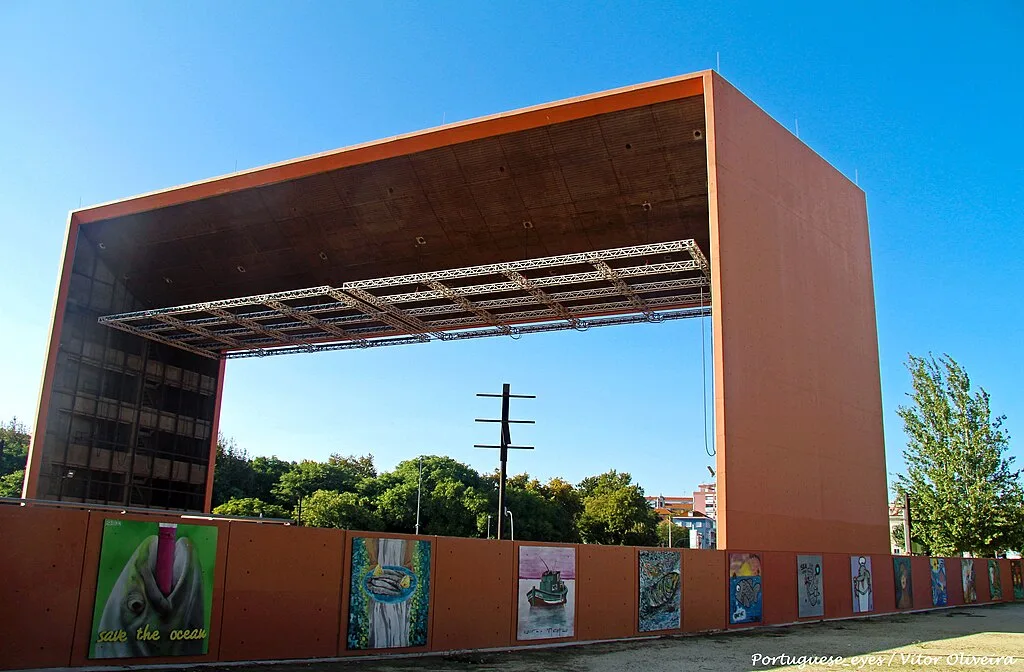 Photo: Vitor Oliveira, CC BY-SA 2.0. Wikimedia Commons.
A twenty-meter steel arch rises above the Sado waterfront, framing an open-air stage where music fills summer evenings. And on the building’s southern wall, a boy with birds — a character from a 1930s photograph — gazes over the city from Setúbal’s most famous mural.
History
The POLIS Program
The José Afonso Auditorium (Auditório José Afonso) was built as part of the “Viver Setúbal — POLIS” urban rehabilitation program (Programa de Requalificação Urbana e Valorização Ambiental das Cidades). It was the first completed structure of the Polis program in Setúbal. The project was designed by architect Manuel Salgado, known for his work on the Belém Cultural Center and the public spaces of Expo'98 in Lisbon.
Construction cost 4.3 million euros. The auditorium was inaugurated in November 2005. The opening ceremony was attended by the president of the municipal chamber and Polis program coordinator Pinto Leite, representing Minister Nunes Correia.
The Name
The auditorium is named after José Afonso (1929–1987), better known as Zeca Afonso — one of Portugal’s most important singers and songwriters. His song “Grândola, Vila Morena” served as the signal to launch the Carnation Revolution on April 25, 1974. Zeca Afonso spent his last years in the Setúbal area, teaching at a school in Azeitão, and died at Setúbal hospital on February 23, 1987. More than 30,000 people attended his funeral.
The square where the auditorium stands — Largo José Afonso — also bears his name.
Architecture and Description
The José Afonso Auditorium is an open-air concert venue with a capacity of up to 2,500 spectators.
The main architectural element is a monumental steel scenic arch (arco cénico) approximately 20 meters tall, functioning as both a proscenium and structural support for the stage. Suspended from the arch is a motorized metallic grid (teia metálica motorizada) that can be adapted to different technical requirements — from concerts to theatrical productions.
The building is semi-sunken: the lower level houses storage spaces and dressing rooms, while the spectator terraces follow the natural terrain slope descending toward the waterfront. This design integrates the auditorium into the urban landscape without disrupting the visual connection between Avenida Luísa Todi and the Sado estuary.
The “O Rapaz dos Pássaros” Mural
On the auditorium’s southern wall stands perhaps Setúbal’s most famous mural — “O Rapaz dos Pássaros” (“The Boy with the Birds”), created by Sérgio Odeith and inaugurated on March 28, 2014.
The mural is 20 meters tall, covering the entire southern wall of the building. It reproduces a photograph from the archive of Setúbal photographer Américo Ribeiro, taken in the 1930s. The photograph shows a barefoot boy selling birds on the streets of Setúbal. This boy was Vicente Inácio Martins, who at the time of the mural’s inauguration was 91 years old — and personally attended the ceremony.
The project was the fourth initiative of the “Arte em Toda a Parte” (“Art Everywhere”) program, organized by Immochan company in partnership with the municipality of Setúbal, during construction of the Alegro Setúbal shopping center. The ceremony was attended by Odeith, municipal chamber president Maria das Dores Meira, and Immochan’s general director.
In 2014, the I Support Street Art movement included “O Rapaz dos Pássaros” in its list of 24 best murals in the world.
Cultural Program
The auditorium functions primarily as a summer venue. Events include:
- Musical concerts — from folklore to contemporary music
- Theater productions and dance performances
- National Folklore Festival of Setúbal
- Fest’Asso — festival animating Largo José Afonso
- Various city events and celebrations
During summer months, the auditorium becomes the center of the city’s cultural life, attracting both locals and tourists.
Practical Information
- Address: Largo José Afonso, Setúbal
- Type: open-air auditorium (ao ar livre)
- Capacity: 2,500 spectators
- Getting there: located in the city center, next to Avenida Luísa Todi, within walking distance of main attractions
See Also
- José Afonso — Voice of the Carnation Revolution — the bard after whom the auditorium is named
- Street Art and the TAUS Program — context of Setúbal’s street art scene
- Odeith — Master of Three-Dimensional Illusions — creator of the mural on the auditorium wall
- Avenida Luísa Todi — the main waterfront avenue near the auditorium
If this article was useful — help us write the next one.
☕ Support on Ko-fi