Avenida Luísa Todi — Main Artery of the City
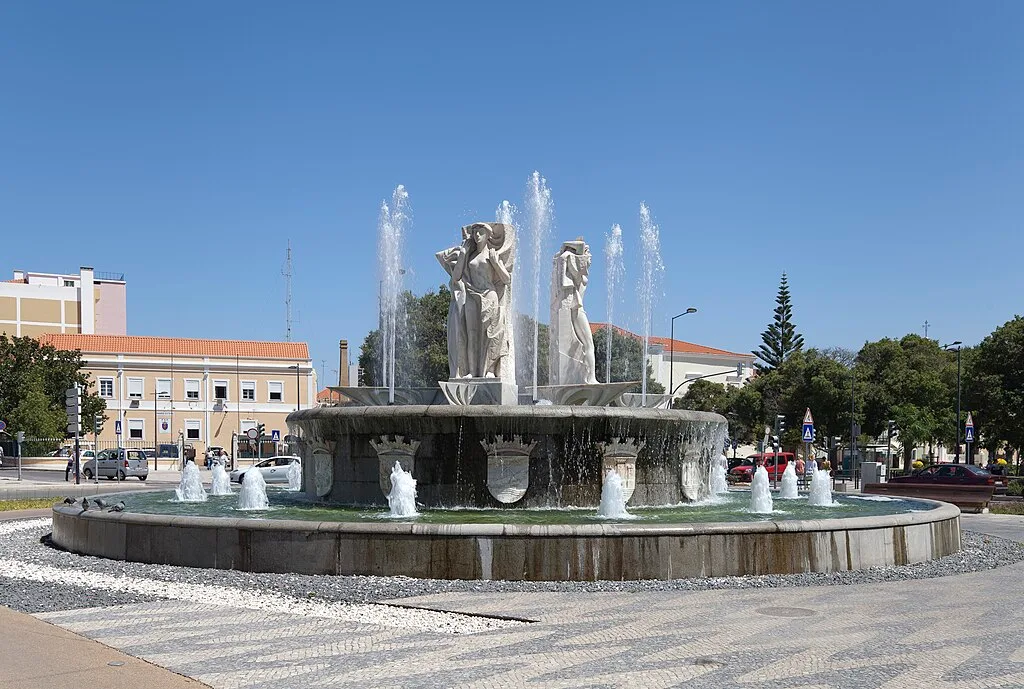 Photo: Diego Delso, CC BY-SA 3.0. Wikimedia Commons.
From water to city center stretches a wide avenue where the smells of sea, coffee from cafés, and history of three eras mix: fishing, industrial, and post-industrial — all have left their mark on the stones of Avenida Luísa Todi.
From Rua da Praia to Avenida Luísa Todi: Renaming of 1895
Avenida Luísa Todi is Setúbal’s main coastal artery, connecting the Fontainhas district waterfront in the west with Praça da Saboaria (Saboaria Square) in the east. About 1.2 km long, it is the heart of public life in the city: shops, restaurants, cafés, banks, administrative buildings.
Until 1895, the street was called Rua da Praia (Rua da Praia, lit. “Beach Street”) — a simple functional name reflecting its location along the shore of the Sado estuary. The name itself emphasized the space’s utilitarian character: it was a coastal path for fishermen, merchants, and porters, not a grand boulevard.
The decision to rename was made by the Câmara Municipal de Setúbal (municipal council) in 1895, in the context of a broader program to modernize urban toponymy. Instead of descriptive names (“Well Street,” “Fishermen’s Alley”), authorities began naming streets after historical figures connected with the city — a practice that spread across Europe in the 19th century as part of national romanticism.
The choice of Luísa Todi’s name (1753-1821) was determined by several factors:
- Worldwide fame — one of the greatest opera singers of the 18th century who glorified Portugal
- Local origin — born in Setúbal, in the Troino quarter
- Symbolic connection — her career began with performances on Setúbal streets, including Rua da Praia
- Gender dimension — [DISPUTED] There is controversy regarding the use of the husband’s surname (Todi) rather than the maiden name (Aguiar). Some feminist researchers point out that this reflects the patriarchal practice of depriving women of their own name.
The renaming occurred 74 years after the singer’s death, when her figure was already mythologized and cleansed of ambiguous aspects of her biography (for example, complex relations with the Portuguese court).
Three Historical Periods of the Street
Period I: Fishing and Trading Waterfront (until 15th — 17th-18th centuries)
In medieval and early modern periods, the territory of modern Avenida was a coastal zone with irregular construction. Archaeological finds attest to the presence of:
- Fishing huts (cabanas de pescadores) — temporary seasonal dwellings
- Salt warehouses (armazéns de sal) — storing salt before shipping on boats
- Shipyards (estaleiros) — minor repairs of fishing boats
- Fish market (mercado de peixe) — open trade under awnings
The street as such was absent — this was a coastal strip with chaotically located buildings, warehouses, and net-drying areas. Construction was one-story, predominantly wooden or clay, vulnerable to fires and floods.
In this period, fishing and agriculture dominated. Residents engaged in coastal fishing, harvesting mollusks in the estuary, growing vegetables in gardens beyond the fortress walls. The economy was subsistence or locally market-based, without large capital investments or industrial enterprises.
Period II: Bastion Defense and First Urbanization (17th-18th centuries)
In the 17th century, in the context of wars for Portuguese independence from Spain (1640-1668) and the threat of pirate raids, defensive bastions (baluartes) were built along the shore:
- Bastion of São Filipe (Baluarte de São Filipe) — western part, protection from sea attacks
- Bastion da Praia (Baluarte da Praia) — central part, artillery platform
- Bastion da Saboaria (Baluarte da Saboaria) — eastern part, control of port entrance
Bastions structured the space, transforming the chaotic coastal strip into an organized defensive line. Between bastions, a patrol road (caminho de ronda) was laid, becoming the prototype of future Rua da Praia.
Construction became more orderly:
- Warehouses consolidated into large royal arsenals (arsenais régios)
- Fishermen received licenses to build huts in certain zones
- Construction too close to bastions was prohibited (firing zone)
However, the street remained functional, not representational: no architectural beauty, no grand facades — only utilitarian structures for defense and commerce.
Period III: Industrial Transformation (late 19th — mid-20th century)
True transformation occurred in the late 19th — early 20th century with development of the canning industry. Along Avenida were built:
- Canning factories (fábricas de conservas) — multi-story brick buildings with characteristic smokestacks
- Port warehouses (armazéns portuários) — storing finished products before shipping
- Administrative buildings (escritórios) — offices of canning companies
- Tenement houses (prédios de rendimento) — housing for factory workers
Architecture of this period reflected industrial aesthetics:
- Brick facades with minimal decoration
- Large windows for workshop illumination
- Metal structures (beams, stairs)
- Pragmatic layout without frills
The street acquired industrial noise and smell: factory whistles regulated life’s rhythm, the smell of fried fish and oil permeated the air, trucks delivered canned goods to the port. This was a working street, where social life concentrated not in cafés and salons (as in Lisbon center) but in tascas (workers’ taverns), workshops, and union meetings.
It was in this period (1895) that the renaming in honor of Luísa Todi occurred — an attempt to add cultural prestige to a space that was actually an industrial zone.
Monument to Luísa Todi: 1933 Sculpture
In 1933, 38 years after the street’s renaming, the monument to Luísa Todi was installed on Avenida’s central esplanade — one of the few in Portugal dedicated to a woman.
Authors and Style
- Sculptor: Leopoldo de Almeida (1898-1975) — one of Portugal’s leading 20th-century sculptors, author of Salazar-era monuments
- Pedestal architect: Abel Pascoal — architect specializing in public structures
The monument is executed in Art Deco style with elements of neoclassicism, characteristic of Estado Novo’s (Salazar’s New State) official art. The bronze figure of Luísa Todi is depicted:
- In 18th-century opera dress
- At the moment of performing an aria (hand gesture, open mouth)
- On a high granite pedestal (about 3 meters)
- With bas-reliefs on the pedestal depicting musical instruments and laurel wreaths
Installation Context
The monument was installed during the Estado Novo period (1933-1974) — António Salazar’s authoritarian corporatist regime. The regime actively used monumental propaganda to create national identity, glorifying:
- Great past (age of discoveries, medieval kings)
- Traditional values (family, patriotism, Catholicism)
- Cultural achievements (writers, musicians, scientists)
Luísa Todi fit into this agenda as a symbol of Portuguese greatness (international fame) and femininity (singer, not politician or military leader). Her image was safe for the regime: no political activity, no connection with republicanism or socialism.
Today the monument is a popular meeting place, landmark, tourist attraction. But it’s important to remember its political context: it’s not just a tribute to a great singer, but part of authoritarian cultural policy.
Modern Avenida: From Industry to Services (1970s — Present)
With the crisis of the canning industry in the 1970s-1980s, Avenida Luísa Todi underwent functional transformation:
- Factory closures — most canning enterprises went bankrupt or moved to other regions
- Building repurposing — old factory buildings transformed into shops, restaurants, offices, housing
- Service sector development — banks, insurance companies, travel agencies
- Gentrification — rising real estate prices, influx of middle class
Today Avenida is a commercial and cultural center:
- Restaurants (predominantly seafood cuisine) — more than 30 establishments
- Cafés and confectioneries — traditional pastelarias with pastéis de nata and coffee
- Shops — clothing, electronics, books, souvenirs
- Cultural spaces — small galleries, antique shops
- Public events — fairs, concerts, festivals (especially in summer)
Architecturally, Avenida represents a palimpsest of eras:
- Several 17th-century defensive bastions preserved as archaeological ruins
- 19th-20th century industrial buildings with brick facades
- Modernist buildings from the 1950s-1960s (typical of Salazar era)
- Postmodernist interventions from the 1990s-2000s (glass facades, reconstructions)
This eclecticism sparks debate among urbanists:
- Critics speak of lack of cohesive architectural vision, “museumification” of industrial heritage
- Defenders emphasize organic development reflecting the city’s real history (not idealized reconstruction)
Social Life and Cultural Role
Avenida is a public space in the full sense: a place for meetings, walks, political demonstrations, celebrations.
Daily Life
- Morning (7:00-10:00): cafés opening, workers rushing to offices, elderly reading newspapers over coffee
- Day (10:00-18:00): tourists, shopping, business lunches in restaurants
- Evening (18:00-23:00): family walks, dinners in restaurants, youth in bars
- Night (23:00-2:00): nightlife (though less intense than in Lisbon)
Political Events
Historically, Avenida was a place for political demonstrations:
- 1974: demonstrations after the Carnation Revolution
- 1980s-1990s: union protests against canning factory closures
- 2010s: protests against austerity measures (austeridade)
Avenida’s wide space makes it ideal for mass gatherings — a tradition dating back to the 19th century when republican political rallies were held here.
See Also
- Luísa Todi — Prima Donna of European Stages
- Fontainhas — District of Fishermen and Salt Workers
- Canning Industry of Setúbal
- Mercado do Livramento — Market on the River Bank
If this article was useful — help us write the next one.
☕ Support on Ko-fi