Cabo Espichel and Our Lady's Sanctuary
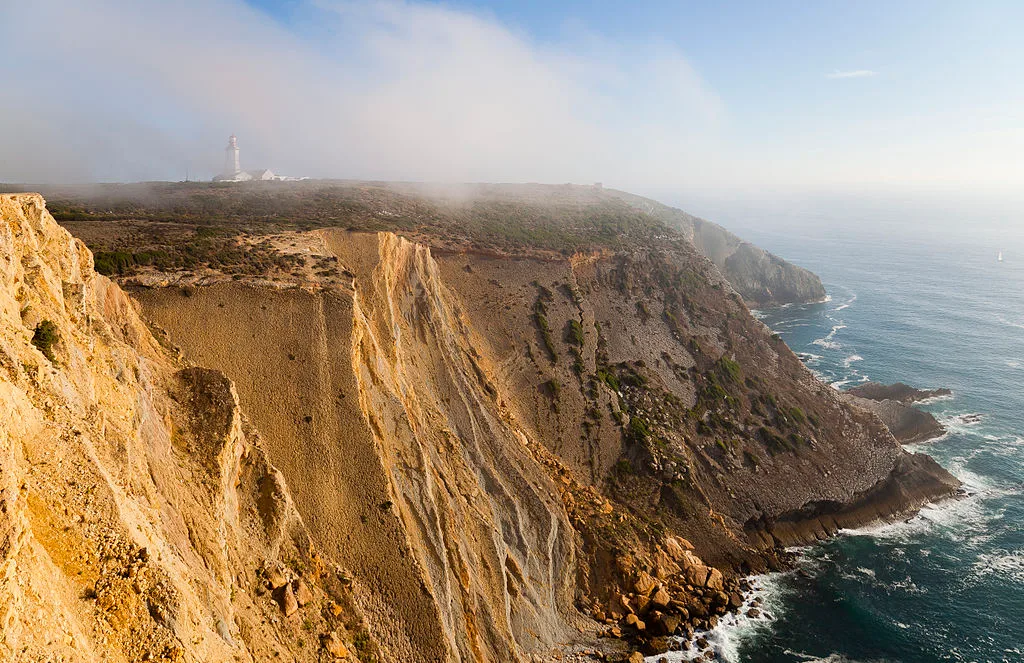 Photo: Diego Delso, CC BY-SA 3.0. Wikimedia Commons.
At the edge of the earth, where vertical cliffs plunge into the Atlantic abyss, human faith built a sanctuary — a place where the legend of Our Lady’s miraculous apparition meets the reality of fossilized dinosaur tracks left 150 million years ago.
Geography and Geology: Edge of the Earth
Cabo Espichel is the southwestern tip of the Setúbal peninsula, located in the municipality of Sesimbra, approximately 40 km west of Setúbal and 50 km south of Lisbon. It is one of Portugal’s most dramatic coastal landscapes: nearly vertical limestone cliffs up to 134 meters high plunge into the Atlantic Ocean.
Geological Characteristics
The cape is composed of Jurassic limestones aged about 150 million years (Late Jurassic), deposited on the bottom of a shallow tropical sea covering the Iberian Peninsula territory in the Mesozoic era. Subsequent tectonic processes raised the seabed, and erosion (waves, wind, rain) carved the modern relief.
The cliffs demonstrate:
- Horizontal bedding — parallel limestone layers corresponding to sedimentation cycles
- Karst forms — caves, grottos, caverns created by limestone dissolution by water
- Abrasion niches — cavities at cliff bases created by wave erosion
- Paleontological finds — marine organism fossils (ammonites, belemnites, bivalve mollusks)
The most famous paleontological feature is dinosaur tracks (pegadas de dinossauros) in coastal cliffs, documented since the 19th century. Tracks belong to sauropods (long-necked herbivorous dinosaurs) and theropods (carnivorous dinosaurs) and are preserved as three-toed prints in ancient lagoon deposits.
Local legend interpreted these tracks as “tracks of Our Lady’s mule” (pegadas da mula da Nossa Senhora), illustrating a typical mechanism of Christianization of prehistoric or natural objects.
Legend of Our Lady’s Apparition
According to Catholic tradition, documented since the 14th century, a miraculous apparition of Our Lady (Nossa Senhora do Cabo) occurred at Cabo Espichel. Several versions of the legend exist, the main one stating:
In the 13th century, fishermen from Sesimbra and surrounding villages, caught in a storm, prayed for salvation. Suddenly, on the cliff top, appeared a glowing figure of a woman who showed the way to shore. The ships safely reached harbor. The next day, residents climbed the cliff and discovered on the rocks tracks resembling mule hooves — a sign that Our Lady descended from heaven riding a mule.
An alternative version connects the apparition with shepherds (pastores) or peasants (lavradores) lost in fog and saved by light emanating from the cape summit.
Historical Veracity
The exact date of the apparition is unknown. The first written mention of pilgrimage to the cape dates to 1366, when royal chronicles mention a procession from Lisbon. This allows us to suppose the cult emerged no later than mid-14th century, possibly in the context of gratitude for deliverance from the Black Death (plague of 1348-1350).
The legend is typical of Marian cults (cultos marianos) in medieval Portugal: Our Lady appears in an inaccessible place (mountain peak, cape, cave), leaves a material sign (tracks, statue, spring), becomes an object of local veneration, then regional and national pilgrimages.
Pilgrimage Tradition: Círio dos Saloios (since 1430)
Círio dos Saloios (“Procession of Peasants”) is one of Portugal’s oldest continuous pilgrimage traditions, documented since 1430. The name comes from saloios — traditional designation for peasants (camponeses) of Lisbon’s surroundings engaged in farming and market gardening.
Historical Development
In the 18th century, pilgrimage reached peak popularity:
- Participated 26 parishes (freguesias) of the Lisbon-Setúbal region
- Total number of pilgrims reached 10,000-15,000 people per year
- Processions walked from distant villages (up to 80 km), journey took 2-3 days
- Carried banners (bandeiras), crosses, votive offerings (ex-votos)
Pilgrimage performed not only religious but also social functions:
- Communication between isolated rural communities
- Marriage market — youth met, engagements were concluded
- Commerce — fairs, selling agricultural products, artisan goods
- Cultural exchange — spreading news, songs, dances
In the 19th-20th centuries, tradition weakened due to:
- Secularization of society after liberal reforms of 1820s-1830s
- Urbanization — rural population outflow to cities
- Transport development — pilgrimage lost epic journey character
However, tradition didn’t completely cease. Since the 1970s, there has been revitalization in the context of interest in cultural heritage and local identity.
Architectural Complex of Santuário
Santuário de Nossa Senhora do Cabo Espichel is a large-scale architectural ensemble built in the 17th-18th centuries with funds from the crown, church, and pilgrims’ donations.
Main Elements
1. Church (Igreja de Nossa Senhora do Cabo)
Built in 1701-1707 by architect João Antunes, one of the leading representatives of Portuguese Baroque. Architectural characteristics:
- Plan: Latin cross with one nave
- Facade: Baroque, with two towers (unfinished)
- Interior: gilded altars (talha dourada), 18th-century azulejos (tiles)
- Main altar: statue of Our Lady of the Cape, object of pilgrimage veneration
2. Pousada (pilgrims’ inn)
Two symmetrical wings (alas) forming a courtyard (pátio) before the church:
- North wing (Ala Norte): 30 cells for pilgrims
- South wing (Ala Sul): 30 cells + administrative premises
- Architecture: ascetic, with open galleries (arcadas) on first floor
Today the wings are abandoned, but discussions continue about restoration and transformation into a museum or hotel.
3. Aqueduct (Aqueduto)
Built in the 18th century to deliver water from a source located 3 km from the cape. Partially destroyed, but surviving arches demonstrate engineering mastery of the era.
4. Lighthouse (Farol do Cabo Espichel)
Built in 1790, one of Portugal’s oldest operating lighthouses. Tower height 32 meters, light visible at 17 nautical miles. Automated since the 1960s.
5. Chapel of Memory (Capela da Memória)
Small chapel on the cliff edge, built in the 15th century (rebuilt in 17th) at the site of Our Lady’s supposed apparition. Inside — pilgrims’ votive offerings: paintings, sculptures, personal items.
Annual Festival: Festas em Honra de Nossa Senhora do Cabo Espichel
The modern Festival in Honor of Our Lady of the Cape is held annually September 23-26 and includes religious, cultural, and entertainment events.
Festival Program
September 23 — Opening, evening mass
September 24 — Pilgrimage processions from surrounding villages:
- Procession from Sesimbra (12 km on foot)
- Procession from Aldeia do Meco (8 km)
- Bus deliveries of pilgrims from distant parishes
September 25 (Sunday) — Main day:
- Solemn mass (Missa Solene) at 11:00 with participation of Setúbal bishop
- Procession with statue of Our Lady around sanctuary
- Blessing of the sea (bênção do mar) — priest blesses ocean, praying for fishermen’s safety
- Fair (feira) with traditional products, crafts
- Concert of folklore ensembles in evening
September 26 — Closing, farewell mass
Attendance
In the 18th century, the festival gathered 10,000-15,000 people. Today attendance is about 5,000-7,000 people, mainly:
- Elderly pilgrims — retirees preserving tradition
- Tourists — attracted by spectacle and landscape
- Youth — participates in cultural events but less in religious ones
The church and municipality of Sesimbra are trying to rejuvenate the tradition through educational programs in schools, contemporary music concerts, social media marketing.
Dinosaur Tracks: Collision of Science and Legend
In Cabo Espichel’s coastal cliffs, more than 100 dinosaur tracks are documented, preserved in Late Jurassic limestone deposits (150 million years ago).
Scientific Significance
Tracks belong to:
- Sauropods (Sauropoda) — giant herbivorous dinosaurs (e.g., Lourinhanosaurus), leaving rounded four-toed prints up to 80 cm diameter
- Theropods (Theropoda) — carnivorous dinosaurs (e.g., Allosaurus), leaving three-toed prints 30-40 cm long
Tracks attest that in the Jurassic period, the territory represented a coastal lagoon with muddy bottom where dinosaurs wandered, leaving prints quickly covered by sediments and fossilizing.
Since the 19th century, tracks have been studied by paleontologists:
- 1884: first scientific description by Portuguese geologist Nery Delgado
- 1950s-1970s: systematic research by Portuguese and French specialists
- 2000s: inclusion in Geopark Naturtejo (UNESCO geopark), protection and popularization programs
Religious Interpretation
The church long ignored scientific interpretation, preserving the legend of “tracks of Our Lady’s mule”. Only since the late 20th century has the official position softened: the paleontological nature of tracks is acknowledged, but it’s emphasized that “God acts through nature,” and ancient tracks became part of Divine providence that indicated the place for the sanctuary.
This is an example of accommodation — a strategy of coexistence between religious tradition and scientific knowledge without direct conflict.
Contemporary Significance: Between Tourism and Spirituality
Today Cabo Espichel is a multifunctional space:
- Religious: operating sanctuary, pilgrimage site
- Cultural: Baroque architecture monument, cultural heritage object
- Natural: part of Parque Natural da Arrábida, ornithological zone (seabird nesting)
- Scientific: paleontological object, geopark
- Tourist: scenic views, hiking trails, photography
Use conflicts:
- Mass tourism vs. preserving fragile architecture (old buildings require restoration)
- Commercialization vs. spiritual authenticity (souvenir shops, restaurants)
- Open access vs. protecting dinosaur tracks (erosion from tourist feet)
The municipality of Sesimbra developed the Cabo Espichel Management Plan (2020), providing for balance through attendance limits, ecological tourism, educational programs.
See Also
- Geology of Serra da Arrábida
- Reconquista and Medieval History
- Fishing Culture and Traditions
- Azeitão — Village of Cheese and Wine
The light is on for free. But someone has to clean the lantern.
☕ Support on Ko-fi