Castle of Palmela
The Castle of Palmela (Castelo de Palmela) is a medieval fortress crowning the hilltop of the town of Palmela, overlooking the valley of the Sado River and the Serra da Arrabida mountain range. Once the headquarters of the military-religious Order of Santiago, it is now a national monument of Portugal and a historic hotel (pousada).
History
Prehistoric and Roman Period
The first settlement on the hill where the castle stands dates to the Neolithic era. Some researchers date the foundation of a fortified settlement to 310 BC. [UNVERIFIED] During the Romanisation of the Iberian Peninsula, around 106 AD, the Roman praetor Aelius Cornelius is believed to have fortified this site. The strategic position of the hill – commanding the Sado valley, the Tagus estuary, and the route southward – determined its military significance throughout all subsequent history.
The Moorish Fortress
After the Visigothic period, the hill was occupied by the Muslims, who erected the first substantial fortification between the 8th and 9th centuries. In the 10th–12th centuries, the defences were significantly expanded. It was this Moorish fortress that formed the foundation for all subsequent rebuilding.
The Reconquista: The Struggle for Palmela
The castle changed hands repeatedly during the Reconquista:
- 1147 – King Afonso Henriques (Afonso I) captured the castle in the context of the conquest of Lisbon.
- 1165 – the Battle of Palmela: Afonso I defeated the Muslim ruler of Badajoz, consolidating control of the fortress.
- 1186 – King Sancho I granted Palmela, together with Almada and Alcacer do Sal, to the military-religious Order of Santiago (Ordem de Santiago).
- 1191 – the Almohad caliph Yaqub al-Mansur recaptured the castle, inflicting a heavy defeat on the Christians.
- 1194 – Sancho I attempted to retake the fortress.
- 1201 – the castle was definitively reconquered by the Portuguese. The king ordered the restoration of the fortifications and confirmed the grant to the Order of Santiago.
Headquarters of the Order of Santiago
From the date of its grant in 1186, and definitively from 1201, Palmela became the stronghold of the Order of Santiago in Portugal. The Order – a military-religious brotherhood founded in Spain in 1170 to fight the Moors – played a decisive role in the Reconquista and in the subsequent governance of southern Portugal.
In 1443, the castle was officially designated as the principal seat (sede) of the Portuguese branch of the Order of Santiago. This transformed the fortress from a purely military installation into a religious-military complex. The knight-monks built within the castle walls a monastery and the Church of Santiago (1483), which became the centre of the Order’s spiritual life.
The 1755 Earthquake
The earthquake of 1755 inflicted significant damage on the castle: the church and the defensive walls partially collapsed. The catastrophe accelerated the decline of the fortress as a functioning military installation.
Secularisation and Neglect
In the 19th century, following the dissolution of the religious orders in Portugal (1834), the castle lost its inhabitants and gradually fell into ruin. For more than a century, the complex deteriorated.
Architecture and Description
Walls and Layout
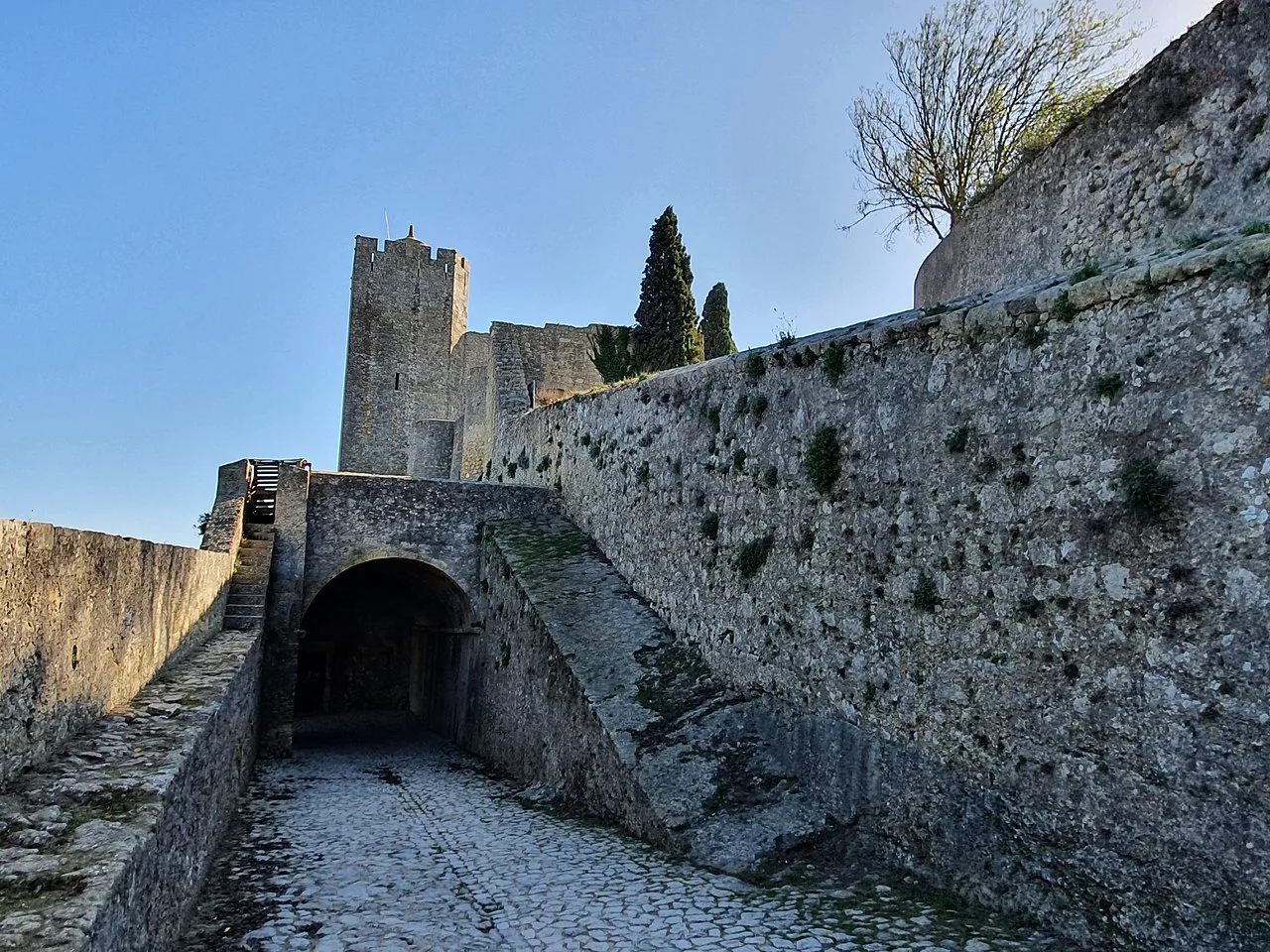
The castle occupies the summit of the hill and consists of several defensive rings from different periods. The lower ring of walls (barbaca) encloses a substantial area; the upper castle (alcacova) is a compact citadel of Moorish origin. The overall plan reflects the layering of historical epochs: the Moorish core, medieval Christian additions, the 15th-century monastic complex.
The Church of Santiago
Within the walls stands the Church of Santiago (Igreja de Santiago), erected in 1483 in the Late Gothic style. The church was dedicated to the patron saint of the Order – the Apostle James. Despite the damage sustained in the 1755 earthquake, it has preserved its Gothic structure.
The Church of Santa Maria
Also within the castle grounds is the Church of Santa Maria, originally dating to the 12th century but rebuilt during the Renaissance.
The Monastery of the Order of Santiago
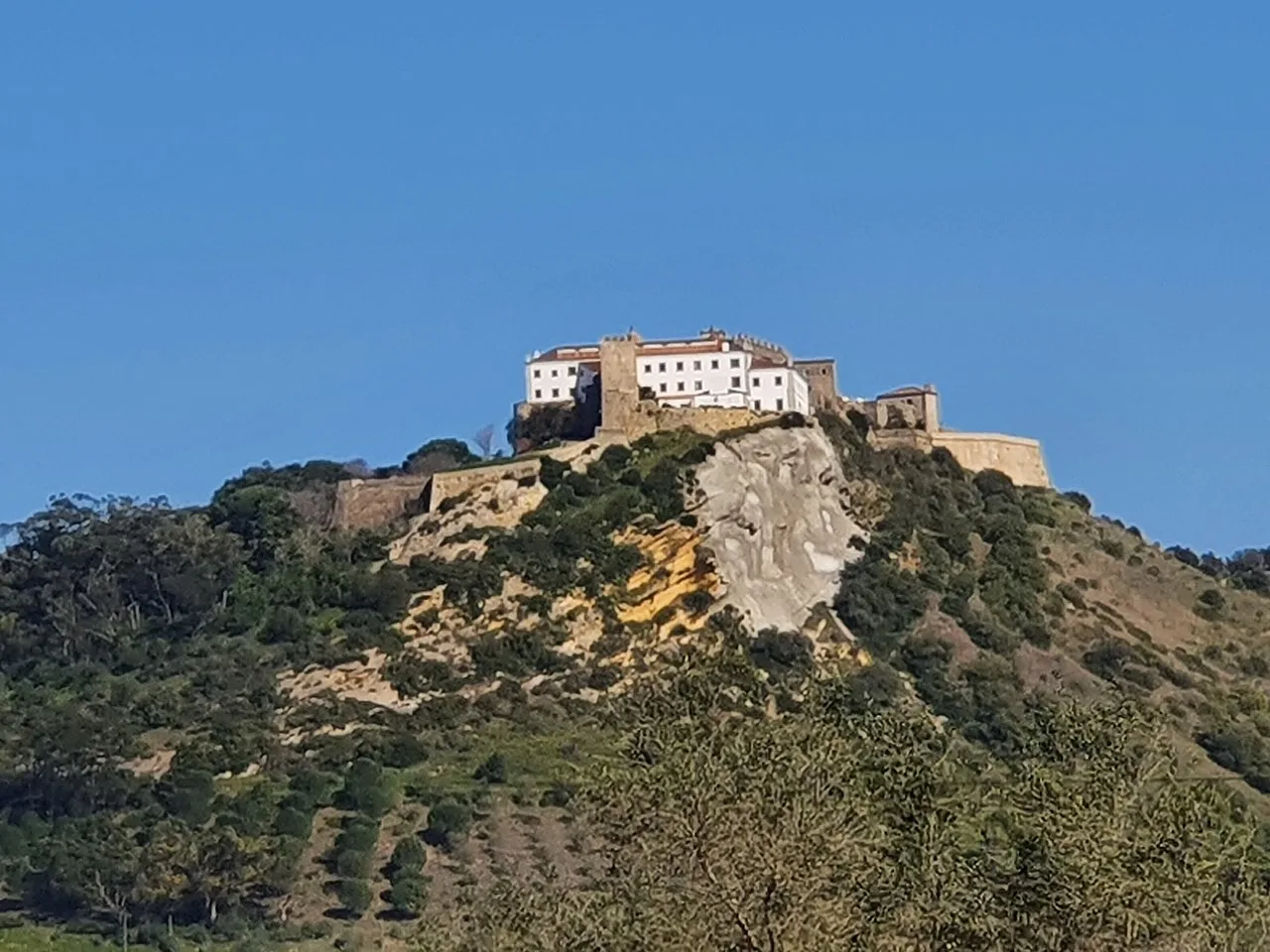
The monastic buildings, adjoining the church, include a cloister, refectory, and cells. It was these quarters that were converted into a pousada hotel in the second half of the 20th century.
The Panorama
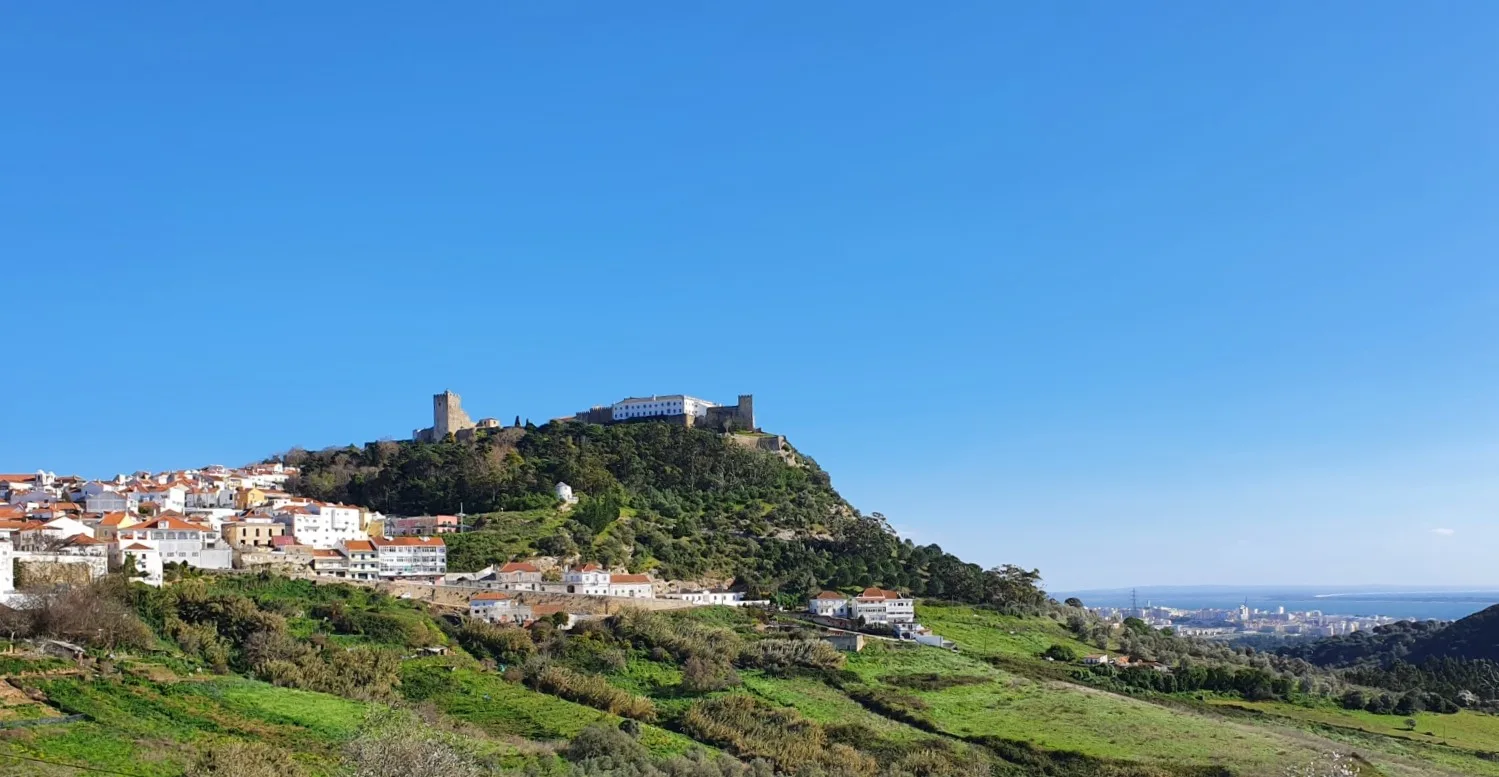
The castle is situated at an elevation that affords a panoramic view of the surrounding landscape. From its walls one can see:
- The Sado valley and the city of Setubal
- The Serra da Arrabida mountain range
- The Troia Peninsula and the Atlantic Ocean
- The plains of the Alentejo to the east and south
On a clear day, the view extends as far as Lisbon and the Vasco da Gama Bridge.
Significance
Military and Strategic
The Castle of Palmela controlled one of the key positions in southern Portugal. Its location allowed observation of both maritime and overland routes between Lisbon and the Alentejo. During the Reconquista, the fortress was one of the links in the defensive line that protected Lisbon from the south.
Religious and Historical Context
As the headquarters of the Order of Santiago, Palmela was the administrative centre for vast territories in southern Portugal. The Order controlled lands, revenues, and jurisdiction stretching from Almada to the Algarve. The history of the castle is inseparable from the history of the military-religious orders that played a decisive role in the formation of the Portuguese state.
Protected Status
The castle is classified as a National Monument of Portugal (Monumento Nacional) by decree of 23 June 1910.
The Pousada: A Historic Hotel
In the 1940s, work began to save the castle from destruction. The restoration, which took approximately ten years, was carried out with the aim of converting the monastic quarters into a hotel within the Pousadas de Portugal network – a government programme for accommodation in historic buildings.
The Pousada Castelo Palmela opened in 1979. The former monastery of the Order of Santiago was transformed into a hotel that preserves the historic atmosphere: the cloister, stone corridors, views from the fortress walls. The pousada is currently managed by the Pestana group.
Practical Information
- Address: Castelo de Palmela, 2950 Palmela
- Coordinates: 38.5667 N, 8.9000 W
- Distance from Setubal: approximately 8 km to the north
- Access: the castle grounds are open to visitors; the pousada is an operating hotel
Opening hours for the castle grounds may vary. It is advisable to check before visiting.
Image sources
- castelo-walls.webp — Walls and towers of Castelo de Palmela. Author: GualdimG. License: CC BY-SA 4.0. Source
- castelo-pousada.webp — Castelo de Palmela with the Pousada. Author: GualdimG. License: CC BY-SA 4.0. Source
- castelo-panoramic-setubal.webp — View towards Setubal and Troia peninsula. Author: GualdimG. License: CC BY-SA 4.0. Source
See also
- Monastery of Jesus – another monument from the era of the military-religious orders in the Setubal region
- Fort of Sao Filipe – a 16th-century fortress, also converted into a pousada
- The 1755 Earthquake – the catastrophe that damaged the castle
- Arrabida Natural Park – the mountain range visible from the castle walls
If this article was useful — help us write the next one.
☕ Support on Ko-fi