Jardim do Quebedo
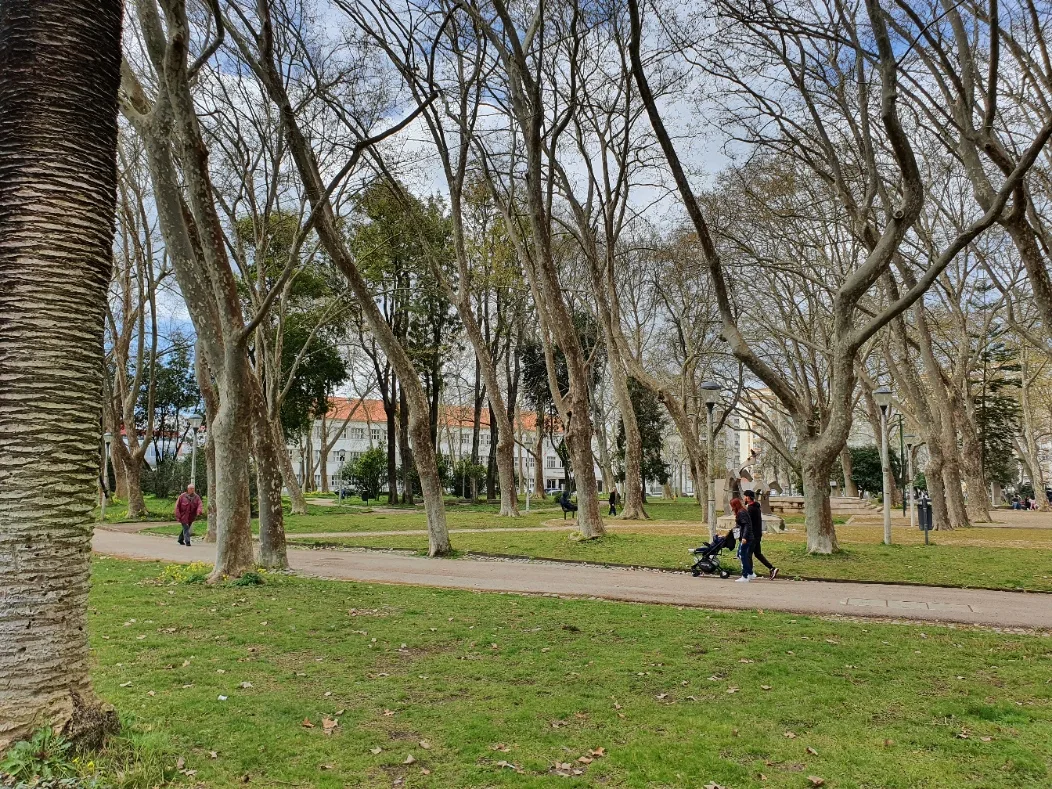 Photo: GualdimG, CC BY-SA 4.0. Wikimedia Commons.
The Jardim do Quebedo is a historic urban garden in the centre of Setubal, also known as the Parque do Quebedo and Jardim 1.o de Maio. A green space that arose in the 19th century on the site of a former trading square, it became one of the city’s principal places of recreation.
History
The Origins of the Names
The Jardim do Quebedo has borne several names over the years, each reflecting a particular layer of urban history:
- Jardim dos Grilos (“Garden of the Crickets”) – an early name linked to a nearby church. [FOLKLORE] The nickname “grilos” (crickets) is associated in Portuguese tradition with the Discalced Augustinians, who acquired it at the “lugar do Grilo” in Lisbon, and later became famous for the Igreja dos Grilos in Porto. Whether an analogous connection existed in Setubal is undocumented.
- Jardim de Palhais – the name that became attached to the garden during its formative period.
- Jardim General Luiz Domingues – the official designation, honouring a military figure.
- Jardim 1.o de Maio (“1st of May Garden”) – a name associated with International Workers’ Day.
- Jardim / Parque do Quebedo – the most common colloquial name, firmly established in everyday speech among the city’s residents.
The word “Quebedo” itself, in the toponymy of Setubal, denotes the district adjoining the garden. The name derives from the Palacio dos Quebedos – a palace situated to the west of the garden, on the square formerly known as Praca de Sao Bernardo.
From Trading Square to Garden
The site now occupied by the garden originally formed part of the Praca de Sao Bento – a square used for trade. The transformation of the trading square into a public green space took place in the late 19th century, during the period when European cities were creating public parks and gardens en masse, inspired by the hygiene movement and the garden-city ideal.
For Setubal – an industrial city with densely built fishing and factory quarters – the appearance of a publicly accessible garden held particular social significance: it was a place where residents of the working-class districts could find rest in the shade of trees.
The Quebedo Railway Station
The Quebedo district gained further importance with the arrival of the railway. The section between Setubal and Setubal-Mar was built in 1907, but the platform at Praca do Quebedo (Apeadeiro de Praca do Quebedo) officially began serving passengers only on 25 May 1920, as part of the Sado line connecting Setubal with Alcacer do Sal. In 1934, the General Directorate of Railways approved the project for the station building, designed by architect Cottinelli Telmo, as part of the programme for developing the Southern and South-Eastern networks. The proximity of the railway halt to the garden determined its role as a transit point – a place where passengers waited for trains or rested upon arrival.
Description
Vegetation
The garden is notable for its dendrological collection. Among the trees that stand out for their size and botanical interest are:
- Linden trees (Tilia sp.) – creating the atmosphere characteristic of European urban gardens
- Lagunaria (Lagunaria sp.) – a tropical tree, testifying to the mild climate of the region
- Southern nettle tree (Celtis australis) – a Mediterranean species typical of southern Portugal
The tree plantings form a dense canopy that provides shade during the hot summer months, when temperatures in Setubal regularly exceed 30 C.
The Palhais Fountain
The centrepiece of the garden is the Fonte de Palhais, also known as the Chafariz de Sao Bernardo – after the nearby Bernardine nuns’ convent. Built of white marble in 1772, it is a Baroque structure of the Pombaline era, with a flat backing and an elliptical basin. Its decorative programme displays the dynamism typical of the Baroque – volutes, curved and angular forms, ornamental projections. Beyond its decorative function, the fountain historically served as a source of drinking water for the residents of surrounding neighbourhoods.
Small Architectural Features
The garden is adorned with statues and water features. The specific composition of the sculptural elements requires clarification from local sources.
Significance
A Social Space
In a city historically oriented toward industry and fishing, publicly accessible green spaces played an important role in the organisation of daily life. The Jardim do Quebedo is one such place where social boundaries were effaced: fishermen from the waterfront quarters and office workers from the city centre alike came here to rest.
Urban Ecology
In the context of Setubal’s dense historic fabric, the garden represents a significant green island. Mature trees, some of which are more than a century old, sustain a stable microecosystem within the urban environment.
Contemporary Life
The garden continues to function as a living public space. In recent years, new attractions have appeared, including a terrace cafe integrated into the garden landscape. Cultural events and fairs are held here from time to time.
Practical Information
- Address: Praca Luiz Domingues / Avenida Belo Horizonte, 2910 Setubal
- Coordinates: 38.5220 N, 8.8940 W
- Access: open public garden, free entry
- Transport: the Praca do Quebedo railway platform (Sado line) is located nearby
The coordinates are approximate and correspond to the central part of the garden.
See also
- Praca do Bocage – the central square of Setubal, another key public space in the city
- Monastery of Jesus – the architectural landmark of central Setubal
- Museu do Trabalho Michel Giacometti – the waterfront museum documenting the history of the working quarters
All our knowledge is free. Creating it is not.
☕ Support on Ko-fi