Museu do Trabalho Michel Giacometti
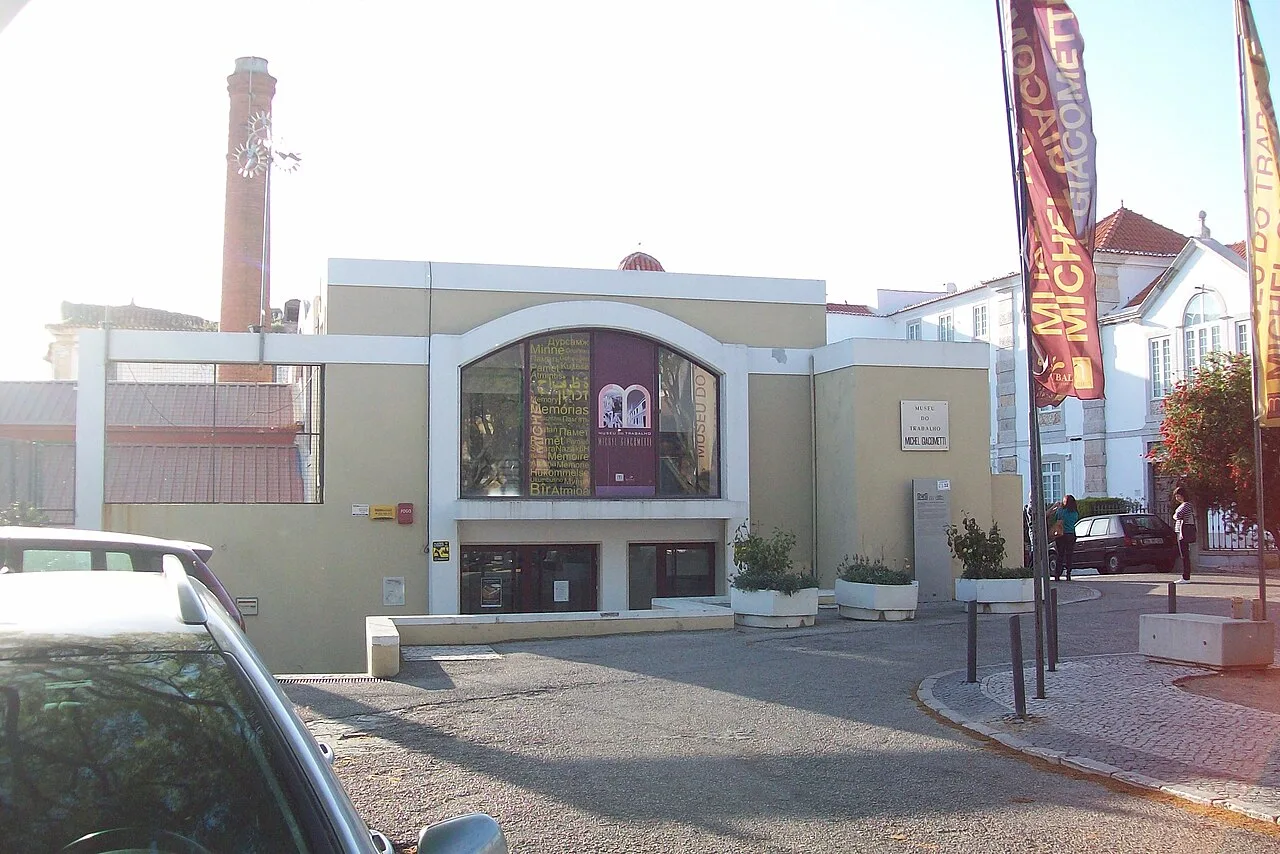
The Museu do Trabalho (Museum of Labour) Michel Giacometti is a municipal museum in Setubal, housed in a former canning factory on the waterfront. It is dedicated to the history of labour, industry, and folk traditions of the region, and bears the name of the Corsican ethnographer Michel Giacometti, who spent thirty years collecting the testimony of Portuguese popular culture.
History
The Perienes Canning Factory
The museum building is a former five-storey canning factory, Perienes (Fabrica de Conservas Perienes), one of the numerous canning enterprises that defined Setubal’s economic character throughout the 19th and 20th centuries. The factory stood in the historic quarter of fishermen, salt workers, and cannery hands – the district adjoining the waterfront of the Sado River.
Setubal was one of the principal centres of Portugal’s canning industry. By the mid-20th century, the country had more than 400 canning plants, a significant proportion of which were concentrated in Setubal, Espinho (near Porto), and the Algarve. The production of canned sardines in olive oil became one of Portugal’s key export industries – by 1912, the country ranked first in the world in canned fish exports.
The Perienes factory ceased operations in 1971, becoming one of the casualties of the gradual decline that overtook the industry in the second half of the 20th century.
Michel Giacometti: The Ethnographer and His Mission
The museum bears the name of Michel Giacometti (1929–1990) – an ethnographer of Corsican origin who devoted his life to documenting Portuguese popular culture.
Giacometti was born on 8 January 1929 in Ajaccio (Corsica). Orphaned at an early age, he was raised by maternal uncles, lived in North Africa (colonial Algeria), then returned to France, where he studied literature and ethnology in Paris.
In 1959, Giacometti moved to Portugal and spent the last thirty years of his life in the country. He founded the Arquivos Sonoros Portugueses (Portuguese Sound Archives) and systematically travelled the country, recording oral traditions that were vanishing in the wake of modernisation. In the 1960s, in collaboration with the composer Fernando Lopes-Graca, he published the Antologia da Musica Regional Portuguesa (Anthology of Portuguese Regional Music) – one of the most important collections of traditional Portuguese music.
Giacometti’s work was not merely scholarly but also civic in character: under the Salazar regime, the documentation of folk culture was a form of cultural resistance. After the Carnation Revolution (1974), his activity intensified and ultimately led to the creation of the Museum of Labour – an institution dedicated to preserving the memory of Setubal’s working heritage.
Michel Giacometti died on 24 November 1990 in Faro.
The Opening of the Museum
The museum opened in 1995 in the restored building of the Perienes factory. The decision to house the museum in a former industrial building was deliberate: the space itself becomes an exhibit, allowing the visitor to sense the scale and atmosphere of canning production.
In 1998, the museum received an honourable mention from the Council of Europe as part of the European Museum of the Year Award – recognition of the quality of its concept and exhibitions.
Description and Exhibitions
Permanent Exhibitions
The museum contains several permanent exhibitions:
-
“The Canning Industry: From Auction to Tin” (A Industria Conserveira: Do lota a lata) – documents the full cycle of canning production: from the fish auction and gutting to packaging and labelling. The exhibition features factory equipment, colourful tin labels (works of graphic design in their own right), and a series of contemporary paintings depicting the processes of production.
-
“The Rural World – The Ethnographic Collection of Michel Giacometti and the Genesis of the Museum” (Mundo Rural) – a collection assembled in the 1970s by students of the Servico Civico Estudantil (Civic Student Service) under Giacometti’s guidance. It comprises tools, household objects, and material testimony to the agrarian culture of Portugal.
-
“Mercearia Liberdade – A Heritage to Preserve” (Mercearia Liberdade) – a recreation of a traditional Portuguese grocer’s shop (mercearia), a vanishing type of commercial space.
Industrial Architecture as Exhibit
The five-storey factory building preserves its industrial structure: the high ceilings of the production floors, the industrial windows overlooking the waterfront. The riverside location is no accident – factories were built close to the wharves where fishing boats landed their sardine catch.
Significance
The Museum of Labour occupies a special place in Setubal’s cultural landscape for several reasons:
-
Memory of a lost industry – the canning industry that once defined Setubal’s identity has all but vanished. Of the more than 400 factories across Portugal, only about 20 remain today. The museum preserves the memory of an industry that fed thousands of families and shaped the social fabric of entire neighbourhoods.
-
An ethnographic approach – the museum does not confine itself to the technical history of production; it shows the people – the fishermen, the women of the canning factories, the salt workers – their working conditions, their daily lives, and their culture.
-
Giacometti’s legacy – the museum carries forward the work of an ethnographer for whom the collection and preservation of popular heritage was a life’s purpose. In a sense, the entire museum is a materialisation of his method: the systematic, respectful documentation of a vanishing world.
-
Industrial conversion – the transformation of an abandoned factory into a museum was one of the early examples of industrial conversion in Portugal and influenced the approach to the renovation of Setubal’s waterfront.
Practical Information
- Address: Largo Defensores da Republica, 2910-470 Setubal
- Coordinates: 38.5232 N, 8.8864 W
- Opening hours: Tuesday–Friday 09:30–18:00, Saturday–Sunday 14:00–18:00
- Closed: Monday and public holidays
- Admission: approximately 1.60 EUR
Opening hours and admission fees may change. It is advisable to check current information on the Museus Municipais de Setubal website.
Image sources
- museu-exterior.webp — Museu do Trabalho — a former canning factory. Author: El-Kelaa-des-Sraghna. License: CC BY-SA 4.0. Source
See also
- Monastery of Jesus – the Setubal Museum, another municipal museum in the city
- Livramento Market – the historic market, linked to Setubal’s fishing tradition
- Praca do Bocage – the central square, located nearby
All our knowledge is free. Creating it is not.
☕ Support on Ko-fi