Fado in Setubal
Fado (port. fado) is a genre of Portuguese music pervaded by the feeling of saudade – a longing for what is lost, an abiding nostalgia. In Setubal, fado possesses a distinctive character: here the music is inextricably linked with the fishing community, the sea and the Sado estuary, and its sound differs from both the metropolitan Lisbon style and the academic Coimbra tradition.
Origins
Fado as a national genre
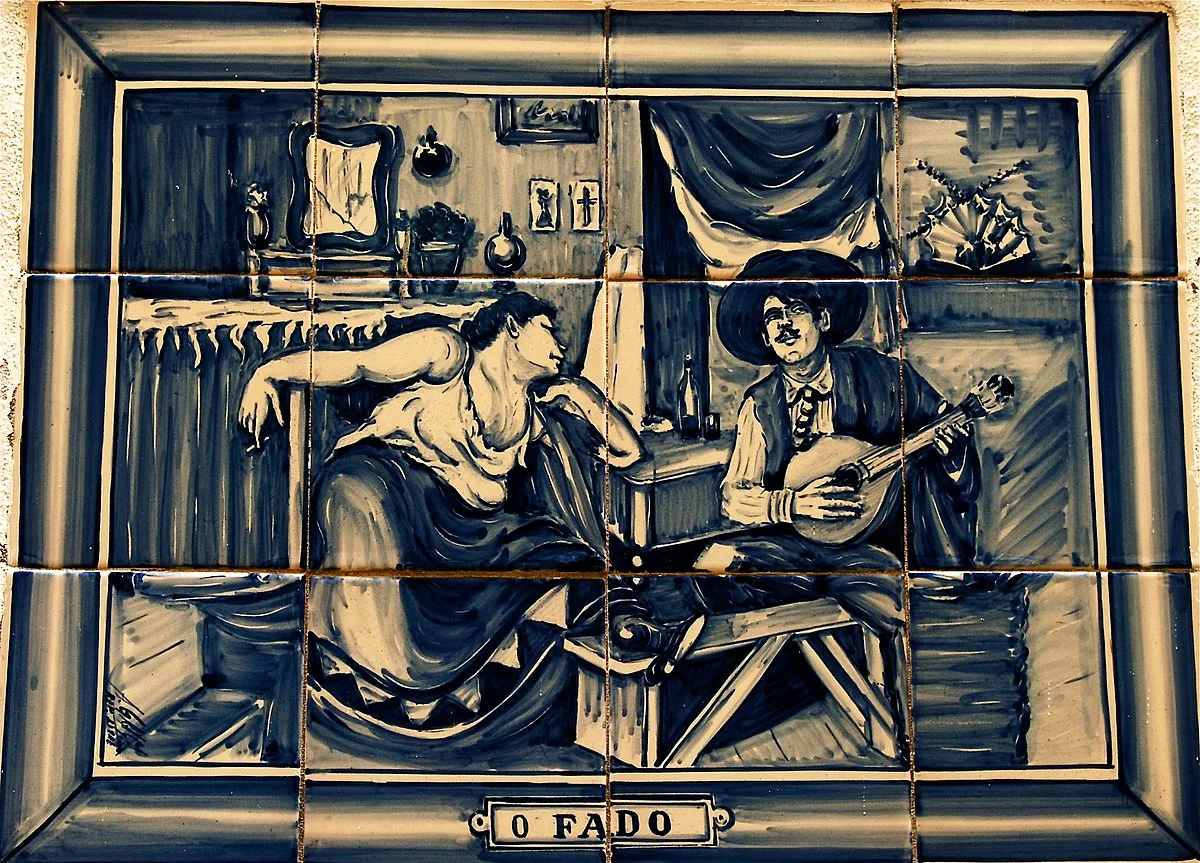
Fado was born in the Lisbon neighbourhoods of Alfama and Mouraria in the 1820s, although its roots probably run deeper – to Portuguese seafaring songs, the Brazilian lundu and the medieval troubadour tradition. In its earliest form, fado was performed spontaneously: in courtyards, in the streets, in taverns, among sailors, fishermen and the urban poor. It was the music of marginalised people, the voice of those whose lives were bound up with the sea, with parting and with uncertainty.
In 2011 UNESCO inscribed fado on the Representative List of the Intangible Cultural Heritage of Humanity, recognising it as a unique expression of Portuguese cultural identity.
The musical tradition of Setubal
Setubal has deep musical roots. The city gave Portugal one of the greatest opera singers of the 18th century – Luisa Todi (1753–1833), whose name adorns the city’s main waterfront promenade, the Avenida Luisa Todi. Although Todi was not a fadista in the modern sense, her legacy fostered in Setubal a special regard for vocal art and musical expressiveness.
Fado most likely reached Setubal in the second half of the 19th century, along with the growth of port life and the intensification of links with Lisbon. The city’s fishing quarters – Bairro do Troino and Bairro dos Pescadores – became a natural environment for this music, whose principal themes were the sea, separation and the hardships of a fisherman’s life.
Description
The character of Setubal fado
Fado in Setubal differs from the two best-known schools – those of Lisbon and Coimbra:
- Lisbon fado is urban and theatrical, tied to the nightlife of the capital, with professional casas de fado (fado houses) and a commercial industry
- Coimbra fado is academic, performed exclusively by men, linked to the university tradition, and more refined in its melodic idiom
- Setubal fado is popular, tied to the fishing community, performed in neighbourhoods and in the streets, preserving a bond with the everyday life of the sea
In Setubal fado, the prevailing themes are those distinctive to a port city:
- Waiting – fishermen’s wives awaiting the return of their husbands from the sea
- Saudade for the sea – longing for those who left and never came back
- Life on the Sado River – the estuary as the centre of communal existence
- Toil and poverty – the hard lot of fishing families and the women of the canning factories
Instrumentation
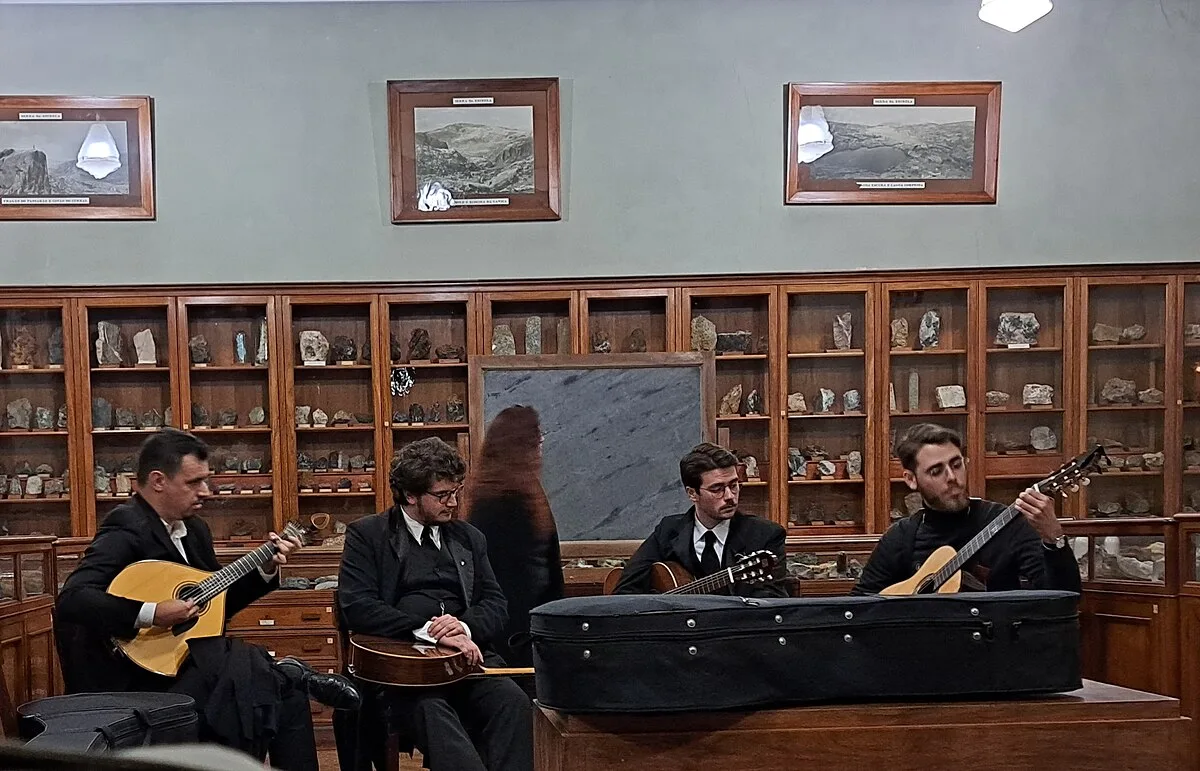
The traditional fado ensemble comprises:
- Guitarra portuguesa – a twelve-stringed, pear-shaped guitar with a characteristic shimmering tone that defines the timbre of fado
- Viola de fado – a classical six-stringed guitar providing the harmonic foundation
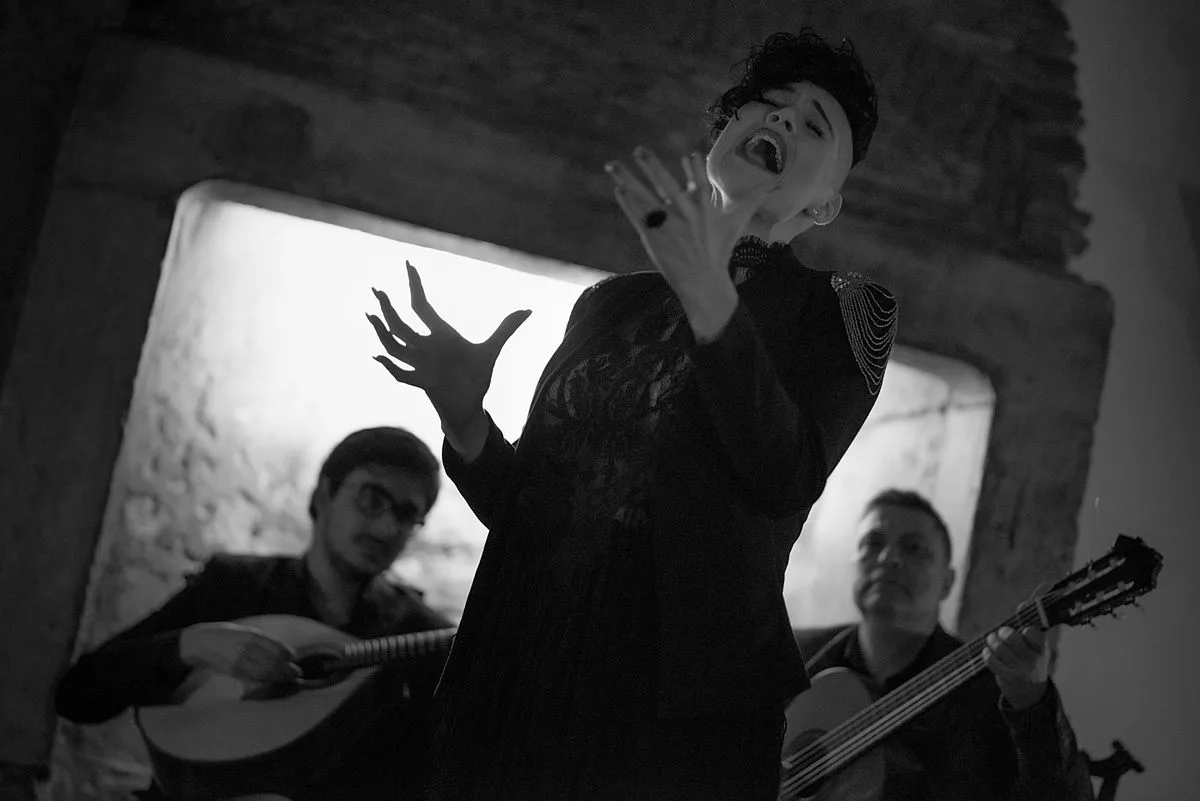
- Voice (voz) – the central element; the fadista typically sings standing, with eyes closed, wearing the traditional black shawl (xaile)
Significance for the city
Fado and the fishing identity
In Setubal, fado is not a museum piece or a tourist attraction but part of the living culture of the fishing quarters. It is the music that rang out in the harbour taverns where fishermen would drink wine and eat choco frito after a day’s work, and that continues to sound in the streets of the city on summer evenings.
The connection between fado and the sea in Setubal runs deeper than in Lisbon: here saudade is not an abstract philosophical category but a concrete experience of families whose men went to sea every day and did not always return. Fado in the Setubal tradition is a chronicle of the life of the fishing community.
Fado as a social institution
In the fishing quarters of Setubal, fado historically served as a bond of social cohesion: fado evenings in the taverns were a form of collective experience, a communal therapy. Women whose husbands were at sea would gather to sing and to listen to songs that expressed their shared experience of waiting and anxiety.
How it takes place today
The “Fado em Setubal” programme
Since 2015 the Municipality of Setubal has run the “Fado em Setubal” programme as part of the cultural initiative “Cultura em Movimento” (Culture in Motion). The programme has been running for more than eight years and continued even during the pandemic.
Format:
- Time: Fridays and Saturdays at 21:30, from July to August
- Venue: Streets and squares of Setubal’s neighbourhoods, as well as towns across the municipality – Azeitao, Palmela, Gambia
- Format: Free open-air concerts, three fadistas per evening
- Duration: 16 nights per season
The fadistas of Setubal
Around 15 local performers take part in the “Fado em Setubal” programme. Among the best known:
- Carolina Mendes – winner of the “Best Fadista of the Municipality” contest (2018)
- Ramiro Costa – one of the leading male voices of Setubal fado
- Maria Caetano – a representative of the older generation of fadistas
- Maria do Ceu Freitas
- Susana Martins
- Nuno Rocha
- Piedade Fernandes
Regular instrumentalists: Custodio Magalhaes on the guitarra portuguesa and Vitor Pereira on the viola de fado.
Venues
Fado in Setubal is heard in a variety of settings:
- Quinta do Bom Pastor in Vila Fresca de Azeitao
- Largo 2 de Setembro – a square in the historic centre
- Jardim de Palhais
- Parque de Vendas de Azeitao
- The neighbourhoods of Gambia, Vanicelos, Vale Ana Gomes
- During the Feira de Santiago and the Bocage Festivals, fado also features in the programme
Evolution
| Period | Event |
|—|—| | 1820s | Birth of fado in Lisbon | | Second half of 19th c. | Fado reaches Setubal through port links with Lisbon | | Early 20th c. | Fado sounds in the taverns of the fishing and canning quarters | | 1920s–1930s | Formalisation of the genre in Portugal; emergence of the casas de fado | | 1950s–1970s | The era of Amalia Rodrigues; fado becomes a national symbol | | 2011 | UNESCO inscribes fado on the Intangible Cultural Heritage list | | 2015 | Launch of the “Fado em Setubal” programme by the municipality | | 2018 | Carolina Mendes wins the municipal fadista contest | | 2020–2021 | The programme continues in an adapted format during the pandemic | | 2022 | 8th season of “Fado em Setubal”: 15 fadistas, 16 nights over the summer |
Fado and other traditions of Setubal
Fado in Setubal does not exist in isolation – it is woven into the fabric of the city’s life:
- During the Semana do Choco (Cuttlefish Week), fado performances accompany gastronomic events
- At the Feira de Santiago, fado is heard alongside other musical genres
- The Bocage Festival (City Day, 15 September) includes fado evenings as an integral part of the programme
- The summer cycle of “Fado em Setubal” transforms the city’s neighbourhoods into open-air concert venues
Some scholars believe that Setubal fado has preserved qualities lost in the commercialised Lisbon variant: spontaneity of performance, a bond with a specific community, the absence of a boundary between performer and listener. In the street concerts of Setubal, fado remains what it was at the very beginning – music born from shared experience.
Image sources
- fado-performance.webp — Live fado performance. Author: Mind Booster Noori. License: CC0 (Public Domain). Source
- fadista-guitarra-portuguesa.webp — Fadista with a guitarist. Author: Jimmy Baikovicius. License: CC BY-SA 2.0. Source
- azulejos-fado-portugal.webp — Azulejo ‘O Fado’ — fado scene on tiles. Author: Pedro Simoes. License: CC BY 2.0. Source
See also
The light is on for free. But someone has to clean the lantern.
☕ Support on Ko-fi