The Fishing Culture of Setubal
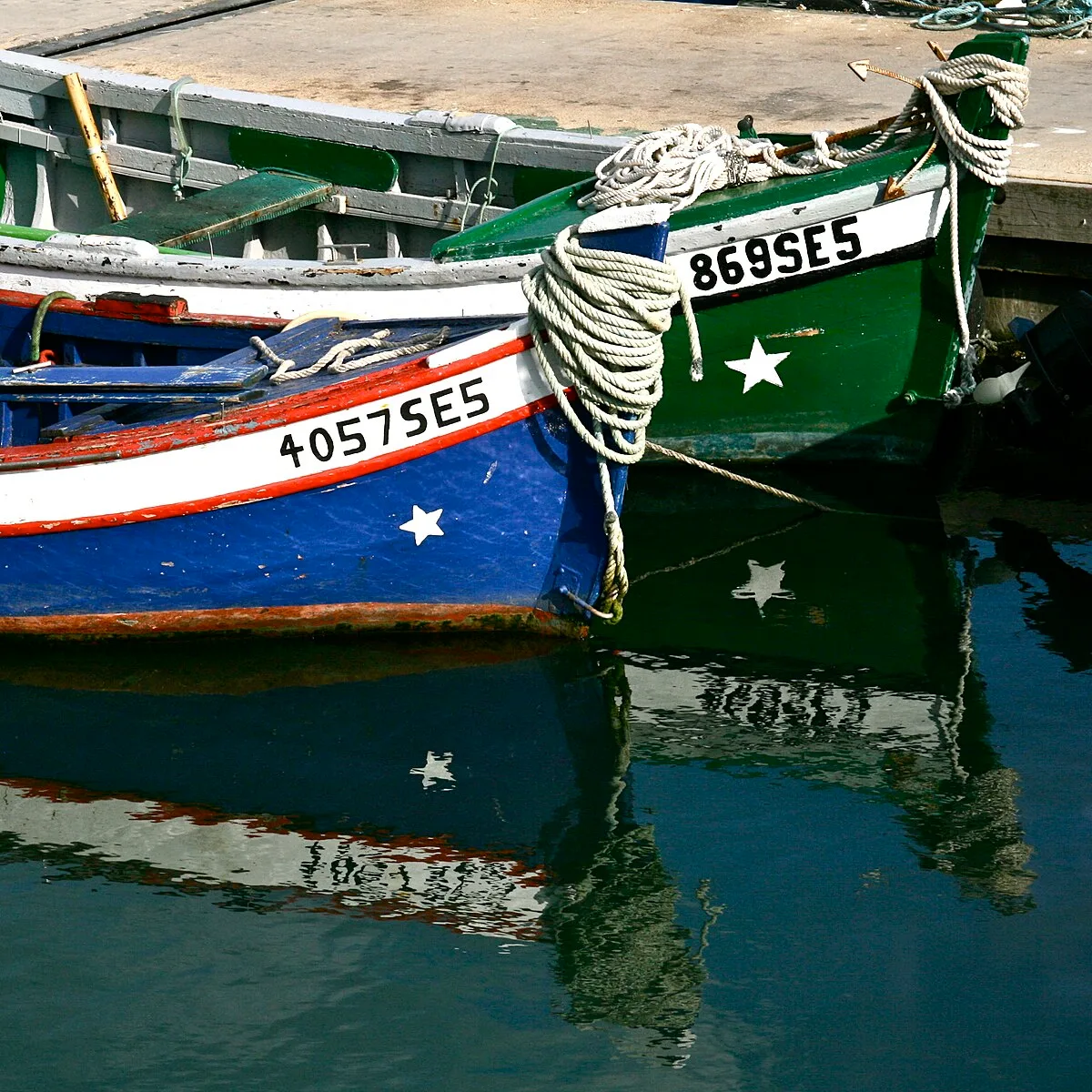
Fishing is the historical foundation of Setubal’s economy and cultural identity. Over the course of more than a century, the city became Portugal’s largest centre for sardine fishing and canning, and its bond with the sea continues to define its character.
Origins
Geographic Preconditions
Setubal lies at the mouth of the River Sado, which empties into the Atlantic Ocean, opening onto the Bay of Setubal. This location created ideal conditions for fishing:
- The Sado Estuary – a rich ecosystem where fresh water mingles with salt water, providing a favourable habitat for a wide variety of fish species
- The Atlantic coast – direct access to the open ocean and migratory fish routes
- A sheltered bay – a convenient anchorage for fishing vessels and a natural site for processing the catch
- Massive shoals of sardines that traditionally passed along the coast of the Setubal Peninsula
Fishing in these waters dates back to Roman times – archaeological finds at Cetobriga, on the opposite bank of the Sado, attest to the production of the fish sauce garum in antiquity. The tradition of salting and processing fish existed here long before the industrial age.
Description
Types of Catch
The principal fish species harvested off the coast of Setubal include:
- Sardine (sardinha) – the main and historically most important commercial species
- Horse mackerel (carapau / chicharro) – a staple species and everyday dietary mainstay
- Mackerel (cavala) – one of the key targets of coastal fishing
- Anchovy (biqueirão) – a small fish used for canning
- Squid (lula) – a commercially fished species
- Cuttlefish (choco) – the signature ingredient of the local cuisine
Alongside industrial fishing, artisanal fishing persists – small boats working the inshore waters with traditional gear.
Fishing Quarters
Setubal’s history produced distinct fishing quarters, whose life was organised entirely around the sea:
- Bairro do Troino – considered the oldest fishing settlement in Setubal
- Bairro dos Pescadores (the Fishermen’s Quarter) – a neighbourhood whose memory is preserved in works of urban art. A mural by the artist Angela Miranda Penedu was recently created on the Caminho dos Pescadores (Fishermen’s Path), dedicated to two departed residents of the quarter
In these neighbourhoods, a distinctive way of life took shape: men went out to sea, women worked in fish processing, and family and social bonds were governed by the rhythm of the ocean.
The Canning Industry
Birth of the Industry
The modern canning industry in Setubal began in 1854, when Manuel Jose Neto and Feliciano Antonio da Rocha founded the first cannery to employ the sterilisation method. The true industrial leap, however, came after 1880 with the arrival of French industrialists who brought steam-powered technology. Their interest in Setubal was driven by a shortage of fish off the coast of Brittany – they were seeking new sources of raw material.
The Boom
Growth was rapid:
| Year | Number of factories in Setubal |
|---|---|
| 1854 | 1 (the first factory) |
| 1897 | 26 |
| 1910s | 85 |
| Peak (mid-20th c.) | Approximately 400 over the entire history |
Setubal became Portugal’s largest canning centre. In 1912, around 10% of the city’s population worked in the canning industry. By the end of the First World War, Portugal had more than 200 canneries, the majority of which were located in Setubal.
In the late nineteenth century, Ramirez – Europe’s oldest continuously operating canning company – opened plants in Setubal and the Algarve for the production of sardines in olive oil.
The Role of Women
The canning industry in Setubal had a pronounced gendered character: 95% of the factory workforce were women (operarias conserveiras). Men handled the fishing and the soldering of tin cans, while virtually all the actual canning work – arranging, gutting, and packing the fish – was done by women.
Working conditions were harsh:
- Workers could be summoned “at any hour of the night, whenever the factory owner saw fit”
- The working day lasted 10 to 11 hours
- Pay amounted to 180 reis for 5 hours of work (extremely low)
- Technology went unmodernised for decades; the industry was built on the mass exploitation of cheap female labour
The Strike of 1911
The years 1910–1911 saw rising social unrest among cannery workers. In March 1911, a strike broke out with demands for higher wages and a shorter working day. During clashes with the Republican Guard, a female worker named Mariana Torres was killed. This episode is considered one of the earliest instances of organised women’s trade union action in Portugal. The memory lives on in the city: the play “Mulheres de Sal” (“Women of Salt”) was staged by the municipal theatre in tribute to the cannery workers.
Decline
From the mid-twentieth century onward, Setubal’s canning industry entered a period of decline:
- Depletion of fish stocks – shrinking sardine shoals
- Relocation of production northward, to the Matosinhos area near Porto
- The 1974 Revolution and the social instability that followed compounded the difficulties
- By the Second World War, the number of factories had already fallen significantly
- By 1983, Portugal had just 152 canneries remaining (nationwide)
Setubal’s factories closed one after another. Today, all that remains of them are the brick chimneys of former canning plants scattered across the cityscape, and buildings repurposed for other uses.
Tangible Heritage
The Museum of Work (Museu do Trabalho Michel Giacometti)
The only cannery to have been preserved and restored is the former Fabrica Perienes, once one of the largest in the country. Its French heirs sold the building to the Setubal municipality, which in 1995 opened the Museu do Trabalho Michel Giacometti (Michel Giacometti Museum of Work) on the site.
- Address: Largo Defensores da Republica
- Permanent exhibition: “A Industria Conserveira (Da lota a lata)” – “The Canning Industry (From fish auction to tin can)”
- The museum holds recorded memories of cannery workers – their accounts of labour, emotions, and personal lives bound up with the industry
- It is part of a former fishing village, preserving the surrounding context
Mercado do Livramento (Livramento Market)
The market first opened its doors on 31 July 1876 at the initiative of the president of the municipal council, Antonio Rodrigues Manito. The current building dates from 1930 and was designed by the architect Marcelino Aleman Mendonca Cisneiros de Faria in the Art Deco style. The original floor area was 4,160 square metres with 44 stalls devoted to fish and vegetables.
Of particular value are the tile panels by Pedro Pinto, depicting the economic activity and history of Setubal. In 2015, the publication USA Today named it one of the world’s most renowned fish markets.
The market remains in operation: every morning, fishermen deliver the fresh catch – sardines, sea bream, octopus, shellfish. For more than 140 years, the undisputed star of the market has been fresh fish.
The Fishing Port
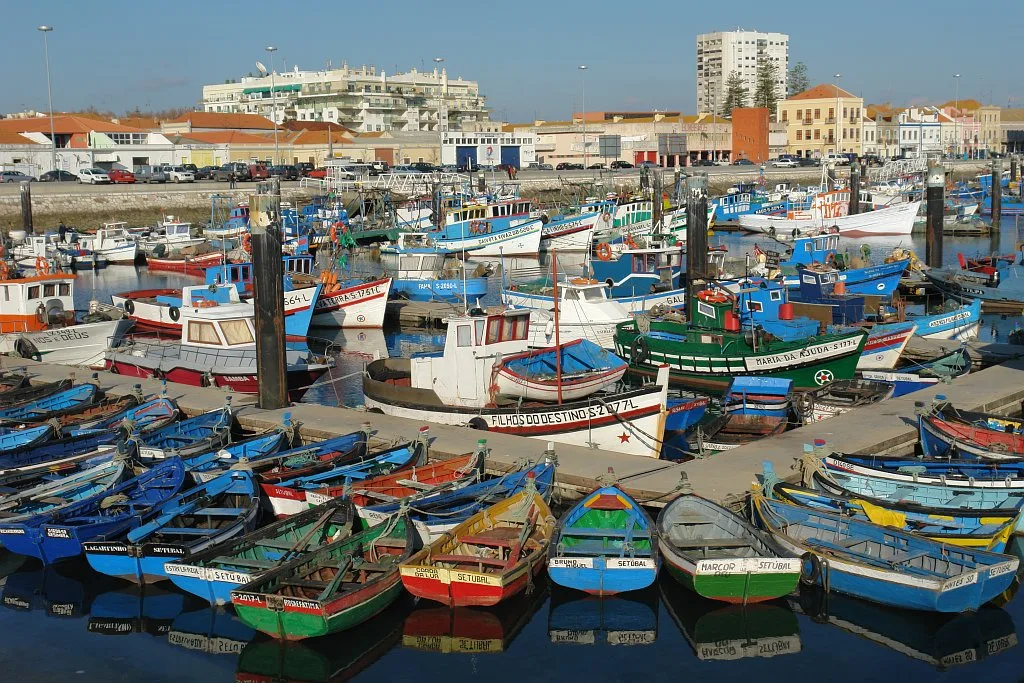
Setubal’s fishing port (Porto de Pesca) is located in the central part of the city waterfront. It is home to a fish auction (lota) operated by the company Docapesca, with a computerised bidding system. Nearby stand the secondary fish market and the Rio Azul market, which is open to the public.
The Arte Xavega Tradition
The Technique
Arte Xavega is a traditional Portuguese fishing technique that has been practised for centuries. It is a unique form of artisanal fishing found only in Portugal. The method involves casting a net from a boat 2 to 4 kilometres offshore, encircling a shoal of fish, and then hauling the net onto the beach with the help of tractors (historically, oxen and human muscle).
The process:
- One end of the net is attached to a tractor on the beach
- The boat heads out to sea, unfurling the net
- Having described an arc around the shoal, the boat returns to shore
- The other end of the net is attached to a second tractor
- Both tractors slowly haul the net and its catch onto the beach
The arte xavega season runs from March to November, with the best time for observation being June to August.
Arte Xavega and the Setubal Peninsula
Arte xavega is traditionally practised along the stretch of coast from Espinho to Sesimbra and in the Algarve. On the Setubal Peninsula, the technique can be observed on the beaches of Sesimbra, Costa da Caparica, and Fonte da Telha. Several municipalities (Almada, Sesimbra) are promoting arte xavega as intangible cultural heritage.
[DISPUTED] Within the city limits of Setubal itself, arte xavega was apparently not practised in its classic form – the technique is suited to open sandy beaches, whereas Setubal is situated on a bay. However, on the nearest beaches of the peninsula (above all Sesimbra), this tradition was part of the broader fishing culture of the region.
Present-Day Status
Arte xavega is in decline owing to financial hardship and a lack of young recruits – fishing is regarded as a dangerous and poorly paid profession. Nevertheless, a number of fishing communities continue to practise the technique, especially on resort beaches where arte xavega attracts tourists as a living cultural spectacle.
Significance for the City
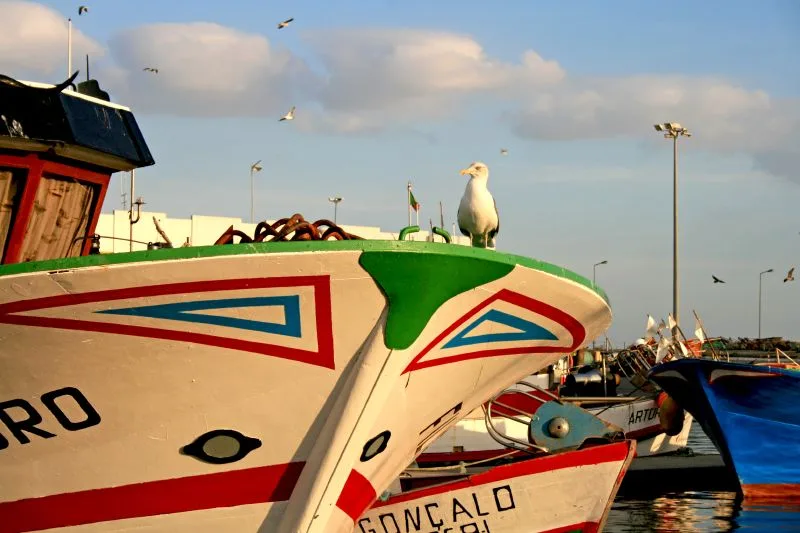
Fishing is not merely an economic sector in Setubal’s history. It is the foundation of the city’s identity, shaping:
- Demographics – fishing quarters defined the city’s social structure
- The economy – the canning industry was the main employer for more than a century
- Gastronomy – Choco Frito (fried cuttlefish), grilled sardines, and other seafood dishes became the city’s culinary calling cards
- The urban landscape – factory chimneys, the fishing port, Livramento Market
- Social history – the women’s labour movement, strikes, and later the connection to the Carnation Revolution
- Cultural heritage – the Museum of Work, mosaic tile panels, urban art
Even after the sharp contraction of the fishing industry, Setubal remains a city defined by the sea. Locals still say the city lives “da lota a lata” – “from the fish auction to the tin can.”
Practical Information
- Mercado do Livramento – every morning, fresh fish straight from the boats; best visited in the early morning
- Museum of Work – permanent exhibition on the canning industry; housed in a former factory
- Fishing port – visitors can watch the unloading of the catch
- Seafood restaurants – along the waterfront (Avenida Luisa Todi) and in the port area
- Arte xavega – the nearest place to observe the technique: beaches of Sesimbra and Costa da Caparica (June–August)
- Caminho dos Pescadores – the “Fishermen’s Path,” featuring murals dedicated to the fishing community
Timeline
| Period | Event |
|---|---|
| Antiquity | Garum production at Cetobriga |
| Middle Ages | Artisanal fishing and salting |
| 1854 | First cannery | | 1880s | Arrival of French industrialists and steam technology | | 1897 | 26 factories | | 1911 | Cannery workers’ strike; death of Mariana Torres | | 1910s | 85 factories – the peak of industrialisation | | Mid-20th c. | Onset of decline; production shifts northward | | 1974 | Carnation Revolution and further upheaval | | 1995 | Museum of Work opens in the former Fabrica Perienes | | 2015 | Livramento Market named one of the world’s finest fish markets |
Image sources
- setubal-fishing-boats.webp — Fishing boats in Setubal harbour. Author: Francois Philipp. License: CC BY 2.0. Source
- fishing-boats-setubal.webp — Fishing boats in port. Author: Francisco Antunes. License: CC BY 2.0. Source
- fishing-harbour-setubal.webp — Fishing harbour of Setubal. Author: Osvaldo Gago. License: CC BY-SA 3.0. Source
See also
- The Carnation Revolution in Setubal
- Feira de Sant’Iago
- The Canning Industry
- Cetobriga – The Roman City
- Mercado do Livramento
- Choco Frito
- The Sado Estuary
The light is on for free. But someone has to clean the lantern.
☕ Support on Ko-fi